A SCOTTISH SOLDIER

“Ye hypocrites! Are these your pranks?
To murder men, and give God thanks?
Desist, for shame! Proceed no further:
God won’t accept your thanks for Murther!”
Robert Burns, 1793, ‘Thanksgiving For A National Victory’.

For many centuries the people who inhabited the Scottish Highlands mainly lived a rural life in a feudal-style system of clans, who sometimes fought with each other in disputes over land and cattle. After the Union of 1707, however, there came a time when the Highland clans were regarded as a threat to the British monarchy and state. In 1745 a new British national anthem, ‘God Save the King’, was adopted – the 5th verse (which is not sung often nowadays) stated:

Lord grant that Marshal Wade
May by thy mighty aid
Victory bring.
May he sedition hush,
And like a torrent rush,
Rebellious Scots to crush.
God save the King!

The next year, in 1746, the wearing of tartan was outlawed, when ‘Highland dress’ was made illegal under the Dress Act. This was implemented after the battle of Culloden, with the Highlanders being depicted as disloyal, as well as wild and formidable – ever ready to resort to violence to settle a quarrel, or stage revolts. A brutal crackdown ensued, with several punitive expeditions by British state soldiers taking place, forcing many Highland people to flee their native land.

While the fighting qualities of the clansmen was feared, those who had defeated them at Culloden sought to harness this for their own use. There was to be an ever-increasing need for ‘cannon-fodder’ as the Empire was forged and policed, so, the British Army often sought to recruit the martial races they had defeated. The Gurkhas are a later example of this process.

In England, before the Civil War and Oliver Cromwell’s New Model Army, there had been no standing army. Previously, the monarchy had raised armies to fight specific wars, after which these forces were disbanded. A permanent standing army, under Parliament control, gradually emerged from the period of the Civil War and the ‘Glorious Revolution,’ when William of Orange’s forces defeated those of James II.

Most of the rank and file soldiers came from the poor and dispossessed in England. Ironically, many who later filled the ranks were former enemies, including Irish and Scottish clansmen. During both the Highland clearances in Scotland and the famine in Ireland recruitment drives were undertaken.

Most clan chiefs were already incorporated into the establishment, with their sons being educated at English public schools. Dr Johnson noted that these chiefs then: ‘Degenerated from patriarchal rulers to rapacious landlords’. With the Highlands ‘pacified’ and the clan system repressed – then changed to suit the new masters – the enlistment could begin and the Scottish writer, John Prebble, outlined the background to the recruitment and what happened next:
“Highland soldiers were Britain’s earliest colonial levies, first raised to police their own hills, then expended in imperial wars. The Gaelic people of the 18th century, three per cent only of the population, nonetheless supplied the Crown with sixty-five regiments, as well as independent companies, militia and volunteers. … He was often recruited by threat, or sold by the chief he trusted. Promises made to him were cynically broken, his pride was outraged by the lash, by contempt for his fierce attachment to his language and dress. The family he hoped to protect by enlistment was frequently evicted in his absence and replaced by sheep.”
[Mutiny, by John Prebble, Secker and Warburg London, 1975].

Scottish Highland soldiers, whose forbears had been hunted down for wearing their native garb, now wore a shiny new British military tartan to serve the Empire. ‘Ye Heilan Cheils’ is a song about the use of Highland lads in Britain’s wars:

As Prebble wrote: ‘Contrary to romantic belief, the Highlander was rarely a willing soldier, his songs lament the day he put on a red coat’:
If I were as I used to be,
amongst the hills,
I would not mount guard
as long as I lived,
nor would I stand on parade,
nor for the rest of my life
would I ever put on a red coat.

While the navy protected the Empire and its trading routes at sea, it was the army that forced its extension on the ground. During Queen Victoria’s reign, from 1837 to 1901, British soldiers, fighting under the Union Jack, carried out the following colonial campaigns:
Anti-colonial revolt in Canada, 1837; Capture of Aden, 1838; First Afghan War, 1838-42; Against Boers, South Africa, 1838-48; Opium Wars in China, 1839-42; War in the Levant, 1840; War in Afghanistan, 1842; Conquest of Sind, India, 1843; Gwalior War, India, 1843; First Sikh War, India, 1845-6; Against Native Africans, South Africa, 1846-52; North-West Frontier of India, 1847-54; Second Sikh War, India, 1848-9; Second Burmese War, 1852; Eureka Stockade, Australia, 1854; War with Persia, 1856-7; North-West, Frontier of India, 1858-67; Storming of the Taku Forts, China, 1859-60; Maori Wars, New Zealand, 1861-4; Operations in Sikkim, India, 1861; Ambela Expedition, 1863; Yokohama, Japan, 1864-5; Bhutan Expedition, 1865; Expedition to Abyssinia, 1868; Red River Expedition, Canada, 1870; Ashanti War, West Africa, 1874; Expedition to Perak, Malaya, 1875-6; Galekas & Gaikas war, Cape Colony, 1877; North-West Frontier, India, 1878-9; Second Afghan War, 1878; Third Afghan War, 1879; Zulu War, 1879; North-West Frontier of India, 1880-4; Transvaal Revolt or First Boer War, 1880-1; Bombardment of Alexandria, 1882; Expedition to the Sudan, 1884-5; Third Burmese War, 1885; Suakin Expedition, Sudan, 1885; End of the Nile Campaign, 1885; North-West Frontier of India, 1888-92; Minor Operations in India, 1888-94; Siege & Relief of Chitral, India, 1895; Mashonaland Rising, East Africa, 1896; Re-Conquest of Egypt, 1896-8; Tirah Expeditionary Force, India, 1897-8; North-West Frontier of India, 1897-8; Boxer Rising, China, 1900-1.

Besides these conflicts, the Crimean War, 1853-6; the Indian Mutiny, 1857-8; and the Boer War, 1899-1902, involved the British Army in major warfare during this period. William Ernest Henley was an influential English poet, critic and editor of the late Victorian era, who wrote verse that exalted the Empire. In ‘A New Song to an Old Tune’ the suffering of British soldiers was portrayed as a glorious sacrifice:
What if the best of our wages be
An empty sleeve, a stiff-set knee,
A crutch for the rest of life – who cares,
So long as the One Flag floats and dares?
So long as the One Race dares and grows?
Death – what is death but God’s own rose?
Let but the bugles of England play
Over the hills and far away!

Henley did not mention the casualties suffered by the conquered, perhaps, like many others, he did not consider this worthy of contemplation? In contrast, the then dean of St. Patrick’s Cathedral in Dublin, Jonathan Swift, in his poem ‘On Dreams’ commented on ‘the Redcoats’ in Ireland, who were ruthlessly enforcing the Penal Laws and putting down dissent:
The Soldier smiling hears the Widow’s Cries,
And stabs the son before the Mother’s eyes,
With like Remorse his Brother of the Trade,
The Butcher, feels the lamb beneath his blade.

Swift, who was also an Irish author and satirist, became best known for his book ‘Gulliver’s Travels’. Like Swift, many of the subject peoples, over whose countries the Union Jack flew, had their own view of British rule. They called Britain’s flag the ‘butcher’s apron’ and when British politicians boasted that the Empire ‘was the place where the sun never sets’ they added ‘and the blood never dries’.

‘Civilisation’ and ‘Christianity’ were the oft-declared motives for empire, but, for the rich, the Empire was a cash-cow, which was ruthlessly milked for economic exploitation and maximum profit. Great fortunes were made, for instance, from the use and trafficking of slaves and forcing opium on the Chinese people.

In the popular Music Halls, some performers were ardent supporters of Britain’s expansionist wars, including Sir Harry Lauder, a Scottish singer and comedian. While some Scots regarded Lauder as a ‘tartan fool’, Sir Winston Churchill claimed he was: ‘Scotland’s greatest ever ambassador … rendering measureless service to the Scottish race and to the British Empire’. During WW1 Lauder promoted recruitment and campaigned for the war effort, writing:
“I know that I am voicing the sentiment of thousands and thousands of people when I say that we must retaliate in every possible way regardless of cost. If these Germans savages want savagery, let them have it.”

The Run-Down of Empire
While Scotland had existed as an independent country up to the Acts of Union in 1707, there had been internal divisions due to the different systems of life and control in the Highlands and Lowlands. The British state victory at Culloden facilitated the suppression of the feudal clan system in the Highlands, which suited the lowland bourgeoisie as much as Westminster. Under the ‘Union’, the Scots then gradually developed a separate national consciousness, but one that was subservient to, and dominated by, a partisan British nationalism – and the money-making Empire.

Up to the present day, there is still a romanticised view of Scotland that can be glimpsed on some shortbread tins; a world of noble stags, on brooding heather covered hills, amid swathes of tartan and claymore wielding kilted clansmen. Ironically, some of this idealised vision was incorporated by the Crown, with the Scottish highland regiments being rigged out with their own distinctive, but made-up, tartan attire. The core loyalty was now with the Union Jack, however, and in the 1960s the military side of this Westminster-loyal tartan kitsch often featured in the ballads of the popular entertainer Andy Stewart.

The Second World War had left the UK almost bankrupt, so, as well as a patriotic ‘we won the war’ feeling, this was a time of the loss of overseas territory that mingled with the austerity brought on by the need for fiscal restraint. In turn, this created the circumstances of economic conscription that saw many youngsters, including myself, join the armed forces. In 1960 Andy Stewart, who was a big fan of Sir Harry Lauder, produced a patriotic hit single called: ‘A Scottish Soldier’:

In the song the soldier’s service ‘far away from his hills of home’ is depicted as ‘battles glorious’ and ‘deeds victorious’. The soldier’s death followed, but there were no explanations, or any questions asked. It was true, of course, that a lot of soldiers were dying then, because from the end of WW2, up to1968, ironically called the year of revolution, the British military had been continually involved in many campaigns of varying intensity, which included:
Greece, 1944-47; Palestine, 1945-48; Vietnam, 1945; Indonesia (Java), 1945-46; India/Pakistan, 1945-47; Aden, 1947; Ethiopia (Eritrea), 1948-51; British Honduras, 1948; Malaya, 1948-60; Korea, 1950-53; Kenya, 1952-56; Cyprus, 1954-59; Aden (border), 1955-60; Hong Kong, 1956, 1962, 1966 and 1967; Suez, 1956; Oman, 1957-59 and 1965-present day (Advisers, secondment of troops and mercenaries); Jamaica, 1960; Cameroons, 1960-61; Kuwait, 1961; Brunei, 1962; Malaysia (North Borneo and Sarawak) 1962-66; British Guiana (Guyana), 1962-66; Aden, 1963-67; Operation Crown, Thailand, 1963-68; Swaziland, 1963; Uganda, 1964; Tanganyika, 1964; Mauritius, 1965-68; Bermuda, 1968.

Most of these were colonial conflicts, because, from 1945, British governments, confronted with freedom demands from national movements in British colonies, used armed force in attempts to crush them. As the red of Empire gradually shrank in our school atlases, most people in Britain took little notice – except when new ‘trouble spots’ sprang to their attention. These engagements were often hidden from view and/or had their events distorted by biased reporting and therefore constitute a hidden history for most of the home population, like this footage from Aden:

Hardly ‘battles glorious’ or ‘deeds victorious’, but this is what happens when you brainwash soldiers into a racist frame of mind – then send them into other people’s countries and order them to assert their authority and take control.

Just as the Victorian wars to build the Empire had been accompanied with waves of jingoism and propaganda, so the run-down followed a similar pattern. The late James Cameron was a journalist who covered many of these colonial conflicts, but his reporting was an honourable exception to the usual jingoistic type of coverage. In an article in ‘The Guardian’, he made these comments about Britain’s small wars, during the rundown of Empire:
“I have spent the greater part of my working life watching British troops being pulled out of places they were never going to leave. The process started in the 1940s, when Mr. Churchill insisted that the British could never leave India, and of course they did. A wide variety of Colonial Secretaries in the years to come made it abundantly clear that their forces would never leave Malaya, or Kenya, or Cyprus, or Aden. All these places were integrally part of an imperial system that could not be undermined and must be protected, and one by one all these places were abandoned, generally with the blessing of some minor royalty and much champagne.
In most cases some rebellious nationalist was released from gaol, or its equivalent – Nehru, Nkrumah, Kenyatta, Makarios – given the ritual cup of tea at Windsor and turned into a President. The thing in the end became a formula, though the process wasted a great many lives and much time and money, and as far as I know on every occasion the formula followed the one before it: We shall not leave; we have to leave; we have left. At no time in our colonial history did one occasion leave any precedent for the next one, except for the statement that we would never pull out, which was always one thing before the last.”
[Guardian, 2nd June 1975].

During these conflicts, cinema news (later TV) took over from the music-halls, and with the press took up the task of imperial cheer leaders with a relish. Cocooned in a media web of ‘Our boys doing a jolly good job in trying circumstances’, ‘peace keepers’ amid ‘bandits’, ‘extremists’ and ‘terrorists’ – the folks back home rarely asked any questions. The truth was usually very different, as these ‘small wars’ were about power, hegemony, natural resources, cheap labour and profits – where intimidation, internment, torture and killings were systematically used by our Armed Forces to protect ‘British interests’.

Ordinary soldiers were not responsible for these colonial conflicts, but did have to serve in them. The military was then made up of regulars and others on National Service (which ended in the early 1960s) and most obeyed their orders and carried out what they saw as their duty. Some, carried away on a tide of indoctrination and jingoism, believed passionately in what they were doing.

In 1977, a disabled Scottish ex-soldier, who signed on as regular soldier just after the end of WW2, wrote about his experiences in some of these small wars. While Andy Stewart had given us a sanitised patriotic version of the ‘Scottish soldier’, this veteran gave us a realistic vision of what service life was really like in the British Army:
“It is getting along to 30 years since I first signed on as a regular. I was out of work, and in trouble with the police. The army was much bigger in those days. Once in it I was convinced there was no way they would get me back to the slums of Glasgow. My own bed and locker. Good clean clothes. Plenty of good grub. Great comradeship from the men in my billet. What more could a young man ask? I had known poverty and hunger all my boyhood days. The army was a great life for me. It is hard for young working-class men to realise the attractions of such a life, unless they have known similar poverty and hunger.
In those days the army fought ‘the dirty commies’. We shot ‘the yellow slant-eyed bastards’ in the hills of Korea, chasing him back to the Yalu River, where ‘some bastard politician’ stopped us from going over and finishing them off for good. We went into the jungles of Malaya, and ‘routed them out’. It cut us to the quick to see ‘that evil bastard’ Chin Peng get all that cash for surrendering. He and his will-o’-the-wisps had given us a lot of trouble and sweat. Now the government was giving him a load of cash. It was crazy. If they’d turned him over to us we would have chopped him up into little cubes and fed him to the dogs that ran around in packs in Kuala Lumpur.
Out in Kenya we hated that ‘black cannibal’ Jomo Kenyatta. The officer from Intelligence who gave us our political lectures (did you know they gave such things in the British army?) told us Jomo wrote for the Commie paper, the ‘Daily Worker’. If we’d caught him in the forests of the Aberdares we would have chopped him up with blunt pangas.
In Cyprus we fought that ‘little murdering bastard’ Grivas. It was strange how nobody would turn the ‘little wall-eyed bastard’ in. It did not matter how much we kicked and beat them. The Greek Cypriots would never divulge his hiding place. Came the day when I copped a packet. It was not pleasant. They took me on a stretcher, all strapped down, and flew me back for medical attention. I was paralysed from the waist down. Every jolt I got caused racking pains to tear through my body. Lying beside me on the plane was a young Scottish lad. He came from my native city of Glasgow. I guess they put him beside me because I spoke ‘Glasca’ like him. Maybe they thought the sound of his native accent would quieten him down. He was as mad as the proverbial mad hatter. When he looked at me out of his mad eyes, I felt myself shrink back in fear. After all, I was only an arm’s length away from him, and partially paralysed.
In different hospitals in various countries, experts prodded and poked me. They caused me a lot of pain. But months later I was still affected with terrific pain if I got any sudden movements. I went back to civvy street like an old man – shuffle-shuffle. It was in the Union Jack Club opposite Waterloo Station that my position was brought home to me. A young soldier like myself was lying dead drunk. His documents had fallen out of his jacket. I saw he had been in places out East that I had just been in. He was discharged just like me. But he could get no work. I felt a wave of despair wash over me. How could I survive? Back in Glasgow I went to sign on at the Labour Exchange. They had no work for ex-killers. ‘So what if you do have ribbons from half a dozen campaigns? We need men who can work all day and every day. You can hardly walk!’ These clerks were all throw-backs to the means test days. They could not even manage a look of pity for a young man with a pale face, all complete with dark rings under the eyes for added effect.
How I hated mankind. Here I was, reduced from being a hard soldier, six feet tall, twelve and a half stone in weight, down to nine stone something. Yet nobody gave a dam about it. Even the ex-Regulars Association would not attempt to find me a job. The fat bastard ex-sergeant major had just the job I could have done. Nobody would help me. I would have to look out for myself. I made it. No thanks to the bastards who run the country. They took my youth and young manhood. Today I still suffer pain. But my muscles have toughened a lot. As of now, they are able to bear me up. But what will happen when I get old and they become less strong? I just don’t fancy the idea of sitting out the remainder of my days in some establishment for infirm soldiers, raving about the days when we were young.
Oh! I forgot to tell you. I could not find a wife. You see, I am rendered impotent. Yip Ming was my last bed-mate. She was a Chinese prostitute I lived with, out in the Far East. She bore me two sons. But I could not marry her. The army would not permit it. She went back to China and I have lost touch with her. My sons will be in their twenties now. Probably they read the thoughts of Chairman Mao and curse their white-skinned father.”
[British Soldiers Speak Out on Ireland, IOI, 1978]. 

The Lament of Widows
In 1881, under the Childers Reforms, a new Highland regiment was created by amalgamating the 91st (Argyllshire Highlanders) Regiment of foot and the 93rd (Sutherland Highlanders) Regiment of foot. The men of the 93rd had been acclaimed as ‘the thin red line’ in the Crimean War. The new amalgamated regiment, called the (Princess Louise’s) Argyll and Sutherland Highlanders, was to forge a reputation as ‘glorious’ and ‘honourable’ as any in the British Army.

The Regiment served with the Highland Brigade in the Boer War, won six Victoria Crosses in the First World War and fought with distinction in the Second World War and Korea. Most regiments in the British Army, however, have an unspoken ethos of: ‘What happens up the sharp-end – stays up the sharp-end’. This creates a ‘hidden history’ of conflicts that is rarely exposed to outsiders, which only emerges in some veteran’s nightmares long after they have ceased serving.

Often, the bad dreams occurred after the soldiers’ involvement in colonial style conflicts. In Northern Ireland in 1972, for instance, two Catholic men, 31-year-old Michael Naan and 23-year-old Andrew Murray, had been found murdered at isolated farm buildings in County Fermanagh. Murray had been stabbed 13 times and Naan 19 times through the heart and chest.

Michael Naan had been a prominent member of the Civil Rights Association and had taken part in a number of protest marches and the pathologist said his wounds were ‘consistent with an attack by someone who had gone berserk’. The murders had taken place in a mixed border area where tit-for-tat killings occurred and a sectarian motive was attributed to the slayings. Loyalists were suspected of carrying out a crime, which became known as the ‘pitchfork murders’, after the alleged murder weapon.

Back in Britain, later in the 1970s, people were horrified by a series of brutal murders of young women, many picked up from ‘red light’ areas in northern English cities. Reading about the latest ‘Yorkshire Ripper’ murder in 1978 had a profound effect on a Scottish ex-soldier. The lurid accounts of the multiple stabbings of the latest victim had evoked memories of a night, six years before, when he had been on a tour-of-duty in Northern Ireland.

The veteran knew who had really carried out those killings of Naan and Murray in 1972 and the similarity between those and the Yorkshire Ripper murders began to prey on his mind. Convinced that the same people must have carried out both the ‘Ripper’ and the Northern Ireland slayings, he contacted the police and gave them full details of those killings in County Fermanagh.

In reality there was no link between the two crimes, but the police were under intense public pressure to catch the ‘Ripper’, so, they began to investigate the ex-soldier’s allegations. Subsequently, in 1980, two former compatriots of the ex-soldier, a staff-sergeant and a sergeant, were tried and jailed for life for the murders of Naan and Murray. When the staff-sergeant confessed to the police he broke down in tears and said:

“I did it. I did the killings. Oh my god. Yes, I did it. I killed them. They would not stop screaming – I have been having bloody nightmares about it …”

A one-year suspended sentence was given to the officer-in-charge, who was described as an ‘exemplary officer’. He had attended Harrow and Sandhurst and came from ‘a distinguished military background’. The officer told the court he’d been in charge, and, although he was not on the patrol himself, he had found out about the killings later. He then admitted why he’d kept quiet:

“I mulled the whole thing over in my mind and decided that for the good of the army and the regiment it must never go any further.”

A rank-and-file member of the patrol, who was a private at the time of the killings, received a four-year sentence for manslaughter. In 1970 he’d been pictured in some papers being inspected by the Queen, while on Royal Guard duties at Balmoral. It also came out during the trial that the murder weapon was not a pitchfork as first thought, but the stabbings were in fact carried out with a bowie knife that one of the soldiers possessed; it subsequently emerged that many of the troops in Ireland carried ‘personal weapons,’ to which those in authority were turning a blind eye.

This information only saw the light-of-day, because a veteran had the events on his conscience and he’d made the wrong connection to the ‘Ripper’ killings. The story did not end there, however, because the veteran who had revealed the information then received several death threats during the trial, which he believed had come from members of his former unit. So, upset and angry, he handed over to the Scottish Sunday Mail paper a dossier containing information on up to forty killings carried out by fellow soldiers in Aden fourteen years previously.

The paper printed many of these in early 1981 and a controversy ensued, with the Sunday Mail being inundated with letters. Serving soldiers complained bitterly about ‘former mates telling tales out of school’ and attacked the paper for printing material detrimental to ‘the honour of the regiment’.

Others, mainly ex-soldiers, wrote in telling how the terrible events in Aden had been on their minds. Unable to forget, they welcomed the opportunity to unburden themselves and some wrote of their own experiences, telling how:

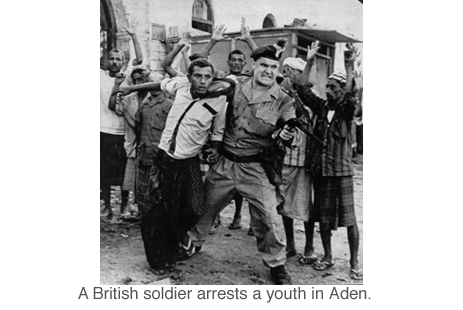
The Yellow Card instructions – which laid out the circumstances in which soldiers could open fire – were abused. To detain an Arab, soldiers were taught to shout ‘waqf’ – pronounced as ‘wakeef’ – meaning halt. If three warnings were ignored troops were then entitled to shoot, but some soldiers treated this as a joke and shouted ‘fuck off’ or ‘corned beef’ instead. Not surprisingly, most Arabs did not understand this and several were just gunned down.
The bodies of Arabs killed by soldiers were taken in a three-ton truck and dumped off a bridge into the bay, some of the dead were suspects who had been arrested, or wounded Arabs who had been taken to the army medical centre. A soldier who had carried out the ‘dumping’ of the bodies stated: ‘Some of the prisoners’ bodies had gunshot wounds, but some had been given injections’.
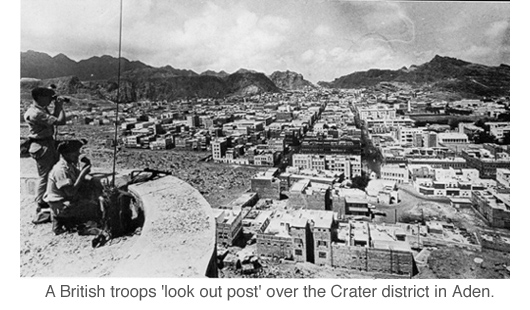
The army had set up machine-gun emplacements on high ground overlooking the Crater district and some nights – especially if there had been attacks on soldiers – those heavy guns were fired into this deprived area as a punishment. Ripping through the neighbourhood, the heavy velocity bullets must have caused untold deaths and destruction.
Clearly showing the racist way Arabs were viewed by the military, officers had initiated inter-platoon rivalry by awarding Robertson’s Jam ‘golliwog labels’ to each platoon for the killing of an Arab. The labels were pinned to the unit notice board and a veteran recollected:  “At one stage my platoon had notched up 13 kills and another platoon were one kill behind. Their corporal even told the privates to use their bayonets, for it was to be that sort of killing. They went into an alley and killed a young Arab who was out after curfew.”

The Sunday Mail passed the dossier to the Scottish Lord Advocate who promised an investigation. But this time there was no pressing reason to examine these events. Two years later the Sunday Mail printed a tiny article saying that the Lord Advocate had decided that ‘no proceedings should be instituted in this case’.
[Sunday Mail (Scotland) 17th Dec. 1978; & the editions of 26th April, 3rd May, 10th May and 17th May 1981. Also see ‘LOST LIVES’ (656 & 657), Mainstream Publishing, 1999].

The military unit involved in those incidents in County Fermanagh and Aden was the Argyll and Sutherland Highlanders. In Aden the 1st Battalion of the regiment had been led by Lt-Colonel Colin ‘Mad Mitch’ Mitchell, a British ‘war hero’, who ‘pacified’ the Crater district and whose ‘strong-arm methods’ were acclaimed by much of the British media.

As the fighting against the rebels in Aden had intensified Andy Stewart was on hand to lend patriotic backing with another hit song, ‘The Barron Rocks of Aden’, set to the military pipe tune of that name. Another song in the same partisan tradition, ‘700 Glengarried Men’, was written by an officer of the Argyll and Sutherland Highlanders about their operations in Aden:

After Aden, the song was used in attempts to stop the regiment being disbanded. The Argyll and Sutherland Highlanders had loyally carried out the dirty work for Westminster and the MoD in various colonial conflicts, but in spite of this, in 2006 – 39 years after the ‘Emergency’ in Aden had ended – the unit was disbanded and amalgamated into the Royal Regiment of Scotland. After leaving the army, Lt-Colonel ‘Mad Mitch’ Mitchell became a right-wing Tory MP.

However, two-hundred-and-twenty years before the Argyll and Sutherland Highlanders were running their operations in Aden, other British state forces were carrying out similar actions in the Scottish Highlands. The ‘Highland Widow’s Lament’ is a song about the repression suffered after the Government’s victory at Culloden in 1746 – and ‘the pacification’ of the Highlands that followed:

Then, it was the Scottish Highlanders who were being stereotyped as a lessor people, denigrated as ‘bloodthirsty vermin’, and forced to migrate from their native homes by the forces-of-the-Crown. But today, how many widows and mothers are there, across the world in many places, including Aden, who are lamenting the loss of their husbands and sons at the hands of more recent soldiers-of-the-Crown, including those in Highland regiments?

The Amnesty Report & the Honest Soldier
Aden had been taken over by the British East India Company in 1838/9, after Royal Marines had landed and secured the territory. Regarded as a vital part of the fabric of British world control, it was used mainly to protect the Empire shipping-trade using the Suez Canal. In the 1960s, like in many conflicts of this type, the British administration, using ‘emergency’ legislation, brought in a system of detaining suspects without trial.

In 1966 Amnesty International produced a report chronicling the torture of the detainees in Aden, which included:

  • Stripping prisoners and forcing them to stand naked during interrogations.
  • Hitting and twisting genitals and pushing lighted cigarettes against prisoners’ skin.
  • Keeping prisoners awake in cells by detaining them naked in supercooled cells.
  • Forcing naked prisoners to sit on poles directed towards their anus.

The British authorities refused any cooperation to the Amnesty representative, Dr S Rastgeldi, as he compiled his report. After it was published it was subject to attacks by the authorities and in the British media. The Sunday Times, for instance printed an article, which suggested that: ‘the Amnesty reputation for “accurate and fair-minded investigation” should be temporarily eclipsed’.

A Scottish soldier, George Lennox, who was a corporal in the Royal Army Ordnance Corps, had been stationed in Aden toward its last years under the Union Jack. He’d witnessed some of the ill-treatment dished out to the detainees and he took exception to the Sunday Times article, because, based on what he had witnessed, he believed the Amnesty Report was accurate.

Lennox was then serving in the BAOR, in West Germany, and he wrote a letter to the ‘Sunday Times’ to criticise their article for attacking the Amnesty Report:
“In the interests of helping to restore Amnesty International’s reputation as an organisation of the utmost impartiality and honesty I should like, as a serving member of the British Forces in Aden at the time of question, to bring to light a few facts which should prove that the allegations of maltreatment of Adeni detainees by British Servicemen and reported by Amnesty, are not without foundation.        … It should be made clear at the outset, however, for while I was serving in Aden I was not prepared to make any protest, although fully aware of the methods employed in detaining Adeni suspects at the Ras Morbut interrogation centre which have subsequently been brought into the open by the Amnesty report. If it were not for a deep feeling of moral obligation to come to the aid of Amnesty, in view of the constant inaccurate and unjust reporting by the press since their charges were made known, I doubt if I would have been prepared to do so even now.
On several occasions, whilst on unit guard duty at Fort Morbut (the Ras Morbut interrogation centre was situated in close vicinity to our Guard room — in fact one of our main responsibilities was the patrolling of the perimeter fence), I was witness to the pathetic screaming and howling, sometimes lasting well into the night, of detainees of the interrogation centre. On enquiring in the morning from the guards of the centre I was invariably told, in boastful fashion, of the beatings and tortures which they had had a hand in. The versions told by the guards differ very slightly, if at all, from the charges reported by Amnesty. I have also no doubt in my mind that they were under the instructions of the interrogation officers. I can recall a telephone conversation between one such officer to the guard commander of the centre who instructed to give ‘cell six a rest as he was sure he was about to talk’ but to keep ‘cell three awake’.              On one instance however, I personally was witness to a heinous act of brutality equal to the worst reported by the Amnesty representative. It took place at Ras Morbut the day after four suspects were brought in by the Aden Special Branch who had arrested them in connection to the killing and wounding of two RAF servicemen behind the Ma’alla Straight. I was in Fort Morbut on guard duty. At about mid-afternoon I heard screaming coming from the direction of the interrogation centre. Through our Guard Room window, I watched three soldier from a famous infantry regiment in Yorkshire, drag out an Adeni detainee into the exercise yard. There was blood coming from the man’s mouth and he was dressed only in a loin cloth round his waist. The three soldiers, standing about five yards apart, began, in turn, to hit the Adeni. The first soldier was using a five-foot-long broom handle and beating the man about the head and prodding him in his midriff and genitals. He was then passed to the second soldier who hit him with a tin mug commonly used by the Infantry. The third used his fists. The unfortunate wretch fell unconscious twice. He was revived with a fire hose only to be beaten again. This was the only act of brutality I witnessed but you can be assured many more took place. The fact that the sickening screaming occurred usually prior/or immediately after the arrival and departure of the intelligence and interrogation officers makes me convinced of the validity of the reports made by the soldiers themselves and Amnesty International. Furthermore, it was common knowledge, and if I remember rightly the joke of the troops, in reference to the charge of a man having a stick put up his anus as alleged to have happened by Amnesty.
I fully realize the feeling of everyone concerned who have had dealings with Adeni terrorism and that the British administration there will do everything in their power to protect their affairs, but at the same time, why should an organization such as Amnesty International be ridiculed because the truth has been hidden by the same administration …
Yours faithfully
(CPL G.S. LENNOX, RAOC)
Because I am still a serving member of the services and liable to service prosecution I should desire to remain anonymous …”

The Sunday Times did not print Lennox’s letter, but a copy was known to be in circulation soon after at the MoD. A little bit later Lennox was playing rugby at his base in West Germany, when he was arrested and flown in a light plane back to Blighty to end up in a Security Services safe house. Here he was held and interrogated over a few weeks and repeatedly told that that he should not tell any more about what he had witnessed in Aden.

I met up with George Lennox about a decade later at a meeting I’d helped to organise in west London. He, like me, was now in Civvy Street and at the meeting he explained how the troops had operated in Aden in attempts to dominate and control the people there:
“Most of the soldiers who went into the houses of the Adenese, who arrested them, shot them, who even tortured them, never asked the question, ‘Why am I doing it?’ This is not part of your thinking while you’re in the Army. You haven’t got the experience to think for yourself which is one of the reasons why you join the Army, and if you did you’d probably come up with a lot of unsatisfactory answers and I think you would question your role.
So it’s very easy for the politicians to use a military force, those in uniform, to perform tasks such as the Army was doing inside Aden and that was to crush any political opposition. Because the people who are performing that task, who themselves are the people who are being killed and injured, don’t ever question why they’re doing it. That’s always been a fact.

I know that when I was in Aden we never talked about the political situation there. Our level of consciousness, or our level of conversation of talking about the people there was, ‘Oh these fucking wogs’, etc. which was essentially I think to be expected of any army or military personnel under active service. We were conditioned to think in terms of, ‘That is the enemy, this is who we’re fighting’, and never question it.”
[British Soldiers Speak Out on Ireland, edited by Aly Renwick, Information on Ireland, 1978].

The same claims of the abuse and cruelty towards detainees that occurred in Aden, had also been raised before in Malaya, Kenya and Cyprus – later, they surfaced again in Northern Ireland, Iraq and then Afghanistan. While there were differences in the locations and circumstances, the details of the allegations of brutality and torture are remarkably similar. It is clear there is a chasm between the official versions of what happens in these kind of conflicts and what actually occurs.

All this points to the fact that this type of oppression is systematic and is covertly instigated and sanctioned by those in authority – by both Westminster Governments and the MoD. Extreme violence is used to get the desired results, with a blind eye being turned towards it by the higher-ups – with denials issued and cover-ups attempted, if any ill-treatment is exposed. Therefore, if we want to stop torture happening again, the most important link to expose is how the orders and sanctions come down the chain-of-command.

If the exposure of brutal treatment becomes difficult to refute, it is apparent that those at the top do not really care if a few rank-and-file troopers end up in the dock for ‘getting carried away’ and using ‘excessive force’. This will be used, however, only as long as the role of the top brass in the process remains hidden. For an example of this see the film ‘Breaker Morant’ about events during the Boer War, when Australian mounted troops were ordered ‘to take no prisoners’ by the British high command, but subsequently, to facilitate peace talks starting, some were charged with ‘war crimes’ and 2 were shot by a military firing-squad:

Despite the level of repression in Aden it proved to be a failure for the Army’s counter-insurgency methods, and Britain was finally forced to withdraw in 1967. By then, however, Britain was already strongly entrenched in neighbouring Oman, which was under the rule of a despotic Sultan. In 1970, Britain’s grip on the Omani state machine enabled them to mastermind the overthrow of the old Sultan in favour of his son, Qaboos, a Sandhurst graduate. Supposedly more ‘liberal’, he was not any more democratic – and even today Britain continue to ensure the rule of autocratic Sultans.

The casualties suffered by Britain’s forces in Aden amounted to around 120 killed (including over 90 servicemen) and 550 wounded; while the rebels had about 400 dead and 1,750 wounded. The non-combatant civilian casualties are unknown, but are likely to be considerable. Tragically, people in this area are still being attacked today by British made aircraft and missiles, which have been sold to Saudi Arabia by UK armament companies, for huge sums of money.

Reclaiming Our History & the Need for Change
Like Aden, Cyprus was another territory taken over by Britain in the late Victorian period, this time to protect the Empire trade-shipping on the Mediterranean side of the Suez Canal. In February 1955 an ‘Emergency’ was declared in Cyprus and the following year British troops opened fire on a demonstration of students and school children in Famagusta. During which 18-year-old Petrakis Yiallouris was killed by a bullet from a soldier’s Sten-gun.

When the British media tried to justify the soldiers’ actions, the Scottish poet, Helen Fullerton, gave an alternative view in her poem ‘Cypriot Question’. In it a Cypriot mother has an imaginary conversation with the mother of a British conscript soldier:

In Famagusta, one February morning
The market place and the streets were full
When crowds of children marched protesting
That General Harding had closed their school:
Then the British Army went into action
With baton charges and tear gas drill
And the children’s stones were met with bullets
For the troops had orders to ‘shoot to kill’.

Ah, British Mother, had you a boy there?
No blame to him for the evil done
Or that a sorrowing Cypriot couple
Lost that day a beloved son
When at eighteen years, in the cause of freedom
Petrakis Yiallouris met his eclipse
Shot through the heart, by a conscript soldier,
‘Cyprus, Cyprus!’ upon his lips.

When the dockers heard it, they struck in anger
And our shops were closed and our streets were still
And we drew around us our little children
Your troops had orders to ‘shoot to kill’;
But they feared Petrakis more dead than living
And they made us bury him out of sight
Fifty miles from the scene of the murder
In lashing rain and by lantern light.

Scotland’s hero, brave William Wallace
They slew for the love he bore his land
And they shot James Connolly as he was dying
And made a mighty crown of the felon’s brand;
They make the widow, they make the orphan,
They shoot the children – it’s come to this:
But ah, British Mother, had they a quarrel
Your conscript laddie and our Petrakis?

Fullerton’s poem was in the tradition of Scotland’s national poet, Robert Burns, who was born 13 years after the highland clans had been defeated at Culloden. He knew about repression, because throughout his life he’d viewed Britain’s role at home and in world affairs. Burns had a radical spirit, which he expressed in some of his poems, like ‘The Tree of Liberty’ and ‘A Man’s A Man for a’ That’. He also strongly opposed the hypocrisy around wars, like in his short poem about a naval skirmish won against French revolutionary forces in 1793, called ‘Thanksgiving For A National Victory’:
Ye hypocrites! Are these your pranks?
To murder men, and give God thanks?
Desist, for shame! Proceed no further:
God won’t accept your thanks for Murther!

Conflicts abroad continue in our own time and the powers-that-be who initiate and conduct our wars, still seek to falsify the history of them and obscure the actions of our troops with a cloak of patriotic ‘honour and glory’. Behind this ‘rally-around-the-flag’ bunkum, they insinuate that any questions, or criticism, will be disloyal and against ‘our boys’. But surely it is in the interests of all of us – service-personnel as well as civilians – that it is the actualities, and not fabrications, which are revealed.

By writing, or speaking, about their experiences, veterans can help to confront those in power with the truth. George Lennox attempted to do so while still serving and came up against an army system that will lie and do anything else to preserve their false narrative of events. Lennox, however, was an honest soldier and although he became a victim himself, his was a valiant attempt to tell the truth and he leaves an example for all of the rest of us.

Another veteran who left lessons for us was Hamish Henderson (1919 – 2002), who was born to a single mother in Blairgowrie, Perthshire, shortly after the end of WW1. Like many others from this time he became determined to see an end to all wars, but two decades later, as Henderson reached manhood, the world was hurtling towards another global conflict.

Just before the start of WW2 he was a visiting student in Germany, where he helped a Quaker network that arranged for refugees to escape the Nazi regime. Back home in Scotland, Henderson was reluctant to join the war, but he realised that if the fight against fascism was to be successful then German military power had to be confronted. So, he served as an intelligence officer with the 51st Highland Division in the Western Desert and then in the invasion of Italy.

Throughout WW2 Britain’s armed forces had continued with their hierarchies intact, but many anti-fascists had joined up to fight Hitler. They did their best to subvert establishment views, circulating books like Jack London’s ‘People Of The Abyss’ and Robert Tressell’s ‘The Ragged Trousered Philanthropists’. Informal discussion groups were also organised and , in Egypt, the ‘Cairo Parliament’, which regularly attracted hundreds of troops to debates, became so radical that the brass-hats eventually suppressed it. It was activity of this sort that helped secure the large, serving and ex-services, vote for Labour after the war had ended.

During the war Henderson collected the songs and poems of his fellow soldiers and produced a substantial amount himself. His poem sequence about the desert fighting in eastern Libya, ‘Elegies for the Dead in Cyrenaica’, expresses a compassionate view of the war. He refused to let his humanity be consumed by the fighting and viewed the ordinary German soldiers as like himself and his companions – caught up in events that were difficult to comprehend and in a conflict that neither wanted.

In his songs Henderson often reflected the feelings of his fellow soldiers in their war against Nazi fascism and one of his best known was ‘The 51st (Highland) Division’s Farewell to Sicily’, which is sometimes shortened to ‘The Banks of Sicily’:

Henderson celebrated the 1945 Labour election victory in a now liberated Rome, but found it difficult to find closure after returning home. He went back to Italy and translated the prison letters of Antonio Gramsci, the socialist philosopher who had died in one of Mussolini’s prisons. Henderson later used Gramsci’s theory of hegemony as a way to view and understand his own home culture in relation to establishment rule in Scotland.

In 1951 the American folklorist Alan Lomax arrived in Scotland and Henderson accompanied him on a tour around the country, which helped to provoke an upsurge of interest in Scottish folk memory, tradition and melodies. Folk clubs became commonplace and traditional songs, as well as new – often political – refrains, became routine. On his retirement, Henderson’s efforts in the field of folklore, and his own vast output of work, was rewarded when he was made an honorary fellow of the School of Scottish Studies.

In 1983 Henderson refused an OBE in protest at the nuclear arms policy of the Thatcher government. He was also aware of the part that Scottish soldiers had played in building and holding the Empire. And one of Henderson’s most notable songs was his ‘Freedom Come-All-Ye’, which he wrote in the Lowland Scots’ common language:
Roch the wind in the clear day’s dawin
Blaws the cloods heilster-gowdie owre the bay
But there’s mair nor a roch wind blawin
Thro the Great Glen o the warld the day
It’s a thocht that wad gar oor rottans
Aa thae rogues that gang gallus fresh an gay
Tak the road an seek ither loanins
Wi thair ill-ploys tae sport an play

Nae mair will our bonnie callants
Merch tae war when oor braggarts crousely craw
Nor wee weans frae pitheid an clachan
Mourn the ships sailin doun the Broomielaw
Broken faimlies in lands we’ve hairriet
Will curse ‘Scotlan the Brave’ nae mair, nae mair
Black an white ane-til-ither mairriet
Mak the vile barracks o thair maisters bare

Sae come aa ye at hame wi freedom
Never heed whit the houdies croak for Doom
In yer hoos aa the bairns o Adam
Will find breid, barley-bree an paintit rooms
When Maclean meets wi’s friens in Springburn
Aa thae roses an geans will turn tae blume
An the black lad frae yont Nyanga
Dings the fell gallows o the burghers doun.

In the fourth line from the end Henderson mentions John MacLean, who was detained under the ‘Defence of the Realm Act’ for opposing the First World War. Harry Lauder had supported WW1 and undertook tours to raise recruits for the killing fields in France, in contrast John MacLean had opposed the ‘Great War’ and called on working class youth not to join up. While Lauder was knighted in 1919 for his services to the war effort, MacLean was harassed, arrested and jailed.

A Scottish socialist of ‘Red Clydeside’ fame, MacLean was jailed five times for his socialist and anti-war activities. He was sentenced to 4 years in jail after his last arrest for ‘sedition’, but at his trial he made a 75-minute speech from the dock, in which he stated why he thought wars like WW1 occurred:
“For the full period of my active life I have been a teacher of economics to the working classes, and my contention has always been that capitalism is rotten to its foundations, and must give place to a new society. I had a lecture, the principal heading of which was: ‘Thou shalt not steal; thou shalt not kill’, and I pointed out that as a consequence of the robbery that goes on in all civilised countries today, out respective countries have to keep armies, and that inevitably our armies must clash together. On that and on other grounds, I consider capitalism the most infamous, bloody and evil system that mankind has ever witnessed …”

Hamish Henderson’s song – in the lines: ‘Broken families in lands we’ve harried, Will curse “Scotland the Brave”, no more, no more’ – suggests that Scottish soldiers should no longer be doing the dirty work of the British state, or Big-business. During and after his service, the WW2 veteran has left us an example, based on truth and a striving for justice, that offers veterans and others, not only a way to reclaim our past, but also a nobler way forward too.

Henderson set ‘Freedom Come-All-Ye’ to the tune of a pipe march, ‘The Bloody Fields of Flanders’, which he heard for the first time in 1944 on the beachhead at Anzio, in Italy. The version here, which includes a photo of Henderson, is sung by Luke Kelly of the Dubliners and contains Scots and English subtitles:

‘Freedom Come-All-Ye’ is Henderson’s most important song, in which the veteran suggests, or hopes, that a wind-of-change will blow through Scotland and the world at large, which will sweep away exploitation and imperialism. The song then rails against the tradition of the Scottish soldier as both imperial cannon-fodder and colonial oppressor. And Hamish Henderson ends his song with an internationalist vision, to which we should all concur, of a future global-society, which is peaceful, multiracial and just.
Postscript: Help Make the UK a Neutral Country
Veterans For Peace UK is a voluntary and politically independent ex-services organisation of men and women who have served in conflicts from WW2 through to Afghanistan.
As a result of our collective experiences we firmly believe that: ‘War is not the solution to the problems we face in the 21st century’. We are not a pacifist organisation, however, as we accept the inherent right of self-defence in response to an armed attack.
VFP works to influence the foreign and defence policy of the UK, for the larger purpose of world peace. We are working to restrain our government from intervening, overtly and covertly, in the internal affairs of other nations.
In order to achieve this goal, we are seeking support, across the political spectrum, for the UK to become a permanently neutral country.

………………….

Information compiled and written by VFP member, Aly Renwick, who was born and reared in the Scottish Lowlands. He joined-up at 16 and served for 8 years in the British Army from 1960-8. His books are available from the VFP Shop:

https://vfpuk.org/product-category/books/

To read the 1966 Amnesty International report chronicling the torture of the detainees in Aden:

https://www.amnesty.org/download/Documents/204000/mde270021966eng.pdf

The film ‘Home Soldier Home’ (1978, 40 mins B&W 16mm) is a film in which veterans speak about their experiences of serving tours-of-duty in the North of Ireland, in British colonies and back in Britain, intercut with extensive footage of the army in action in Belfast, Aden, Kenya and Aden. It includes footage of George Lennox talking about his service in Aden:

http://www.platformfilms.co.uk/shop/home-soldier-home/

In the 1980s two books were written suggesting that changes should be made to the military set-up in the UK. The first in 1985, ‘Democratic Defence – a non-nuclear alternative’ by Peter Tatchell took a radical look at the existing status-quo and suggested that our defence forces should be just that and not forces that interfered directly, or clandestinely, in other people’s countries: “Peter Tatchell proposes an alternative to nuclear weapons that is non-provocative, self-reliant, and distinctively democratic. It involves a radical reform of the armed forces, the creation of a community-based citizen’s army, and preparation for non-violent civilian resistance”. The book had a supporting blurb from Bruce Kent, then the general secretary of CND, who later joined VFP.

The second in 1989, ‘A New Model Army’ by Michael Yardley and Dennis Sewell was written by two ex-army officers who pointed out a lot of what was wrong in the existing military set-up – and how they wanted to see it reformed: “Michael Yardley and Dennis Sewell set out to confront by peering through the smokescreen and camouflage to examine the options open to Britain’s Army as it marches into the 1990s. They suggest alternatives which may be necessary if confidence is lost in nuclear weapons – they take a look at the theory of defensive debate – and they also suggest a new perspective on terrorism which threatens to take the upper hand in in the next decade. Finally they take a look inside the institutions of the Army, riddled with a lax morality, racism and a bully-boy mentality”.

Tatchell’s book is more radical, but both books will be of interest to anyone who seeks to change the existing military status-quo. They are available on the internet and second-hand copies can usually be obtained at a fairly low cost.

THE TREATY ON THE PROHIBITION OF NUCLEAR WEAPONS

Basic facts about the TPNW

A contribution by David Collins

The Treaty on the Prohibition of Nuclear Weapons,(TPNW), is the first comprehensive global nuclear weapons ban, initially supported in 2017 by 122 countries, that is 2/3 of the membership of the UN.

  • It entered into force on 22 January 2021. As at 1st February 2021, there were 86 signatories and 52 states-parties, and these numbers continue to grow.
  • The treaty prohibits signatories from developing, testing, producing, manufacturing, transferring, possessing, stockpiling, using or threatening to use nuclear weapons, or allowing nuclear weapons to be stationed on their territory. It also prohibits them from assisting, encouraging or inducing anyone to engage in any of these activities.
  • It includes landmark obligations for states-parties to assist victims of nuclear weapons use and testing and a start to remediation of environments contaminated from nuclear weapons use and testing.
  • It creates a new international standard for nuclear weapons: they are now illegal under international law.
  • Previous weapons prohibition treaties such as the Chemical and Biological and Anti-Personnel Mine Ban Conventions prove that it is possible to shame countries into compliance even without official endorsement. Weapons possessors that have not joined the treaty cannot escape its influence.

The Background to TPNW

The battle over the introduction of the TPNW raged in the UN for over three years. Accident, miscalculation or design faults were seen as the main threats to be addressed. All 9 nuclear powers boycotted the process and the US led the effort to block TPNW by sending out letters to all signatories to withdraw. Russia, US, UK and France remained united against it, but in contrast China tweeted, “we have always been advocating complete prohibition and we make a continuous efforts towards a nuclear weapon free world”. Details of UK opposition to TPNW.

False claims that TPNW is a threat to the Nuclear Non-Proliferation Treaty (NPT) abound, whereas actually they are completely compatible. However President Obama sent out an order to many countries to desist from supporting the treaty; five of those countries, Belgium, Germany, Italy, Holland and Turkey host nuclear weapons.  Japan and South Korea also boycotted the Treaty as naive and dangerous, asserting that it could increase the risk of nuclear use. However Antonio Guterres (Secretary General of UN) has said of the treaty, “It is clear that we will be only be safe on the day that nuclear weapons no longer exist.”

The people’s view is often very different from their governments; for example surveys show that over 70% of Australians, Norwegians, Swedes, Japanese, Finns and Italians and 65% of Americans are now in favour of TPNW. Many supporting programmes such as “Don’t bank on the Bomb” created by the organisation PAX in conjunction with ICAN, are becoming ever more significant and for instance 400 cities in the world have endorsed TPNW, indicating a groundswell of popular opinion in favour of its adoption.

Global financial institutions, bound by international law and keen to establish themselves as responsible investors, will be increasingly hesitant of investing in these ‘controversial’ weapons now they have been delegitimised by the majority of nations. Countries signatory to the treaty will be obliged to refuse any sort of assistance to nuclear-armed states in respect of these weapons.

TPNW challenges the entire logic of deterrence. At the present time we are in a state of extreme peril with the 1947 Doomsday Clock set at 100 seconds to midnight. This is the most dangerous period since the Cuban crisis of 1962 and tensions between the US and China and US and Russia are the worst in decades.

However in the first few weeks of 2021, since the change of the presidency in the USA, there has been a new and significant development in bilateral and multilateral nuclear policy. On 26 January, only 4 days after the TPNW came into force, the United States and the Russian Federation agreed to extend the bilateral cap on U.S. and Russian nuclear arsenals, the New Strategic Arms Reduction Treaty (New START) for five additional years.

Non-nuclear states which are signatories of NPT already have an obligation not to acquire nuclear weapons but the new Treaty also adds that states are not to seek, induce or assist anyone to engage in prohibited activity possession and further use of nuclear arms. This already rules out nuclear arrangements in existing alliances such as NATO and the Asian nuclear alliance of Japan, South Korea and Australia. So far, countries in such alliances have not joined the TPNW, because if there was for example a major power confrontation in Asia, the TPNW would prohibit a state from calling upon a nuclear power to threaten action on their behalf; this would effectively neutralise their nuclear alliance.

Human Centred Security
With the introduction of TPNW we see a paradigm shift, away from the security of states and towards human centred security and to an affirmation of international humanitarian and human rights law, and this change is out there for the whole world to see. That is possibly the most important thing about it.

The International Red Cross has stated that nuclear weapons are both morally unacceptable and unreconcilable with international humanitarian law.  In 2018 the US Human Rights Commission stated that nuclear weapons are incompatible with UN Article 3 in which every human being has the inherent “Right to Life”.  TPNW counters the current framework of exclusive interaction at the state level towards individual human rights.  TPNW is a threat to the theory of deterrence because the nuclear threat is illegal. Nukes are not an acceptable basis for security.

This idea reinforces the obligation for nuclear disarmament which is cited in the TPNW preamble and provides a path to a world of free of nuclear weapons.  Non-nuclear-weapon states have been calling for decades for nuclear disarmament in the United Nations forum and via the NPT but have seen that nuclear-armed states have not moved in any decisive way to a nuclear free world, in spite of their clear obligations under the NPT. They have therefore decided, with TPNW, to create a new path towards getting nuclear disarmament moving again in conjunction with the NPT.

The TPNW marks the beginning of the end of the military hegemony of the nuclear-armed powers as nation after nation asserts its right to live in a world free of the threat of nuclear annihilation by deliberate act or, far more likely, a miscalculation.  In time the nuclear powers may be seen as dangerous outdated anomalies. Is there cause for optimism? Slavery was abolished, women’s rights established, chemical and biological warfare banned, land mines; yes, let’s keep going on behalf of future generations.

Acknowledgements:
John Burroughs, Lawyers Committee on Nuclear Policy, New York
Peter Kuznick, Professor, History, American University, Washington DC
ICAN Website


NEW NEUTRALCOUNTRY.UK WEBSITE IS UP AND RUNNING

The new Neutral Country website is now up and running. With details of the campaign and interesting articles on the subject of Neutral Countries.
Please take a look at neutralcountry.uk

Comments and Feedback are welcome.

THE ORIGINS OF TODAY’S BRITISH ARMY BY ALY RENWICK

“It may be of interest to recall that when the regular army was first raised in the seventeenth century ‘Suppression of the Irish’ was coupled with ‘Defence of the Protestant Religion’ as one of the two main reasons for its existence”.
Brigadier Frank Kitson ‘Low Intensity Operations’, 1971.

An army – the name is taken from the Latin ‘arma’ (arms or weapons) and old French ‘armée’ (armed) – is now usually known as the land-based fighting-force of a nation or state. Britain’s ‘professional army’ of today can be traced back to Oliver Cromwell’s New Model Army that emerged during the English Civil War (1642-1651). This was a period of religious and political revolt, but also saw a rejigging and consolidation of establishment rule.

For centuries before, in medieval Europe, the dominant social system was feudalism, in which the nobility held lands from the crown in exchange for their loyalty and military service. The vast majority of the population, as serfs, were forced to live on their lord’s lands to labour for, and pay homage to, their rulers. During times of conflict, the peasants were forced to take up arms in the interests of their masters.

In the 9th and 10th centuries the Vikings from Norway and Denmark had raided and colonised parts of England, Scotland, Wales and Ireland. The conflict continued during struggles for domination between Viking factions and various indigenous leaders. The Vikings had also established themselves in north-west France and in 1066 William, the Duke of Normandy, pursued his claim to the English throne by landing at Hastings with a large army.

After defeating the English King Harold, the ‘Northmen’ (Normans) then set about establishing their control over all of England and dominating much of Scotland, Wales and Ireland. The Normans brought with them a superior type of feudalism that became the most efficient form of administration, jurisdiction and land tenure since the Romans. This system of overlords and vassals meant crushing slavery for the local peasants, while the barons and the monarchy consolidated their land holdings and ruthlessly enforced their dominance.

The Normans extinguished any opposition and absorbed or moulded the old order, which was already hierarchic, to this new class structure in England. The early Norman kings ruled with a curia regis (royal court), but they also found it helpful to have a council of the tenants-in-chief (landowners) and church leaders, which were often activated to approve and fund royal needs, aspirations and wars. Among the landowning barons, various ruling factions competed for the monarchy, they also often fought each other over land, or honour, and for, or against, the King’s rules, or interests.

In 1215, at Runnymede in Surrey, a group of rebel barons forced King John to sign the ‘Articles of the Barons’. This ‘Magna Carta’ (Great Charter), which committed the king to observe the barons’ privileges and consult with them about taxes, was one of the first cracks in the ‘divine rights’ of kings. Gradually, as the monarch’s authority was increasingly challenged, a parliament emerged, with a House of Lords and the House of Commons, which sat in the Palace of Westminster.

There were also frequent indigenous revolts against the feudal ‘Norman Yoke’. Especially against serfdom, excessive taxes, a corrupt judicial system and the dispossession of the poor from public land by an aristocracy who were intent on securing large estates for private profit. In England, the ancestral memory of this resistance has become embodied in folk legend heroes like Robin Hood.

In 1381 workers and peasants from Kent and Essex revolted against a new poll tax for the King’s wars in France. They formed armed bands and marched on London:


John Ball, a radical priest, questioned why there should be lords and vassals by asking: ‘When Adam delved and Eve span, who was then the gentleman?’ Ball then told the rebels:

“Good friends, matters cannot go well in England until all things be held in common; when there shall be neither vassals nor lords; when the lords shall be no more masters than ourselves.”

Some tax collectors and nobles were assassinated, but the revolt was suppressed after its leader, Wat Tyler, was killed. John Ball was captured and hung, drawn and quartered, but the poll tax was removed.

From 1517 the Protestant Reformation swept through Europe as feudalism was on the wane and bourgeois capitalism was emerging. In many countries the Catholic Church had become a principal feudal force, forming a rich and corrupt part of the state apparatus. In the old order the ‘will of God’, which governed many aspects of people’s lives, was passed down through popes, monarchs and an apparatus of church placemen.

Their interpretation of God’s will, unsurprisingly, was often that the poor should accept their lot and obey their betters. But the idea, implicit in the new religion, that an individual could have a direct relationship with God and interpret the divine will for themselves, was a revolutionary one. In times of revolt it imperilled the rulers and for a time threatened to ‘turn the world upside down’.

In England, a more modest Protestantism gradually became established after King Henry VIII, who had his own reasons for rejecting the Papacy, turned his back on Rome in 1534 and made himself head of the Church of England. But Henry, fearful of the radicalism the new religion had exhibited elsewhere, ensured that the new moderate Anglican Church became an integral arm of the Tudor state. Mary Tudor threatened to reinstate the Catholic Church during her brief reign, but Protestantism was consolidated under the reign of Elizabeth I (1533-1603).

As the new religion became dominant in England many ‘martyrs’ were created in bitter struggles for and against it. Patriotism was whipped up to combat ‘Popish plots’ and supporting Protestantism became synonymous with national security and the need for a strong state. Sir Francis Walsingham, an ardent Protestant, became the state spymaster, running many agents both at home and abroad, including the playwright Christopher Marlowe.

The Rise of the New Model Army

Politically, the centralised state that grew under the reign of the Tudors had helped English trade and expansionism to develop. With the merchant centre, London, as the capital, the entrepreneurs and financiers who stood behind this growing commerce gradually increased in power and influence. It was largely this new merchant class that forced Queen Elizabeth I to use her navy to help check Spain’s competing overseas enterprises.

While Elizabeth 1 had been successful in balancing the various ruling interests and factions during her reign, afterwards, differences started to deepen as the coming bourgeoisie gradually contested the dominance of the old feudal monarchy, aristocracy and church. In the 1640s a civil war started in England when these growing capitalist forces, allied with Parliament and some prominent Protestants, challenged the absolute power of Charles I and his nobles.

Oliver Cromwell, a minor landed gentleman, rose to prominence in the fight against the king by bringing organisation, discipline and training to the Parliamentary military forces. His victorious New Model Army was composed mainly of disciplined and determined Puritans. Often, they would sing psalms as they marched into battle.

Cromwell and his backers needed to mobilise the maximum support to defeat the Royalists and the New Model Army contained within its ranks many soldiers from the lower orders, who pursued objectives that were a great deal more radical than those sought by their leaders. Many were Levellers, who believed in the free interpretation of the scriptures and who opposed establishment control of the church. But they were also political – as well as religious – radicals, who advocated free schools and hospitals for all as well as a more equal society:

“Round about 1646, towards the end of the first Civil War, the Levellers emerged as an independent group. There had been peasant revolts in the past. The first claim of the Levellers to originality lay in this, that they organised as a modern party, run on democratic lines, a third force, drawn from the lower middle class, the skilled craftsmen and the small farmers. Their followers ranged from some well-to-do merchants to the weavers of Spitalfields and the lead-miners of Derbyshire.

… The Levellers were the first political party that dared to make complete religious toleration a chief plank in their platform. By 1647 they had behind them most of the rank and file of the New Model Army and many of its junior officers.”

[The Levellers and the English Revolution, by H. N. Brailsford, Spokesman Books 1976].

The Levellers, who got their name from levelling fences and hedges which enclosed former common land, also opposed primogeniture and great estates. They demanded that: ‘All grounds which anciently lay in common for the poor, [and are now enclosed], be laid open again to the free and common use and benefit of the poor’. Gerrard Winstanley, a leader of the Diggers, declared that: ‘In the beginning of Time, the great Creator Reason made the Earth to be a Common Treasury … but not one word was spoken in the beginning that one branch of mankind should rule over another.’

The Diggers, or ‘True Levellers’, who got their name from their attempts to dig-up and plant crops on enclosed land, considered Charles I to be the ‘Norman Successor’ and that his execution would ensure that the ‘Norman Yoke’ had at last been cast off. The Diggers were hated by the rural landowners, as this song by Leon Rosselson shows:


Winstanley, an early environmentalist, who also attempted to organise the rural poor, left these words for those who would come after:

When these clay bodies are in grave

and children stand in place,

This shows we stood for truth

and peace and freedom in our days.

And true-born sons we shall appear

of England that’s our mother,

No priests’ nor lawyers’ wiles to embrace

their slavery we’ll discover.


Inside the New Model Army the Levellers sought to bring an element of democracy to the military and give lower ranking soldiers a voice. To this end they organised to elect soldier representatives, called Agitators, who put forward the rank and file’s point of view. Two were elected from each regiment and they, with two officers from the same unit, would meet and debate with the senior officers (Grandees) on the Army Council:

“We were not a mere mercenary army, hired to serve any arbitrary power of a state, but called forth and conjured by the several declarations of Parliament to the defence of our own and the people’s just rights and liberties. And so we took up arms in judgment and conscience to those ends.”

[Representation, a Leveller document addressed to Parliament].

The modern negative connotation of the word ‘agitator’ comes from the establishments fear and distaste for this early example of rank and file power. The Agitators were part of a Leveller movement who stood for the separation of church from state and for toleration and liberty of conscience among the people – including soldiers in the army.

Women’s Rights

Under feudalism, poor women had been the serfs of serfs and had no rights, with their lives often dependant on their husband’s goodwill. During the Civil War women became active in organisations like the Ranters, Baptists, Diggers, Levellers and Quakers, which were playing a prominent role in both political and religious aspects of the Revolution. Many women started to question the lack of education for females and discussed issues like polygamy and divorce and the Levellers included in their aims greater equality between men and women – that was to be enacted in law.

This was also a time, however, when fear and superstition, which were constant factors under the feudal system, still abounded and Matthew Hopkins was conducting his witch-hunts, which led to the brutal deaths of over 300 blameless women. Despite this, the Civil War, which brought forward these radical groups, also saw an upsurge in women seeking their rights, including equality in family life. Leveller women organised many protests and petitions addressed to parliament, calling for peace, an end to high taxes and the debt laws – and demanded that Leveller leaders, who’d been arrested, should be released.

One of their petitions asked a simple question:

“Have we not an equal interest with the men of this Nation, in those liberties and securities contained in the Petition of Right, and the other good laws of the land?”

The women were often met by armed force, or trampled by horses – and some were locked away in brutal jails. They were lampooned as ‘oyster wenches’ and ‘fishwives’ – and a male Parliament told them to go home and ‘meddle’ with their ‘huswifery’. Nevertheless, many women persevered, and one report claimed that: ‘Sometimes 5,000 women were swarming around Parliament’, with an MP complaining that:

“A multitude of women … came to the very doore of the House and there cryed … “Peace, Peace,” and interrupted divers of the members both as they went in and as they came out of the House and threatened violence to those members who were enemies of peace.”

Years later, in 1649, as the repression grew, a number of the Leveller leaders were arrested – including John Lilburne, popularly known as ‘Honest John’ – who were taken to the Tower of London. A group of 800 women, many wearing Leveller colour ‘sea-green’ dresses, marched in London to protest, which is celebrated in this song written by Rev Hammer:


The Putney Debates

In London, during the autumn of 1647, a significant Army Council meeting took place at St Mary’s Church in Putney. By then the Royalists had been defeated and Charles I captured and therefore the future way the country would be run was on the agenda. The Grandees favoured an accommodation with the king and aristocracy, while the Agitators and Levellers sought a parliament that would take its authority directly from the people – and be answerable to them.

At these ‘Putney Debates’ the arguments were often enunciated in fairly archaic biblical terms, but it was clear that the Agitators stood not only for the rights of soldiers, but also, with the Levellers, for those of the common people. They complained of ‘rotten parliaments’ and argued for ‘An Agreement of the People’ that included many of the Levellers’ demands. While Cromwell and the other Grandees made their stand for ‘The Heads of the Proposals’, which advocated the preservation of property rights and for the rich to retain their privileges and power:


The Army Council voted mainly in favour of the proposals of the Agitators and Levellers and for a general rendezvous of the army, where things could finally be settled. In the meantime, the king had escaped, telling his supporters that ‘A people called Levellers’ were planning to overthrow him. It was suspected that Charles I was planning a second civil war and the need for unity in the face of this threat became paramount.

The Grandees, moving from debate to repression, took advantage of this feeling and planned the army meeting well. The Agitators and Leveller soldiers turned up with a copy of the ‘An Agreement of the People’ in their hats, to show their allegiances. But while on parade Cromwell rode amongst them, snatching the copies of the ‘An Agreement of the People’ and tearing them up. A budding ‘mutiny’ was then firmly supressed and the leaders were court-martialled.

The king was recaptured and held in Carisbrook Castle, but his planned second civil war still took place in 1648. The New Model Army reunited to win the battle all over again, but this time ‘the Man of Blood’, Charles I, was put on trial. Cromwell deserves credit for his part in removing ‘the divine right of kings’ and, in 1649, a major step towards this was achieved with the execution of the king.

The main objective of Cromwell and his backers, however, was to open the way to a type of parliamentary rule that would be dominated by landed and commercial interests, while the Levellers wanted to leap from the old feudal-style system to a true democracy of the people. Attempts to suppress the Agitators, Levellers, Diggers and others had occurred before, but were now stepped up. Cromwell also ordered the New Model Army to prepare for a campaign in Ireland and some regiments refused.

Leveller soldiers produced a broadsheet warning that service in Ireland would suit the designs of the Grandees, which was to reduce the soldiers to ‘a mere mercenary and servile temper.’ Eight years before, one of the periodic revolts against English rule had occurred in Ireland. Thousands of settlers were killed and many more driven from land taken during the plantations. The ‘Protestant massacres’ were much exaggerated in England and Cromwell made great play of these events to work up anti-Catholic and anti-Irish feelings.

So strong was this propaganda that most of the Levellers believed it, especially after they heard that King Charles had made a pact with the ‘rebel’ Catholic Irish leaders. Yet many still stood against Cromwell’s re-conquest of Ireland and a popular Leveller leaflet asked a series of questions:

“Have we the right to deprive a people of the land God and nature has given them and impose laws without their consent?

How can the conquered be accounted rebels, if at any time they seek to free themselves and recover their own?

Whether Julius Caesar, Alexander the Great, William Duke of Normandy or any other great conqueror of the world were any other than great lawless thieves, and whether it be not as unjust to take laws and liberties from our neighbours as to take goods from another of the same nation?

Whether those who pretend for freedom (as the English now) shall not make themselves altogether inexcusable in entrenching upon others’ freedoms, and whether it be not the character of a true patriot to endeavour the just freedom of all men as well as his own?

Whether the English would not do as the Irish have, if the Irish should dispossess and tyrannise over them?”

[Representation, a Leveller document addressed to Parliament].

The leaflet was denounced as ‘treasonous’ for inciting the army to disobedience. Cromwell’s supporters published a counter broadsheet, which said that the Irish were ‘more brutish than the Indians’ and it was the duty of the English to ‘tame such wild beasts’. Bribery was also tried, with Cromwell offering Irish land to soldiers who would fight for him in Ireland.

Mutinies, Executions and War Overseas

While Cromwell had played a dominant role in the struggle against the Royalists, he was strongly against trying to level ‘the ranks and orders of men, whereby England hath been known for hundreds of years.’ In April 1649 a leading Leveller, John Lilburne, heard Cromwell tell the Council of State that if the Levellers were not broken in pieces:

“They will break you; and bring all the guilt of the blood and treasure shed and spent in this kingdom upon your heads and shoulders, and frustrate and make void all that work that with so many years’ industry, toil and pains you have done.”

The evidence that Cromwell got his way still lies in three unmarked graves in Burford churchyard in Oxfordshire, which hold the bones of men who had been part of a Leveller regiment who had refused to fight in Ireland.

There were three major New Model Army mutinies in 1649, the first by 300 men in an infantry regiment, who stated that ‘they would not fight in Ireland until the Leveller’s programme had been realised’. The men were discharged from the army without arrears of pay. In the second, men of a regiment stationed in London at Bishopsgate, made similar demands and were ordered out of London – away from Leveller influence it was hoped.

The third and most serious was by 400 men stationed at Banbury and commanded by Captain Thompson. When they set off for Salisbury to discuss with other regiments their political demands, Cromwell offered to mediate and assured them that force would not be used against them. But then, under the cover of darkness, troops loyal to Cromwell launched an attack on the ‘mutineers’, killing several.

Captain Thompson and some of his troopers escaped, only for him to be killed a few days later by Cromwell’s men who had pursued them. The rest were captured and imprisoned in the church at Burford. Refusing to recant, three, including a junior officer who was Captain Thompson’s son, were selected and taken out and shot as an example, and a warning, to the others who watched from the roof of the church.

The executed men proudly wore the sea-green ribbon of the Levellers on their chests and died upholding their rights as citizen-soldiers and for the liberties of their country. The events at Burford were one of the main steps, as Cromwell, allied to other conservative forces, gradually suppressed the Levellers, Agitators and other radical religious and political groups.

While much of the initial opposition to Cromwell’s Irish war was motivated by economic grievances, like soldiers’ pay and conditions, this was combined with political demands to push on with the revolution in England – and against being made the instrument by which the establishment imposed their will on another country by force.

Another Leveller leader, William Walwyn, was imprisoned in the Tower, from where he made many direct appeals to the conscience of soldiers in the army. One of these was ‘The English Soldier’s Standard, to repair to for Wisdom and Understanding, in these doleful, back-sliding Times: to be read by every honest officer to his soldiers and by the soldiers to one another’:

“‘It will be’, he declared, ‘no satisfaction to God’s justice to plead that you murdered men in obedience to your general.’ They would not be able to answer, as they might have done hitherto, that they had taken life ‘for those just ends, the rights and liberties of the people’. ‘Is there such haste?’ he asks, ‘If you are wise stay a little … Certainly before you go, it will be good for you to see those rights and liberties of the people, for which you took up arms in judgment and conscience, cleared and secured by Agreement of the People, and not to leave them at the mere arbitrary mercy of a Council of State or a packed Parliament’.

… ‘For consider, as things now stand, to what end you should hazard your lives against the Irish. Will you go on still to kill, slay and murder in order to make them [your officers] as absolute lords and masters over Ireland as you have made them over England?

… It has come to a pretty pass with most of your great officers. They would have you to obey their commands, through to the killing and slaying of men, without asking a reason’.”

[The Levellers and the English Revolution, by H. N. Brailsford, Spokesman Books, 1976].

Cromwell pushed ahead with his war in Ireland and crushed the opposition to English rule in a brutal and bloody campaign. In garrisons like Drogheda, which refused to surrender, the inhabitants were massacred. The Irish population of nearly one and a half million was reduced to almost half. Over 600,000 perished by ‘sword and brand’ or the subsequent pestilence and famine.

Over 100,000 ‘captives’ were either forced to join foreign armies or were sold off as slaves to the West Indies and other colonies. Cromwell rewarded his troops with ‘tickets for land’ confiscated from the Irish (many soldiers complained that they were swindled out of ‘their land’ by the Grandees and the carpet-baggers who had followed Cromwell’s conquest).

The Path to Empire

Cromwell’s Army then campaigned to consolidate the whole of the British Isles for the new social order, which the army now represented. English troops also went to the West Indies and America, where their brutal methods of dealing with the Irish proved effective in winning empire. The soldiers, with their voices muted, either obeyed, or faced harsh punishments.

After Cromwell’s death, the Parliamentary forces made an agreement with the aristocracy and the monarchy was restored with Charles II becoming king. His brother James II succeeded him in 1685, but Parliament intervened once again because James was a Catholic and they favoured his Dutch son-in-law, William of Orange, a fervent Protestant. The deposed James went to Ireland and raised an army there and William, who ironically had the blessing of – and financial help from – Pope Innocent XI, followed and defeated James at the battle of the Boyne.

During the Protestant Reformation a number of penal laws against Catholics were implemented in England, some of which remain, in modified form, on the statute books to this day. In Ireland, however, the Catholic Church retained the people’s allegiance and religion took on a special importance there in the conflict between the native Irish and the British invaders. From 1695 the onslaught against the Irish way of life was now also directed against the native religion, and a series of anti-Catholic Acts were implemented in Ireland.

These ‘Penal Laws’ were designed to keep the native Irish in a state of permanent subjection. Under these Acts:

  • Catholics were not allowed to be armed and they could not own a horse worth more than £5.
  • A reward of £5 was offered for the head of a priest (the same as offered for the head of a wolf).
  • Catholics were not allowed to vote and consequently were totally unrepresented in the Irish Parliament.
  • Catholics were barred from public office.
  • Catholics were not allowed to maintain schools and their children were not allowed to go abroad to be educated.
  • Catholics were not allowed to buy land and restrictions were put on them leasing it.

In 1603 Catholics owned 90% of the land in Ireland, by 1778 they owned less than 10%. At the same time Protestant land ownership rose from 10% to over 90%, forming the ‘Ascendancy’ landlord class. Irish agriculture and industry were strictly controlled to service British interests and subsequently famine was endemic in rural areas. The Penal Laws were designed in part to rid Ireland of Catholics, but mainly was meant to reduce them to poverty and ensure they no longer posed a political threat.

The Irish peasantry, cowed and often starving, could then be exploited in feudal-style servitude. In 1776, the English agricultural reformer, Arthur Young, visited Ireland and observed that:

“A landlord in Ireland can scarcely invent an order which a servant, labourer, or cottier dares to refuse to execute. Disrespect or anything tending towards sauciness he may punish with his cane or his horsewhip with the most perfect security…”

By then Ireland was crisscrossed with military garrisons and, as the British Army perfected its techniques and polished its expertise, Ireland became the training ground for the use of soldiers in colonial conflicts. The great expansion of empire that came after had much to do with the lessons learned in that land just across the water. And Ireland’s history became one of repression and resistance, which continues to the present day.

The Soldier’s Catechism

A ‘Soldier’s Catechism’ was produced in 1644 with a printed copy being issued to every New Model Army soldier that fought against the king. It was ‘Written for the Encouragement and Instruction of all that have taken up Arms in this Cause of God and his People; especially the common Soldiers’. Like most texts of the period it was couched mainly in strident theological terms, but it was written to inspire a citizen army – albeit one motivated by a Protestant religious zeal.

In the following centuries, inside what had now become a standard Imperial Army, most British soldiers came from the poor and dispossessed. Ironically, many who filled the ranks were from Ireland and Scotland, as during both the Highland clearances in Scotland and the famine in Ireland recruitment drives were undertaken. Scottish Highland soldiers, whose forbears had been hunted down for wearing their native tartan, now wore a new British military tartan to serve the Empire.

At one time over half of the soldiers in the British Army were Irish, recruited from a population often hostile to British occupation. After the famine (1845–1849) the Fenians began a clandestine armed struggle against British rule and the movement began the task of secretly recruiting serving British soldiers. John Devoy, who led this work, claimed great success: ‘There were in Ireland in 1865 about 26,000 British regular troops. Of these … 8,000 were sworn Fenians.’ In his ‘Recollections of an Irish Rebel’, Devoy went on to state:

“Not less than sixty per cent of the rank and file of the entire British forces were Irish, including those of immediate Irish ancestry born in England and Scotland. … In the British military establishment stationed outside of Ireland, we had 7,000 IRB (Irish Republican Brotherhood) men.”

Over the centuries there were many revolts, both large and small, by soldiers and other service personnel. Often about wages and conditions, also sometimes about Imperial assignments, these mutinies often involved ethnic troops, such as Scottish, Welsh, Irish, Indian or other soldiers recruited from colonies. Sometimes, soldiers’ revolts took the form of friendly interaction with their officers’ enemies:

“In 1867, many Scots supported the Irish Fenian movement on the grounds of a common Gaelic identity. The 73rd Foot stationed near Cahirciveen in Co. Kerry were a mainly Scottish Gaelic-speaking regiment. It is on record that when they moved into action against Colonel O’Connor’s Fenian troops in Kerry, they formed picket lines, having surrounded the Irish, and began conversations with the Irish through the medium of Gaelic. Discovering they had more in common with the Irish than with their English officers, they let the Irish slip through their lines and escape. This was not an isolated incident.”

[The Celtic Dawn, by Peter Berresford Ellis, Constable, 1993].

Most of the British troops were now active abroad and some soldiers became disaffected by issues like pay, conditions and equipment. Sometimes, the alienation spread to conflict, as armed force was used to expand the Empire. Invariably, open mutinies were savagely suppressed, by execution, imprisonment and flogging as the officer-class reasserted their control and authority.

Under iron discipline and frightened of harsh punishments, most soldiers obeyed orders and tried to retain some dignity and honour in the battles they were thrust into. While most serving soldiers carried out ‘their duty’, however, there was always an undercurrent of resentment and opposition. This was apparent in this satire on army life called ‘The Soldier’s Catechism’:

Question. What is your name?

Answer. Soldier.

Q. Who gave you that name?

A. The recruiting-sergeant, when I received the enlisting shilling, whereby I was made a recruit of bayonets, bullets, and death.

Q. What did the recruiting-sergeant promise then for you?

A. He did promise and vow three things in my name. First, that I should renounce all idea of liberty, and all such nonsense. Secondly, that I should be well harassed with drill. And, thirdly, that I should stand up to be shot at whenever called upon so to do …

Q. Rehearse the Articles of thy Belief.

A. I believe in the Colonel most mighty, maker of Sergeants and Corporals; and in his deputy the Major, who is an officer by commission, … and sitteth on the right hand of the Colonel, from whence he will come to superintend the good from the bad. I believe in the Adjutant; the punishment of the guardroom; the stopping of grog; the flogging with cats; and the certainty of these things lasting. Amen.

Q. What is your duty towards your Colonel?

A. My duty towards my Colonel is to believe in him, to fear him, to obey all his orders, and all that are put in authority under him, with all my heart; to appear before him as a soldier all the days of my life; to salute him, to submit to him in all respects whatever; to put my whole trust in him, to give him thanks when he promotes me, to honour him and his commission, and to serve him as a soldier. Amen. …

[The Rambling Soldier, by Roy Palmer, Penguin Books Ltd 1977].

This text bitterly described the realities of life for a soldier and sullenly poked fun at the way the army was structured. It was clearly written, however, from a position of fear and weakness by soldiers who had no voice in what was happening.

Contrast that with the first Soldier’s Catechism, which was produced in 1644 for the New Model Army that fought against the king. This was ‘Written for the Encouragement and Instruction of all that have taken up Arms in this Cause of God and his People; especially the common Soldiers’. Unlike the sarcastic later version, the original 1644 Soldier’s Catechism was written to inspire a zealous citizen army – and the soldiers fighting for a cause they had a voice in and considered just.

The Agitators’ Legacy

Britain’s ‘professional army’ of today can be traced back to Oliver Cromwell’s New Model Army that emerged during the English Civil War. There had been no permanent army in England before then, because in the past the ruling King, or Queen, had raised armies to fight specific wars – after which these forces were then disbanded. A permanent professional standing army, funded and controlled by Parliament, gradually emerged from the period of the Civil War and William’s ‘Glorious Revolution’, which followed.

Now, every year in mid-May, crowds gather at Burford Church, in Oxfordshire, where there is a memorial dedicated to the three Levellers – Cornet Thompson, Corporal Perkins and Private Church – who, on 17th May 1649, were executed for opposing Cromwell and refusing to fight in Ireland. This short film shows members of Veterans For Peace at the Levellers Day event in Burford on Saturday 20 May 2017:

These annual commemorations are organised by the Workers’ Educational Association and in May 1976 Tony Benn addressed the crowd:

“The Levellers grew out of the conditions of their own time. They represented the aspirations of working people who suffered under the persecution of Kings, landowners and the priestly class and they spoke for those who experienced the hardships of poverty and deprivation.

The Levellers developed and campaigned, first with Cromwell and then against him, for a political and constitutional settlement of the Civil War which would embody principles of political freedom that anticipated by a century and a half the main ideas of the American and French Revolutions.

The ideas of the Levellers were thought to be so dangerous because of their popularity then, that, as now, the establishment wanted to silence them …

But the elimination of the Levellers as an organised political movement could not obliterate the ideas which they had propagated. From that day to this the same principles of religious and political freedom and equality have reappeared again and again in the history of the Labour movement and throughout the world.”

[The International Significance of THE LEVELLERS and the English Democratic Tradition, a Spokesman Pamphlet – No.92, May 2000].

The history books tell us that Cromwell was the victor in the English Civil War, but he was also responsible for making sure that the religious and political revolutions were stopped halfway. This ensured that the new establishment kept control of both. Cromwell had turned his back on many of those who had fought with him to defeat the king, helping conservative forces, allied to the City of London, to take control.

The country’s permanent army was then financed by, and became subordinate to, this new state power. After its democratic tradition was overturned for the iron rule of the officer class, the British Army did, then and over the following centuries, undertake colonial expeditions and wars in the interests of its new masters. They are still doing the same thing today, but the Agitators and Levellers, by taking a stand against fighting in Ireland, had shown us that there are distinct divisions between establishment interests and those of the ordinary people on issues like this.

In 1649 William Walwyn had stated this clearly:

“The cause of the Irish natives in seeking their just freedoms … was the very same with our cause here.”

[Reformation to Industrial Revolution, by Christopher Hill, Weidenfeld and Nicolson, 1967].

In his book, ‘The Levellers and the English Revolution’, H. N. Brailsford concluded his introduction with these words:

“The record of the Levellers is one of failure and defeat. But if history still takes account of moral values, it may rate higher than Cromwell’s victories at Drogheda and Wexford the daring of men who risked their lives to prevent the re-conquest of Ireland. The day when a group of Englishmen first publicly asked the question: By what right are we preparing to appropriate the lands and suppress the religion of the Irish? – That day, in the late summer of 1649, deserves to be remembered in our annals.”

In most democratic countries today, the people are citizens who elect all the houses of their parliaments and their own heads of state. In Britain, where we are classed as subjects, not citizens, we get to elect one house of our parliament, while only those appointed, or with hereditary rights, can occupy the Throne and the Lords. All MPs, peers, judges, bishops and even soldiers and the police have to swear their allegiance, not to the people or parliament, but to the reigning monarch.

The decision to go to war can still be a ‘Royal Prerogative’ and Parliament, never mind the people, does not even have to be consulted. The Prime Minister, who makes the actual decision, is not elected to that position by the public, but is given immense and unaccountable political power. Control then is concentrated among the few at the top, while war, after it is declared, is fought mainly by the many at the bottom.

So, when all the paraphernalia of state power is laid bare – including The Crown, the Lords and the Honours List – we can see the important part it plays in preserving the status quo and why we still get ‘rotten parliaments’. The privileges of the powerful are both guaranteed and protected, while subtle ensuring that we, ‘the lower orders’, are all kept in our place. At the Putney Debates the Levellers and Agitators had advocated a single elected representative assembly, under a sovereign people, to be voted in every two years, which could have put England on the path towards a true democratic parliament, so that the power of vested interests would have been destroyed and a country run by the people, for all the people, created.

Instead, three hundred and sixty years ago, the Agitators, Levellers and others were broken by coercion and intrigue, which was highlighted by the executions at Burford and continued during the New Model Army’s bloody campaign in Ireland. This first national army then became totally undemocratic and the voice, views and interests of the ordinary soldiers, and the people of the country, were stilled and muted to this day. It was the suppression of the Diggers, Levellers and Agitators that made the exploitation of the people – in Ireland, other colonies and at home – possible.

Their ideas could not be killed off, however, and have lived on to our own time. The greatest tribute we can pay them is to continue their struggle for a genuine democratic army and country – and raise our voices to demand truth, peace and freedom for all the people of the world.

Postscript: Help Make the UK a Neutral Country

Veterans For Peace UK is a voluntary and politically independent ex-services organisation of men and women who have served in conflicts from WW2 through to Afghanistan.

As a result of our collective experiences we firmly believe that: ‘War is not the solution to the problems we face in the 21st century’. We are not a pacifist organisation, however, as we accept the inherent right of self-defence in response to an armed attack.

VFP works to influence the foreign and defence policy of the UK, for the larger purpose of world peace. We are working to restrain our government from intervening, overtly and covertly, in the internal affairs of other nations.

In order to achieve this goal, we are seeking support, across the political spectrum, for the UK to become a permanently neutral country.


Information compiled and written by VFP member, Aly Renwick, who joined-up aged 16 and served for 8 years in the British Army from 1960-8. His books are available from the VFP Shop:

https://vfpuk.org/product-category/books/

In Burford every year in May there is usually a Levellers’ Day event:

https://levellersday.wordpress.com

In Wigan, Gerrard Winstanley’s home town, in September there is usually a Wigan Diggers’ Festival:

https://wigandiggersfestival.org/about/


NEUTRAL COUNTRY: THE USA

In my first article I went into details of our first stumbling block, namely our nuclear weapons and the willingness to use them. My second will be the USA, with regard to their bases within the UK, our commitment to the “special relationship”, and NATO.

BASES

In 1942 the USA established a military presence in this country to help us in the fight against Nazi Germany and its Allies. They never went home. They still have a considerable number of military personnel, estimated at around 10,000, on six sites around England, plus 2 other intelligence gathering sites run, I believe by their National Security Agency, the most obvious one being at Menwith Hill, Harrogate. All of these have an RAF title, but very few British military personnel are present. Once past the entry gate they are under American law and rules, and we as British citizens have no right to know what goes on or to pay them a visit. They are supposedly here as a part of NATO now, but we will discuss that shortly, for we need to close these bases if we are to gain Neutrality. This is a Problem now faced by Ireland who allowed the use of a building and runway at Shannon airport to the US military some years ago in breach of their UN treaty on Neutrality. They are still there and show no signs of going.

SPECIAL RELATIONSHIP

Does this really exist? I must admit that I am a really big sceptic on this, even though it is paraded out time and again by successive Prime Ministers. For many people being able to cuddle up to the undoubted military strongman in the world brings a feeling that they will always be there for us, because we have always been there for them. But looking into history this is not always the case, we only recently paid off that portion of our National debt that covered the two world wars of the last century, the USA having loaned us the money to keep fighting, with large interest to pay along the way. We paid off WW2 in 2006, and made the final payment for WW1 on 09 March 2015. The latter had incurred 3.5% interest for the 100 years or so per year. At the moment an extradition trial is still under way for the Journalist Julian Assange, with the USA expecting to win as the treaty we signed with them means they do not need to prove the case to win, they just need to ask. They however make the British jump through hoops to get the request of an American, and still can say no. How “special” is that.

This relationship has also led us into our four most recent wars, namely Iraq, Afghanistan, Libya, and Syria. In each case we joined in not for our own perceived threat, but to give the USA the International support and Alliance it needed to go to war itself. The cost of this has been very high for the UK in terms of wounded and dead servicemen, and for our status in the world, and the cost in those countries attacked, even more. This has got to stop, and Neutrality could be the way.

NATO

To enable us to be neutral we will have to end all mutual defence treaties that we have signed with other countries. If we are going to say that we will not attack anyone who does not attack us, how can we then do so on behalf of another. NATO is the largest such mutual defence treaty we have signed, and will have to be exited. This will also have the big benefit of closing all the military bases that the USA has in this country, and bringing home all our servicemen from their bases overseas in Europe. NATO’s function was set up to oppose the Soviet Bloc, which does not now exist, and still is used as a threat to Russia. By all accounts in the press and on the internet, Russia is way down the list of threats to the UK, so it is time we made peace with them, and all the other countries we have threatened at the same time. Who knows, we might set a trend, with a huge peace benefit.


Michael Elstub served in the British Army, he is currently Chairman of the VFP UK Policy Group.

NEUTRAL COUNTRY: THE WAY FORWARD

This project was started some years ago and has remained a core policy for Veterans for Peace UK, but has stalled for the last few years. It is time that this was reinvigorated, especially at this time of global unrest. For too many years the UK has followed a policy of aggression around the globe, protecting our so called “interests”, and prolonging the history of the Empire, whilst all the time our influence has been declining. A new way forward is called for, but what can that be, and how do we achieve it. Neutrality.

In the coming months I will post articles here pointing a way forward, using the work of my predecessors as a framework, and building with my own research and thoughts. I will gladly receive constructive advice and comments, but remember this is a work in progress with a long way to go. It cannot happen overnight.

A DEFENCE STRATEGY FOR THE 21st CENTURY

AGGRESSION IS NOT DEFENCE

When you review the makeup of our Armed Forces it is easy to see that they are designed not to defend these shores, but to project military power all over the globe. You do not defend these shores with two of the largest Aircraft Carriers in the world, even if they have to borrow aircraft and pilots from the USA. These are to threaten an overseas Nation with extreme firepower if they act in their own interests but against ours. And we have a history, a very long one at that, of using our military might as if we ruled the world. There are only 18 countries in the world that we have not invaded or fought wars against over the last few hundred years. Would you believe 31 wars since 1945, and I wouldn’t be surprised if it was more.

Then take a look at our standing as a Nuclear armed Nation. We have continually maintained the ability to destroy the world by ourselves, even though we have reduced our arsenal by 50% over the past 20 or so years as part of the Strategic Weapons Reduction Treaty, but still retain over 200 warheads for our Vanguard fleet of 4 submarines. One of these is at a constant state of readiness in the world’s oceans, and ready to fire at a moment’s notice. Every Prime Minister since we acquired the capability has threatened to launch a first strike against a perceived enemy, and has used this knowing that the response from them could be even larger. It is time to call a halt to this posturing threat of Mutually Assured Destruction. And they are not independent as they would have you believe, but are maintained, and deployed only with the help of the USA. The only part that is British is the boat and its crew.

On top of all this extreme weaponry, we maintain military bases in 14 countries and have personnel deployed in at least 80 countries around the world. This is not a defence policy, it is a war policy where Britain acts to bully the world and has poorly served us especially in the last 20 years. It does not have to be like this.

Declaring the UK as Permanently Neutral is the answer. Why? Because we would have to get rid of all of these terrible weapons to be considered for neutrality. And we have a great chance right now to make a start. The Total Prohibition of Nuclear Weapons Treaty entered into force on the 22nd of January 2021. For the last 4 years the world has finally said enough is enough, and it is time to rid the world once and for all of the threat of global catastrophe. The UK of course did not take part in the negotiation of this treaty, and has stated that it will Never, Ever, sign or comply. Now is the time for us all to act, by pressuring the Government into signing, by writing to MPs, by debating with friends to do the same, by mass protest or local action when allowed again. By keeping up this pressure for as long as it takes, we can start our way to Neutrality, for without it we can never achieve this goal.

Once achieved, we can then move forward to redesign the capability of our forces into defence not attack. The money saved will be huge, nuclear renewal is expected to cost £210 billion at least over the system lifetime, and they are working on it now. Just think what could be done with that money and how, if we do it, how the other 8 nuclear Nations will feel they have to follow. We start now, today, for a peaceful future for the whole planet.

We would not be alone in Neutrality, Ireland, Switzerland, Sweden, Austria, Finland, Liechtenstein, Malta, Serbia, are already there.


Michael Elstub served in the British Army, he is currently Chairman of the VFP UK Policy Group.