‘Don’t Join the Army’ is a project of Veterans For Peace UK. It is a response to the Army’s consistently misleading and exploitative recruitment campaigns aimed at young people.
Based on the experiences of hundreds of veterans, Don’t Join the Army provides young people with information about military service often missing from the official recruitment material.
Ben Griffin, served with the SAS in Iraq and is the coordinator of Veterans For Peace UK. He said “The army is engaged in a long term campaign to recruit our children and also to capture the imagination of those who will never join. The army is nothing like the recruitment adverts, our new website reveals the reality of army life and the possible negative consequences of army service.”
Rachel Thompson, served in the British Army and witnessed severe sexual harassment. She said “At 17, I was one of the eldest girls in my basic training intake at the Army Apprentice College. I saw grown men who were married with children, engaged in sexual relationships with impressionable, young girls who had just swapped their school uniform for an army uniform. The bullying of both males and females was shocking.”
Kieran Devlin, served in the Gulf War and Northern Ireland. He said “I joined the army at the age of 15 although didn’t begin training until the age of 16. I wasn’t old enough to be legally entrusted with a credit card yet they made me sign an oath of allegiance to the Queen and who ever should succeed her. So what will the army teach your children when the join up? They will teach them to obey, they will teach them to hate, they will teach them to kill other human beings without question and they will teach them to believe they are superior to all others. The army do not uninstall this programming from your children when they leave, so don’t expect to welcome rational, civilised human beings back from army service.”
Veterans For Peace UK is a voluntary ex-services organisation of men and women, who collectively have served in every war that Britain has fought since WW2. We say ‘War is not the solution to the problems we face in the 21st century’.
On Saturday 25 June / Armed Forces Day, VFP London will be holding a counter recruitment presence at Charing Cross Station before heading off to join other groups under the banner “No Pride in War” to protest the presence of the Red Arrows and BAe Systems at this years Pride in London.
All members of VFP UK are encouraged to attend.
Counter Recruitment presence outside London Charing Cross Station from 9am
Leave Charing Cross Station for the Red Arrows protest at 11am.
If you cannot make it to Charing Cross by 11am please get in touch.
Dress: VFP hoody or VFP t-shirt or No Pride in War t-shirt.
Props: Don’t Join the Army flyers, VFP Banner, VFP Flags, No Red Arrows placards, sound system.
Veterans for Peace Southampton is slowly coming together and has formed some useful links with other organizations along the South Coast.
Late May saw a flurry of last minute invitations to take part in various events which VFP members attended.
Saturday May 28th We were invited by CND Dorset to assist with a leaflet outreach and information tent opposing the renewal of the Trident submarine based missile system. It went well.
Sunday May 29th VFP were invited to a ‘Chalk and Talk’ in Boscombe Gardens, Bournemouth on the subject of anti Militarism and the Military Industrial Complex. This invitation was issued by Dorset Peoples Assembly a local offshoot of The Peoples Assembly in London. Again it went well with a lively open discussion and some superb pavement artistry by Stewart MacArthur
Monday May 30th We were invited to host an evening of film and discussion by the Wessex Radical Film Collective and Autonomy Films of Bridport featuring ‘Action Man Battlefield Casualty’ and news items by RealNews. This was held at ‘The Firkin Shed’ in Bournemouth.
Thanks to our fabulous host Paul who gave up his day off to open the pub uniquely to us to host the event.
Forthcoming events in which VFP have been invited to participate :-
July 1st 2016 09.30 Bournemouth War Memorial. Peace Vigil and floral tributes for all victims of all sides both Military and Civilian during the Battle of the Some in 1916 this day 100 years ago.
August 13th 2016 Cliff top Picnic and Kite flying event inspired by ‘Fly Kites not Drones’ generally seen as an antidote to Bournemouth Air Show which has been Militarised in the extreme. This event is the weekend before the main Air Show to minimise any risk of confrontations /upset.
Veterans for Peace now have associations with several organizations in our region who share our common values and goals.
Dorset CND
Dorset Peoples Assembly
Dorset General Membership Branch of The Industrial Workers of the World who voted unanimously at their last branch meeting to support the work of VFP.
Stewart MacArthur – Street and Pavement Artist.
Autonomy Films Bridport.
Individuals too numerous to mention to whom many thanks.
Photographs from ‘Chalk and Talk’ 29/5/2016. Bournemouth.
On Sunday 12th June, as part of the Antiuniversity educational festival, VFP coordinator Ben Griffin joined journalist Charlie Gilmour to give a free guided tour of the statues of central London for a group of 20-30 people.
The aim of the tour was to shed light on the war crimes committed by many of the historical figures who have been immortalised in stone. Together, the people honoured by statues on our route from the Strand to Parliament Square are responsible for the deaths of as many as 30 million people. Is it appropriate for them to remain standing? And what does it say about our society that most people think that it is?
Starting with Sir Arthur “Bomber” Harris, the walk took in Kitchener’s concentration camps; Churchill’s ‘Bengali Holocaust’; the mass reprisal killings that followed India’s First War of Independence, and more besides. Ben brought the subject up to the present, explaining how the military mind-set can enable such atrocities, and how we can fight against militarism today to prevent them from happening again.
Due to the Queen’s 90th birthday celebrations, one or two areas of interest were closed to the public, so we will run this event again at some point in the future should there be any demand.
In 1831, Alexander Somerville, a soldier in the Scots Greys, wrote a letter to the press because he was concerned about his regiment’s riot training. It was just over a decade after the Peterloo Massacre and Somerville was apprehensive: ‘that while the Scots Greys could be relied upon to put down disorderly conduct, they should never be ordered to lift up arms against the liberties of the country and peaceful demonstrations of the people.’
Charged with writing a ‘seditious letter’ to a paper, Somerville was sentenced to be flogged with 150 lashes. Later, he described his ordeal:
‘The regimental sergeant-major, who stood behind, with a book and pencil to count each lash, and write its number, gave the command, “Farrier Simpson, you will do your duty.” The manner of doing that duty is to swing the “cat” twice round the head, give a stroke, draw the tails of the “cat” through the fingers of the left hand, to rid them of skin, or flesh, or blood; again to swing the instrument twice round the head slowly, and come on, and so forth.
Simpson took the “cat” as ordered; at least I believe so; I did not see him, but I felt an astounding sensation between the shoulders, under my neck, which went to my toe nails in one direction, my finger nails in another, and stung me to the heart, as if a knife had gone through my body. The sergeant-major called in a loud voice, “one.” I felt as if it would be kind of Simpson not to strike me on the same place again. He came a second time a few inches lower, and then I thought the former stroke was sweet and agreeable compared with that one.
The sergeant-major counted “two.” The “cat” was swung twice round the farrier’s head again, and he came on somewhere about the right shoulder blade, and the loud voice of the reckoner said “three.” The shoulder blade was as sensitive as any other part of the body, and when he came again on the left shoulder, and the voice cried “four,” I felt my flesh quiver in every nerve, from the scalp of my head to my toe nails. The time between each stroke seemed so long as to be agonising, and yet the next came too soon. …’ [The Rambling Soldier, by Roy Palmer, Penguin Books Ltd 1977.
Throughout the history of the British Army and Navy, officers were often as frightened of their own soldiers and sailors as they were by any enemy. Requiring instant obedience, they therefore enforced stern discipline to maintain their control. In the army the Mutiny Act had stipulated that soldiers committing ‘crimes’ like mutiny, desertion or sedition should be tried under military, not civil law. Crown forces were then empowered to set up courts-martial to deal with these offences.
Over the following centuries British soldiers were punished in a variety of ways. The ‘wooden horse’, which often caused rupture; the ‘log’, which was an iron weight chained to the leg; ‘pack and porcupine drill’ for hours on end, spread out over days and sometimes weeks. In both the army and navy, of all the punishments after execution, flogging was the most dreaded. ‘Calling out the Militia for Duty’ was a soldier’s song in the Victorian era. In one of the verses the colonel tells his men:
‘You are her Majesty’s soldiers now,
And if you dare to wrangle,
The cat-o’-nine-tails is your doom,
Tied up to the triangle.’
Flogging was barbaric, as even a few lashes could rip a man’s flesh to the bone. Other rank and file soldiers were often ordered to administer such punishments. They were usually revolted by their participation, like this ex-drummer:
‘At the lowest calculation, it was my disgusting duty to flog men at least three times a week. From this painful task there was no possibility of shrinking, without the certainty of a rattan over my own shoulders from the Drum-Major, or of my being sent to the black hole …’
The ex-drummer then described his flogging of other soldiers:
‘After a poor fellow had received about one hundred lashes, the blood would pour down his back in streams … so that by the time he had received three hundred, I have found my clothes all blood from the knees to the crown of my head. Horrified by my disgusting appearance, I have, immediately after the parade, run into the barrack-room, to escape from the observations of the soldiers, and rid my clothes and person of my comrade’s blood.’ [The British Soldier, by J. M. Brereton, Bodley Head 1986].
An anti-recruitment broadsheet from the time showed an illustration of a flogging and ends with the message:
‘YOUNG MEN OF ENGLAND!
As you value your own self-respect, don’t let yourselves be bribed by a contemptible bounty of £5 or £6, into voluntarily submitting to this gross degradation. If you do, you must not complain if the punishment of your folly is scored in stripes on your bloody and lacerated back.’
Most of the public gradually became opposed to the corporal punishment of soldiers and sailors. And military recruitment squads were often subjected to a variety of taunts, including:
Q – Why is a soldier like a mouse?
A – Because he lives in constant terror of the cat!
In Perth, in Scotland, local washer women carrying stones in their skirts attacked a public military flogging, forcing the officers to flee and administered a ‘handsome flogging’ to the bare posterior of the unfortunate adjutant, whom the women managed to catch.
The ‘Bloodybacks’
In 1834, in the face of growing public opposition to the flogging of soldiers, a Royal Commission, headed by Lord Wharncliffe, was appointed to examine ‘Military punishments in the Army.’ Anyone with any experience of government reports, will not be surprised to learn that the Royal Commission came down on the side of the establishment consensus and argued in favour of flogging:
‘The opinion of almost every witness whom we have examined, is that the substitution of other punishments for corporal punishment in Your Majesty’s Army, upon actual service, and in the field, is impracticable, and if practicable, would be insufficient for the maintenance of proper discipline.’
The House of Commons was stuffed with members supporting various vested interests, so, when a motion to reform corporal punishment in the armed forces was debated in the House of Commons, unsurprisingly, it was defeated, with 227 votes against and only 94 votes in favour. At Westminster, the Duke of Wellington and the ‘great hero of Waterloo,’ Arthur Wellesley, who was a former Army Commander-in-Chief and now a Cabinet member, vigorously supported flogging saying:
‘British solders are taken entirely from the lowest order of society, … I do not see how you can have an Army at all unless you preserve it in a state of discipline, nor how you can have a state of discipline, unless you have some punishment … There is no punishment which makes an impression upon any body except corporal punishment. … I have no idea of any great effect being produced by anything but the fear of immediate corporal punishment …’
[From the Report from His Majesty’s Commissioners for Inquiring into the System of Military Punishments].
It was Napoleon, Wellington’s great enemy, who described his English opponents as ‘la perfide Albion!’ The French, whom Wellington’s army often faced in battle, claimed they could distinguish the British dead after a battle by the scars on their backs inflicted by floggings. Wellington, who had once called his men ‘the scum of the earth’, also said of his soldiers: ‘I don’t know what they do to the enemy, but by God they frighten me.’ And British soldiers were flogged so often that they became known throughout Europe as the ‘bloodybacks.’
The opposition to flogging, however, continued to grow and in 1867, Arthur J. Otway proposed another motion in Parliament that British soldiers should no longer be flogged in peacetime. In his case against flogging he said that: Men were entrapped into the army when drunk by some wily recruiting sergeant, and when, sobered up, they ran from the trap, they were flogged. In 1865 seventy-two men had been flogged for desertion, and seventeen for habitual drunkenness. Yet when it came to officers, how different was the picture! A captain serving in India was so drunk he had to be forcibly removed from the table of an Indian sovereign – but all he received was a reprimand.
Otway then pointed out that: Far from having diminished, military flogging had actually increased. In 1833 there had been 307 cases; but in 1864 528 men had received a total of 25,638 lashes; in 1865 441 men had suffered 22,275 lashes. One man had been flogged for a ‘miscellaneous’ offence, while another had recently died in hospital after this punishment. [The Strange Death of Private White, by Harry Hopkins, Weidenfeld and Nicolson].
Parliament again proved unsympathetic, as the establishment, intent on protecting their vested interests, maintained the right to control soldiers and sailors through severe punishments. It was not until fourteen years later, and then only under strong pressure from reformers, that the Army Discipline Act of 1881 abolished the flogging of soldiers – but it was to continue in military prisons till 1907. In the navy flogging was also suspended in 1881, although it continued in naval prisons. And flogging was not formally removed from the statute book until 1949.
In Place of the Cat
In the army other punishments were then substituted, like the dreaded Field Punishment Number 1, where the defaulter was lashed in an X formation to the wheel of a gun carriage. He was left like that for many hours a day, doing fatigues and pack-drill during periods of release and fed only bread and water. Archie Baxter, a New Zealander who underwent this punishment as a conscientious objector in the First World War, described his ordeal:
‘My hands were tied together and pulled well up, straining and cramping muscles and forcing them into an unnatural position … I was strained so tightly … that I was unable to move a fraction of an inch … The pain grew steadily worse until by the end of half-an-hour, it seemed absolutely unendurable.’
Soldiers called the new punishment, ‘the crucifixion’ and it was used extensively in the First World War – as were executions. Under the regulations of the Army Act, over 3,000 men in Britain’s armed forces were sentenced to death during the First World War. Many sentences were commuted to terms of imprisonment, but over 300 soldiers were ‘shot at dawn.’ Averaged out, they amounted to more than one execution per week for the duration of the conflict. Many of the executions, however, occurred before and during large-scale attacks – like the Battle of the Somme, when soldiers were ordered ‘over the top’ to almost certain death. Several of the men ‘shot at dawn,’ were suffering from shellshock, which we now know as post-traumatic stress disorder – PTSD.
Today, in a time of the new imperialism and the ‘War against Terror,’ those running Britain’s modern armed forces have retained their ability to force service men and women into a state of blind obedience. While todays control is often more psychological than physical, the rank and file can still be punished for ‘crimes’ like whistleblowing, going awol, dissidence, or even questioning actions they are ordered to perform. Starting, within regiments, with local punishments that can lead to detention in the guardhouse, or, for more ‘serious crimes,’ end up in Colchester military prison. Even when nowadays often being ordered to take part in military actions that are in the direct interests of multinational corporations, the rank and file still must do or die – and never question the reason why.
Aly Renwick served in the British Army in the 1960s and is a member of VFP London.
Last night members of VFP London and other #NoPrideinWar activists made a visit to the Ministry of Defence to demand the cancellation of the Red Arrows fly over at this years Pride.
We processed from Trafalgar Square with a coffin handing out lots of flyers on the way.
We laid a coffin and the No Pride in War flowers in front of the main entrance/exit and had our banners facing the workers as they left.
A big police presence arrived and began diverting MOD workers out of a side exit. We caused the main exit route to be closed down between 5 and 6pm.
There was persistant chanting and speakers from a wide range of backgrounds.
Anyone leaving or entering the building will have seen the demo. Senior people inside will have been briefed about the demo by the cops.
No Pride in War is a coalition of LGBTQI+ and anti-war activists.
We demand the cancellation of the Red Arrows fly past, as well as the withdrawal of BAE Systems from the parade, which is a company that not only profits from war, but also incentivises it.
The Red Arrows serve two purposes; to promote recruitment into the Royal Air Force, and to promote British arms sales internationally, for companies like BAE Systems, who have been invited to the parade.
Pride is being used within a wider public relations strategy that aims to capture the imagination of the public whilst concealing the brutal nature of warfare and the gruesome trade of the arms industry.
Celebrating and promoting institutions of war, that profit from the planning and execution of warfare globally, is an affront to the values that LGBTQI+ movements, and indeed Pride itself, have been built on. There is No Pride in War.
On Saturday, 4th June a number of VFP members and supporters met together in a space offered to VFP to further our aims in Exeter, Devon.
The land is conveniently located within walking distance from the city centre and consists of almost 100 acres of land and one large barn structure.The group explored ideas and potentialities and it was agreed that it was a perfect location for members within the South West to meet.
The group discussed the possibility of using this space for educational talks, retreats, festivals and camping.
The South West is a relatively pro-military area due to the high number of military bases in the region and because the armed forces find a large number of recruits here. Because of this it is important that the true nature of war and it’s devastating consequences, are discussed and brought into the open. The ideas of peaceful resolution and reconciliation need a voice.
What do Bill Clinton and Desmond Tutu have in common, the answer is, they have both appeared at the ‘Hay Festival‘ and both charged ninety pounds a ticket for their one hours lectures. After his appearance in 2001 Bill Clinton called this event the ‘Woodstock of the Mind.’
Over the past twenty years I have been to this festival on many occasions and have managed to meet and chat with such notable and diverse personalities as Roy Hattersley, Fred Truman, Ken Dodd, Lawrence Krausse, Jerry Coyne, Richard Dawkins, Gitta Sereny, Ed Milliband, Robert Winston and my own personal favourite Sir Roger Penrose.
The team ready for action in Hay on Wye town centre
This is the Worlds largest literature festival and takes place every year in this small Welsh border town of books, during the late spring bank holiday. The festival is a ten day event which presents over four hundred lectures on current affairs and dispenses contemporaneous literature offerings from the world of the biblio. Thousands visit this event over the school half term and, with this in mind the festival is visited by many school teachers, college lecturers and journalists, fertile ground for the promotion of Veterans For Peace.
Contemplating our leaflet
Three members from VFP Birmingham ran a print of five hundred flyers to distribute to festival attenders prior to two events of interest. The first was at the fringe event of ‘How the light gets in‘ and a film of Afghanistan Taliban Voices the second a lecture on the effects of combat on returning servicemen coinciding with the book ‘AFTERSHOCK‘ by Reuters journalist Mathew Green
The response was unbelievable, we gave out the five hundred leaflets in just over half an hour and we were engaged in conversation with some amazement that an organisation like ours actually existed. Only Angela, a twelve year service former Queens Alexandra army nurse, was allowed into the show area to distribute leaflets and answer questions. While we poor blokes were denied entry and were forced into the Three Tons local hostelry to lick our wounds and sob over the fact that they would only let Angela in to the VIP area.
Paul engaged in conversation
The highlight of the day for me was when I handed a leaflet to a guy who while walking past showing little to no interest, only for him to turn around grab me and hug me within an inch of my life. He was tearful and said, “boy does the world need you guy”, his sincerity was overwhelming. Many, many festival gatherers took the time to engage us in conversation and all were fully supportive of our message
This was an amazing and worthwhile day, we all agreed we could have given out thousands of leaflets. We hope to have a stall there next year. We engaged with many school teachers and educators and were asked if we would go into some schools to do talks. The general public were fascinated and displayed much interest in Angela’s story of being a military nurse.
A petition has been launched demanding the cancellation of the Red Arrows fly past and the removal of BAe Systems from London Pride 2016. To sign please click here.
Members of VFP London are working with other anti-war and LGBTQI+ activists to keep the Red Arrows and the arms industry out of London Pride 2016. The campaign is called No Pride in War.
The Red Arrows serve two purposes; to promote recruitment into the Royal Air Force, and to promote British arms sales internationally for BAe Systems and other arms companies. The Red Arrows sell a saccharine version of the RAF to the public that is completely removed from the violent reality of their work.
BAe Systems is currently playing a major role in the Saudi Arabia’s military campaign in Yemen. Supplying everything from air-to-ground cluster munitions, to providing operational support for BAE Typhoon and Tornado fighter bombers flown by the Saudi Air Force, thousands of the company’s employees are stationed in the country, and play an active role in the country’s war efforts.
Pride is being used within a wider public relations strategy that aims to capture the imagination of the public whilst concealing the brutal nature of warfare and the gruesome trade of the arms industry.
Here is a video of an action carried out last week at the headquarters of BAe Systems in London.
On Tuesday evening people from a wide range of groups attended a vigil at City Hall whilst the Pride committee held a public consultation. You can read a report on the Campaign Against the Arms Trade website.
There is a meeting next week in London to plan further action in the run up to Pride 2016. If you want to get involved please do come along.
Wed 1 June | 6.30-8.30pm | Friends House Euston
Please sign the petition to the organisers of London Pride demanding the cancellation of the Red Arrows fly past and the removal of BAe Systems from the march.
VFP Birmingham held their first open night from 7pm to 10pm on Tuesday 24th of May. Fifteen members and supporters made their way to the Wellington Public House in Birmingham City Centre, for an introductory evening of poems, anecdotes, peace initiatives, an exposition of soldiers photographs, a Q+A members panel and finally finishing with a quote from Shakespeare’s ‘The Tempest’.
Simon Coldrick, Chris Paling and Stuart Griffiths; post panel posing
The evening began with a short explanation of VFP UKs origins and its evolutionary progress into the formation of local groups. This was followed by some reflective poetry and how words and phrases are used by the military in a duplicitous manner. The first guest speaker Lee Lavis, discussed his work regarding dialogue between former combatants, ranging from the Northern Ireland conflict to his more recent involvement with Basque separatists and the Guardia Civil. Stuart Griffiths then went on to talk about soldiers photographs, their psychological meaning and the ineffaceable effect on both the subject and the recipient.
Chris and Stuart answer questions from the public
The event finished with Simon Coldrick, Chris Paling and Paul Rogers forming a members panel for questions and answers. The evening went very quickly and it was soon time to head home. It is hoped to present a similar event in the Autumn with guest speaker and VFP UK founder member Ben Griffin.
Hats off to all the Veterans, at last a voice of reason. A really interesting and thought provoking evening. I fully support your work and look forward to future events. Jon
Time to go, the clear up begins
Wanted; Birmingham VFP has no female members, if you have served in the military and can make our meetings, new members of all genders are welcome.
The following are a few comments received regarding the open night:
“Its great to see Veterans for Peace starting in Birmingham. It was inspiring and moving to hear from an ex British Army Northern Ireland veteran of how former combatants can help build bridges of humanity and understanding across divides, in Northern Ireland and elsewhere, including with former enemies in the fighting. The shared critique, across those divides, of the establishment forces that create war, was an added dimension. The analysis, again from a veteran, of how photos are used to shape stories about war and the military was illuminating. I’m already looking at newspaper pictures with new eyes.” Martin Newell
“Thank you very much for organising last night. It was really good. The speakers, the panel, the poems and the Shakespeare quotes. The honesty with which all the Veterans spoke. Was very inspiring.” Penny Walker
“I had the great privilege to be invited by Veterans For Peace Birmingham to give a presentation on my current PhD research on personal photographs of British Veterans. It was an important opportunity for me to talk about my research methods, show the many photographs I have been collecting over the years. I received valuable input from an interested and engaged audience, both young and old, Veterans and non Veterans. A big thank you to VFP Birmingham and see you all soon!” Stuart Griffiths
“It was humbling to hear and see people who had been to war who are now working so hard to build the paths to peace. If the government was as committed to peace as the veterans at the meeting, we could all sleep more soundly at night. Veterans for Peace has taken up the vital role of reminding us that peace is not just a good idea, it is an essential vision for all people.” Sunanda
The armed forces should stop recruiting children under the age of 18, according to an open letter to the Ministry of Defence from national children’s organisations and rights groups.
The children’s rights alliances for England, Northern Ireland, Scotland and Wales are among the signatories of an open letter to the Ministry of Defence, made public today, calling for an immediate end to the recruitment of under-18s. The signatories, which also include the Children’s Commissioners for Northern Ireland, Scotland and Wales, call on the MoD to raise the recruitment age in line with the recommendations of the United Nations Committee on the Rights of the Child. (The Children’s Commissioner for England has previously indicated her support for this issue). The letter points out that the UK is the only country in Europe to allow enlistment from age 16 – most countries worldwide now only allow adults from age 18 to join military forces, recognising that enlistment at younger ages is not appropriate in modern armed forces.
The letter has been made public on the same day that the United Nations Committee on the Rights of the Child begins its periodic examination of the UK’s record on child rights. The last time the UK appeared before the Committee, in 2008, it was urged to raise the enlistment age to 18. The Committee also expressed concern about the MoD’s deliberate targeting of children from economically deprived areas.
The letter recognises the appeal of an armed forces career for many young people but argues that “in view of the risks and legal obligations involved, the choice to enlist should be fully informed and only made once young people have reached the age of legal majority”. Signatories also highlighted the elevated risks incurred by those who enlist as children, as the majority join frontline combat roles where risks are higher than average over the course of their military career.
The UN Convention on the Rights of the Child requires states to prioritise older recruits for enlistment. Despite this, in its current report to the Committee the UK government has admitted it intends to increase the number of children it recruits, in order to compensate for recruitment shortfalls.
Rachel Taylor, Programme Manager at Child Soldiers International, said: “The Ministry of Defence claims that targeting disadvantaged and often vulnerable young people for premature enlistment is in their best interests. Children’s rights experts at the UN and across the UK are unanimous in stating that it is not. We urge the Minister to listen to and respect the expertise of these specialists.”
“Enlisting minors is an outdated practice. There are better ways for the MoD to engage with young people interested in a military career, which better protect their welfare in both the short and long term.”
Research by Child Soldiers International has found that:
The majority of enlisted minors join frontline combat roles where risks are higher than average over the course of their military career, despite the ban on deployment to war zones until the age of 18. A study found that recruits who enlisted at 16 and completed training were twice as likely to be killed in Afghanistan as those who enlisted aged 18 and above.
The terms and conditions of employment for minors in the army would be unlawful in civilian life. For example, army recruits aged under 18 can be made to serve in the army for up to two years longer than adult recruits. A judicial review of the terms of service was brought against the MoD by Child Soldiers International in 2015 and is pending appeal. Further information available at http://www.child-soldiers.org/news_reader.php?id=785.
Education provided to the youngest army recruits is rudimentary. The armed forces are exempt from the standards in the Education and Skills Act 2008 governing minimum participation in education while under the age of 18. Further information available at http://www.child-soldiers.org/research_report_reader.php?id=885.
The recruitment of minors in the UK may be unlawful, due to inadequate safeguards on ensuring that the consent obtained from recruits and their parents is fully informed. Children can enlist into the army without their parents meeting recruiters at any stage, as long as a parent’s signature is provided. The army has admitted it has no way to verify the authenticity of these signatures. Further information available at http://www.child-soldiers.org/research_report_reader.php?id=886.
Army staff training, working with and living alongside minors are not legally required to have the basic criminal record checks which would be essential pre-requisites for staff at a boarding school or sixth form college. Despite MoD policy requiring that such checks should take place for staff at the Army Foundation College in Harrogate, a former staff member has confirmed that new staff often begin work before checks have been completed.
For more information and to arrange an interview with a spokesperson from Child Soldiers International, please contact:
Where is the centre of England? its not Nottingham, Derby or Worcester, but a small Warwickshire village called Meriden, midway between Birmingham and Coventry. Some say that Meriden is a corruption of Meridian and historically all distance measurements in England were taken from the medieval trig point on the village green. On Sunday the 22nd of May two members of VFP Birmingham got on their bikes and pedalled to this small village to attend the cyclists annual peace rally, a ninety five year old remembrance ceremony in the centre of England. How did they know it was the centre of England? because it says so on the trig point. Alongside is a memorial obelisk and a plaque to all the cyclists who were killed in the First World War and a later addition from the Second World War.
Pre WW1 this was a popular ride destination for many cycle clubs, pedalling out from Birmingham, Coventry and the rest of the Midlands to escape the industrial and domestic coal smoke for some fresh country air and a hot beverage in the local tea-room. Following the carnage of WW1, a memorial to all cyclists who never returned to experience these simple joys, was erected in 1921. Over 20,000 cyclists attended its unveiling. It is believed that the first British soldier to die in WW1 as a result of enemy action was private John Parr, who was a reconnaissance cyclist, and his role was to ride ahead to uncover information, and then return with all possible speed to update the commanding officer.
Since the memorials inauguration, cyclists have gathered every year on Meriden Green around the country’s National Cyclists’ Memorial, to preserve the memory of all those cyclists who were killed in the two world wars. A century later if the weather is good, hundreds still attend this ceremony organised by the CTC Heart of England branch, the local member group of the Cyclists’ Touring Club, and the parish church of Saint Laurence. I have attended this ceremony on many occasions and I keep returning for the straightforward reason, that there is no British Legion claiming the territory, no arms trade sponsorship, no poppy’s to wear, no royalty with their associated pomp and regalia, no hollow sentiment, no over inflated war stories, no cupronickel bling, no regimental standards, no pseudo tears, no blazers, berets, badges or boots, no fly pasts and no belligerent politicians uttering platitudes of peace, in fact nothing at all that glorifies the brutal, banal and barbaric act of warfare. Just cyclists who make their way under their own power in a dignified and urbane manner, to reflect on the inane, fatuous, vapid and vacuous, futility of warfare. Coupled with the fact, that before the war broke out, the dead were ordinary lads who just wanted to ride their bikes. Anyone who is a cyclist knows the simple joy of cycling and the feeling that “this is as close as it gets to freedom”.
An ardent stipulation by the founders of this cycling festival all those years ago, was that militarism should not be represented in anyway and a post ceremony chat with this years event organiser David Cox CTC West Midlands, confirmed that this ethos is still adhered to. It was a breathe of fresh air to reflect on the waste of young lives without a military or military charity presence. After the ceremony it was off to the village hall for tea, homemade cakes and copious amounts of cycling chit chat, from brake blocks to wheel hubs. It was soon time to once again get on the bike and pedal back to the train station, a total of twenty six miles was completed and it was worth every mile. If ever there is an example of remembering with dignity, the needless dead of all wars then this is about as good as it gets. Peace and happiness to all from VFP Birmingham .
Brian Ashton outlines a catalogue of cruel and harsh treatment meted out on the soldiers of the British military during the First World War set against a background of the use of force against working class struggles in pre-war Britain. Maltreatment of workers and soldiers continued through the entire war, with the shell shocked soldiers subject to sadistic treatments born of propaganda encouraging mistrust of the working class. In what is still a little-told story, of those traumatised by the violence of the war, Ashton brings together the accounts and records that document this period.
We are in the midst of the remembrance fest that is supposed to honour the memory of those who fought in the First World War. But what is being remembered and for whose benefit? Let’s deal with the second part of the question first. It benefit’s the politicians who are currently waging war on us; they can parade their patriotism before the cameras, with their faces suitably solemn and the poppies bright against the grey of their suits. It also benefit’s the companies that have been busy producing commemorative tat. As to the first part of the question: What are we supposed to remember? This ex-squaddie thinks we should remember the things they would like us to forget, lest we forget them. But before looking at the issues that caused anger and concern during the war and after, those being executions, shell shock and mutinies, let’s take a look at the period immediately before the war. 1910 to 1914 saw a sharp rise in working class militancy and a concomitant rise in anti working class propaganda. The verbal assault on an increasingly politicised class was backed up by the use of force, including military force.
The prewar period saw an increase in trade union membership from 2.1 million to 4.1 million and an average of ten million working days per year lost through strikes, including major struggles breaking out in the mining and transport sectors.1 These strikes were unlike the struggles of the late nineteenth century, with Eric Hobsbawm contrasting them as ‘the evangelistic organising campaigns of the dock strike period’, and the ‘mass rebellions’ of the later explosions. As Bob Holton points out in his book British Syndicalism 1900-1914, the most striking difference was ‘the high degree of aggressive, sometimes violent and often unofficial industrial militancy during the latter explosion.’ The army was used against striking workers in order to intimidate those involved and to deter others from taking similar action. During the Liverpool transport strike of 1911 the government sent a gunboat to the Mersey, and some 3,000 troops were dispatched to the city, while the city’s police force was reinforced by hundreds of officers from other constabularies. One historian described the Liverpool strike as near to revolution.
Police make arrests in Liverpool during the transport general strike in 1911
There were violent confrontations between workers and the armed state during the strikes of the period. Two workers were shot dead in the Liverpool conflict and the Welsh coalfield strike of 1910 saw a worker killed in Tonypandy. During the 1911 national railway strike workers resorted to sabotage and engaged in violent conflict with the forces of state. Strikers attacking a railway station in Chesterfield set the building alight, and they were only driven off after repeated bayonet charges by the army. One of the most notable aspects of the period was the active solidarity shown by workers in other industries. During conflict in Llanelly, where railway installations were seized to prevent the movement of rolling stock, two workers were shot dead and others were bayoneted. None of those killed or wounded were railwaymen. And it was not only workers who were in struggle during the period, a total of 62 strikes by schoolchildren took place in towns and cities across the country in 1911. And then the war; it is safe to say that many of those who had confronted and fought the forces of the state in the preceding period volunteered to fight in that war. In Liverpool volunteers signed up at a recruiting station set up on St George’s Plateau, which, in 1911, had been the scene of a violent attack by the police against striking transport workers and their families.
Police with Armored Vehicle at Liverpool Transport Strike 1911
When the working class moves from a class in itself to a class for itself then the capitalist propaganda machine goes into overdrive. The weekly magazines and journals read by the middle classes contained umpteen articles on degeneration, only psychic phenomena took up more printing ink. It was claimed that the levels of alcoholism, lunacy and mental deficiency were on the rise, confirming for some that the country’s racial stock was declining. The middle class birth rate was falling, but that of the very poor, what they called the residuum, remained high. Residuum is a chemical term for a substance left over after combustion or evaporation. Perhaps if the working class had had the same access to medical provisions things would have been different. The Eugenics Education Society declared: ‘The brain of this country is not keeping pace with the growth of weak-minded imbecility and vice’. And Home Secretary Churchill, in 1912, stated that ‘the multiplication of the Feeble-minded was a terrible danger to the race.’
During the Battle of the Somme, British soldiers from the Cheshire Regiment, July 1916
The attitudes of the ruling class were indicative of the opinions prevalent within the commissioned ranks of the military. Attitudes and opinions, inculcated by the public school system, were carried over into military life. And what did the public school system do? The Clarendon Commission of 1864 stated that it was ‘an instrument for the training of character.’ It went on,
‘The English people were indebted to these schools for the qualities on which they pique themselves most – for their capacity to govern others and control themselves, their aptitude for combining freedom with order, their public spirit, their vigour and manliness of character, their strong but not slavish respect for public opinion, and their love of healthy sports and exercise.’2
The officer class feared that:
‘The traditional military qualities of the army and the nation were being eroded and undermined by too much individualism and too little discipline; the rise of unpatriotic working-class politics; the instability of the town-bred masses…and the declining military virility of the nation.’3
Some, like Colonel Baden-Powell, thought that conscription was the answer, that it would ‘discipline the nation by imposing compulsory military service on its youth.’ Others thought that ‘the military instincts of the race were best expressed by the esprit de corps and primordial enthusiasm of the volunteer spirit.’4
There was agreement, though, that morale was of great importance in modern warfare; but how to keep it on tap raised some discussion. Military thinkers disagreed as whether the soldiers will to fight was best mobilised by sterner discipline or by the inculcation of such vague abstractions as ‘racial cohesion’ or ‘national fighting instinct’ and ‘a sense of duty, honour and self sacrifice’.5 I would argue that both methods were used; the vague abstractions to get men into the army and the harsh discipline to make sure they obeyed orders once enlisted. The politicians and the press sold the abstractions, while the military punishment machine imposed the discipline. As Brigadier General Crozier said:
‘I, for my part, do what I can to alter completely the outlook, being and mentality of over 1,000 men… Blood lust is taught for the purpose of war, in bayonet fighting itself and by doping their minds with all propagandic poison. The German atrocities [many of which I doubt in secret], the employment of gas in action, the violation of French women, the “official murder” of Nurse Cavell, all help to bring out the brute-like beastiality which is necessary for victory. The process of “seeing red” which has to be carefully cultured if the effect is to be lasting, is elaborately grafted into the make up of even the meek and mild…The British soldier is a kindly fellow, it is necessary to corrode his mentality.’6
Field Marshal Sir Douglas Haig said that moral fibre was essential in all men under his command. Those who had little or none of this attribute needed to know the daily fear of punishment. Major General Childs stated that harsh punishment was necessary to compensate for the loss of the old regimental spirit, which was lost with the decimation of the ‘Old Army’ in the battles of 1914/15. Perhaps if 19th century generals hadn’t ordered umpteen thousands of men across no-man’s land into a murderous hail of gunfire produced by 20th century technology then the men and their spirit might have survived. The lessons of war seemed to have passed some of the officer class by, including Haig. In 1926 he commented:
‘I believe that the value of the horse and the opportunity for the horse in the future are likely to be as great as ever…aeroplanes and tanks…are only accessories to the man and the horse, and I feel sure that as time goes on you will find just as much use for the horse, the well-bred horse, as you have ever done in the past.’
He was, perhaps, influenced by the Cavalry Training Manual of 1907. It stated:
‘It must be accepted as a principle that the rifle, effective as it is, cannot replace the effect produced by the speed of the horse, the magnetism of the charge, and the terror of cold steel.’
Before looking at the treatment of those charged with serious offences such as desertion let’s take a look at the punishments doled out in the field by the disciplinary machine. The Rules of Field Punishment, approved in 1907, were applied to both the Army and Royal Marines. There were two types of field punishment, No. 1 and No. 2. The only difference was that under No. 1 the prisoner was liable to be tied to a fixed object. The punishments could be awarded by a court martial or a commanding officer, and were regularly given out for fairly minor offences. The troops called Field Punishment No. 1 ‘the crucifixion’. The prisoner was tied with handcuffs, straps or ropes to the wheel of a gun or a wooden T-bar construction. With the wheel he would be secured in the X-position, with the T-bar he would be held in the T position, with his arms tied to the horizontal post and his feet secured to the base of the vertical one. The punishment could be spread out over a number of days, so if the soldier was given 12 hours No. 1 he could be tied up for two hours a day until his time was completed. In regards to No. 2, one version I have come across involved a man being made to hold two buckets of water for a period of eight hours. Whether this was done in two-hour blocks, I don’t know. The application of one and two varied, depending on the whim of the officer ordering the punishment. It has been claimed that some men were placed in site of the enemy when undergoing their punishment. Blindfolds could also be used. One officer justified their use by saying ‘it was to stop the prisoner from making insolent grimaces when an officer walked by.’ If a soldier’s unit was going into action then his punishment would be suspended until he returned, if he did return.
It was said that these punishments prevented troops being sent back behind the lines to serve time in prison, thereby keeping troop numbers up to strength. Private W. Underwood of the 1st Canadian Division, who was sentenced to seven days No 1, described it thus:
It… ‘consists of being tied on a wagon wheel. You’re spread-eagled with the hub of the wheel in your back, and your legs and wrists handcuffed to the wheel. You’d do two hours up and four hours down for seven days, day and night. And the cold! It was January 1915, a really cold month, and when they took you down they had to rub you to get the circulation going in your limbs again. And the only reason I was there was because I missed roll-call.’7
What it did for the poor sod’s moral is not known.
The main system for the dispensing of military justice was the courts martial. In peace-time the General Court Martial was the highest judicial body within the military machine; it consisted of five or more officers, who were usually backed up by a legally qualified judge-advocate. In the theatres of war, except for the trial of officers, most serious cases were dealt with by Field General Courts Martial (FGCM). These were less formal and easier to convene. The Rules of Procedure for an FGCM stipulated that at least three officers should sit on the bench and that the president should hold the rank of Major or above, this was not always possible so occasionally a Captain would preside. A judge advocate could be appointed to assist the bench but this rarely happened. The prosecution in an FGCM was usually carried out by the accused soldier’s adjutant. His defense would be put forward by a junior regimental officer, who would be referred to as the ‘prisoner’s friend’. So, a colleague of the prosecutor, a fellow mess mate or possibly an old school chum, would be charged with saving the accused from the firing squad. Even if the prisoner knew of a civilian barrister, it would have been nigh on impossible to secure his services. Under military law a civilian lawyer could only appear at a court martial outside of the UK if he had the permission of the Army Council.
Under the rules of procedure the accused must be given the opportunity to prepare his defense, ‘and must have the freest communication with his witnesses which was consistent with good order and military discipline and with his own safe custody.’8 The reality of war, though, isn’t about rules of procedure, it is about mass destruction, terror, seemingly endless bombardments and the panic inducing clouds of toxic gas as they drift across no-mans land. So is it any wonder that in many trials there was little in the way of proper defense; the mental state of the accused and the inability of the defending officer to adequately put forward the prisoner’s case were serious impediments to a fair trial. On too many occasions the defending officer lacked knowledge of law and procedure; and the chaos and confusion on the front line meant that often it was impossible to contact or identify important witnesses.
In his novel The Secret Battle, A.P.Herbert drew on his wartime experiences as an army officer; he was called on at various times during the war to use his knowledge of jurisprudence as a defender, and sometimes as a prosecutor. Although the Rules of Procedure state the ‘prisoner’s friend’ should have all the rights of a professional counsel the narrator in The Secret Battle described the difficulties the officer for the defense came up against:
‘Many courts I have been before have never heard of the provision; many having heard of it, refused flatly to recognise it, or insisted that all questions should be put through them. When they do recognize the right they are immediately prejudiced against the prisoner if the right is exercised. Any attempt to discredit or genuinely cross-examine a witness is regarded as a rather sinister piece of cleverness; and if the Prisoner’s Friend ventures to sum up the evidence in the Accused’s favour at the end – it is often “that damned lawyer stuff”’.9
On 24 August 1914 the British Commander-in-Chief received information that the French armies on his immediate right were in the process of withdrawing, thus leaving exposed the whole of his southern flank. He decided to order the British Expeditionary Force’s or BEF to retreat from Mons, it continued until the 5th September, when the BEF drew up in a defensive line to the southeast of Paris. The British Official History stated:
‘They were short of food and sleep when they began their retreat; they continued it, always short of food and sleep, for thirteen days. During this time they covered a distance of about 200 miles, and in the constant fighting almost 20 thousand were killed, wounded or missing.’
The day after the retreat was halted, the first British soldier to be executed during the war, was court-martialled.
He was nineteen at the time. Although a member of a Home Counties regiment, he had enlisted in Dublin in February 1913 at the age of seventeen. He was discovered hiding in a barn in the early hours of the 6th. When asked what he was doing there it is alleged he replied, ‘I have had enough of it. I want to get out.’ He was tried on that day with little time to prepare a defense. The FGCM consisted of a Colonel, a Captain and Lieutenant. It is not known whether or not he had an officer to defend him. No address in mitigation of sentence was made on his behalf and the court sentenced him to death. It is doubtful, given the army’s attitude towards psychiatrists and psychologists, if any inquiries were made into his mental state. The sentence was confirmed that evening by the Commander-in-Chief Sir John French. Two days later at 6.30am the soldier was told the findings of the court martial and that the sentence of death had been confirmed. Within 45 minutes he was taken before a firing squad and shot. He wasn’t old enough to vote, but he was old enough to be executed.
Six days later, on the 14th of September, Army Routine Orders revealed that the commanding officers of two infantry battalions had been convicted of a charge of ‘behaving in a scandalous manner unbecoming to the character of an officer and a gentleman’. During the retreat from Mons, it was stated, they had agreed together, without due cause, that they were prepared to surrender themselves and their men to the enemy. They were not sentenced to be executed they were cashiered, that is they were dismissed from the army in disgrace.10 One law for the officer class and another for the rank and file.
The lower age limit for joining the army in the early days of the war was nineteen, this was reduced to eighteen-and-a-half mid-way through the conflict; though some as young as sixteen enlisted. In the hysteria whipped up across the country at the outbreak of the war, confirmation of age was not as thorough as it should have been. The same applied at the other end of the age-limit, men over forty were being admitted into the military. Not only were the recruiting stations lax over age but also in regards to mental and physical health. There were men with histories of mental breakdown, including periods of confinement in mental institutions, who were allowed to enlist. As were men who were both mentally and physically unfit for combat. A medical examination board system was introduced at the end of 1915, but even then the examinations continued to be of a cursory nature, with each board expected to examine 200 recruits a day. This might seem strange when you consider the attitudes of the ruling class and senior military officers towards the working class in the period immediately prior to the war. But it was, ‘war, me lads’, so the residuum, the unpatriotic trade unionists and the unstable town-bred masses were welcomed with open arms.
It has been argued that many of those put before a court martial were suffering from shell shock at the time of their trials; though considerations of the impact of such traumas on the accused men left a lot to be desired. Some fifty years after the war a former captain recalling his time in a Scottish regiment wrote:
‘Psychologists, sociologists and the like had not yet been invented so there was no pernicious jargon to cloud simple issues. Right was right and wrong was wrong and the ten commandments were an admirable guide… A coward was not someone with a ‘complex’ [we would not have known what it was] but just a despicable creature… Frugality, austerity, and self-control were then perfectly acceptable. We believed in honour and patriotism, self-sacrifice and duty, and we clearly understood what was meant by a gentleman.’11
The figures for those executed during the war have been a matter of argument since the war ended. Judge Anthony Babington, in his book ‘For The Sake of Example’, put the figure at 304. Some 2,600 other death sentences were passed but not carried out, the soldiers serving various terms of penal servitude. Of those executed only three were officers. The number of summary executions is not known and not all formal executions made their way on to the records, so even Babington’s detailed examination is open to contention. In his excellent pamphlet Mutinies: 1917-1920 Dave Lamb puts the figure at 306, and the figure 324 has been quoted in some other publications, but that last figure is for the period 4th of August 1914 to 31st of March 1920. And these figures ignore the 700 odd Indian soldiers who were executed.
And in the period between September and the end of December 1917 at least 13 members of the Labour Companies were summarily executed for going on strike, and a further 38 were wounded. Despite such reprisals, strikes amongst labour companies continued to occur. The companies were made up of civilians, but they came under military discipline. There were some 200 thousand men in the Chinese labour companies alone. They built and repaired roads and railway lines and also worked on the docks of the Channel ports. The companies also employed Fijians, Maoris and Egyptians amongst others. Racism undoubtedly played a major part in the treatment of men in the companies; black South Africans were kept segregated from those human beings ‘classified’ as Cape Coloured. The men lived in tented areas surrounded by barbed wire and patrolled by armed guards. In regards to the Chinese workers, Lamb says that ‘there was substantial syndicalist influence amongst them…They formed several unions, and between 1916 and 1918 they were involved in at least 25 strikes.’ Being subject to military law the strikes would have been regarded as mutinies. Lamb points out that on returning to China after the war the men set up 26 trade unions in Canton, these were regarded as the first modern unions in China. And in Shanghai a syndicalist group was formed called the Chinese Wartime Labourers Corps.
Images taken from ‘War Neuroses: Netley Hospital,1917. Seale Hayne Military Hospital, 1918.’ Wellcome Trust 2008, CCBYNC
During the first two months of 1915 fourteen soldiers were executed on the Western Front, thirteen for desertion and one for quitting his post. Two of the fourteen were a Lance-Corporal from a Yorkshire regiment and a young private from an Irish regiment. The Lance-Corporal had been recommended for mercy by the court because of his previous good service in action and his excellent good character. Unfortunately, for him, the Commander of the second army of the BEF, General Sir Horace Smith-Dorrien, announced that as no executions had been carried out in the soldier’s division, an example was required to stress the seriousness of desertion. The Irish private, who had been in the front-line trenches for some three months, gave as his reason for going absent a letter he had received from home, which told him that his two brothers had been killed in action.
The swiftness of the judicial process seen with the first execution did not become the norm. On many occasions it went thus: When both sides had put their case the court was closed whilst the members considered their findings. The court reconvened when a decision had been reached. If the verdict was not guilty it was declared straight away, if it was guilty the president of the court stated that it had no findings to announce and they proceeded to hear evidence with regards to the prisoner’s character. The reason why no announcement was made after a verdict of guilty was that neither the conviction nor the sentence became official until they were confirmed by the proper confirming authority. For capital offences this authority was the Commander-in-Chief of the area in which the offence took place. When a death sentence had been confirmed by the C-in-C the announcement of the decision usually took place before a special parade of the condemned man’s unit on the evening before his execution, the prisoner would be in attendance. Sometimes, though, this fucking performance would be put off until the morning of the poor sod’s execution. The time between the decision to execute and its announcement usually varied between nine and sixteen days, it could, though, extend to a month or more.
In 1921 during the committee stage of the annual Army Bill a debate on courts martial took place in the House of Commons. A contributor to the debate, Major M. Wood, who had considerable experience of the courts martial in the BEF, stated the he found some courts to be utterly incompetent. He said that it was a scandal to ask such a court to adjudicate upon any case whatever. Major Wood exposed the bind that some of those found guilty ended up in. A major he had spoken to explained his attitude when sitting on a courts martial: Whenever he was involved he always imposed the maximum sentence laid down by the Army Act so that the confirming authority could reduce it if necessary. Wood also spoke to a confirming officer, who said that he never reduced a sentence, because he considered that the members of the court had actually seen the witnesses and were in a far better position than he was to assess the proper punishment for the offence.12 To paraphrase the old saying: The prisoner was damned if they did and damned if they didn’t. Whether a man was shot or imprisoned seemed to depend on one of two factors: Did he have the makings of a good soldier or would the execution be beneficial with regards to army discipline.
Many of the soldiers charged with desertion and other death penalty offences pleaded that they had been suffering from shell shock when the ‘offence’ took place. The term ‘shell shock’ was in common use among squaddies fighting in the war, but it didn’t enter the medical lexicon until February 1915. The man who put it there was the Cambridge psychologist C.S. Myers, who had been working at the base hospital at Le Touquet. The term seemed to reflect the reality that faced the army’s medical officers. Men who displayed no physical evidence of injury were turning up at the medical facilities manifesting clear signs of distress.
‘These soldiers were not wounded, yet they could neither see, smell nor taste properly. Some were unable to stand up, speak, urinate or defecate; some had lost their memories; others vomited uncontrollably. Many suffered from the shakes…Some developed unnatural ways of walking.’13
No one was certain as to how the symptoms were created, but many had opinions and didn’t hesitate to voice them. Within the military, as noted above, some officers regarded shell shock as another term for cowardice. In the world of medicine, opinions sat on two sides of the fence. The neurologists argued that shell shock was caused by damage to the soldier’s nervous system, while the psychiatrists argued that the manifestations had their roots in severe emotional shock.
Despite Haig’s faith in the horse, there can be no argument that the battlefield had undergone a technological revolution. Between the wars of the late 19th century and WWI advances in chemistry had produced new types of explosives that were cleaner and more powerful than gunpowder. These advances allied to improvements in the efficiency of the guns themselves meant that more accurate and sustained bombardments became the norm, and the range of the guns increased. This revolution had produced a different way of fighting. By 1915 the armies on both sides of no-mans land had settled into trench warfare. Because of the developments in weaponry this meant that the men in the trenches were sitting ducks. An understanding of what those in the trenches on both sides of no-mans land underwent can be garnered from the following figures: Over 170 million artillery shells were fired by the British. In the first two weeks of the third battle of Ypres 4,283,550 rounds were fired at a cost of £22,211,389 14s. 4d. To bring that down to a more comprehensible number; in a light barrage you could expect about half a dozen shells to land in the vicinity of your trench every ten minutes, and in a heavy bombardment twenty to thirty shells would be landing in a company sector every minute.14 And the decisions of the military hierarchies to counter the artillery bombardments by going on the offensive with charges across the open land between their respective forces produced casualty figures that could be mistaken for the attendances at major football matches. On the first day of the Battle of the Somme, the 1st of July 1916, the British Army lost 57 thousand men, more than a third of them were killed. By August the 2nd some 200 thousand British soldiers had been killed or wounded. The technology of the artillery had improved and so had that of the machine gun; 20th century technology and 19th century generals, a deadly mix forcibly swallowed by those on the front line. Is it any wonder that some broke down.
Because many of those who broke down were officers there was less talk of degenerates and weaklings. Although when officers broke down and were removed from the line there was a euphemism used to describe the removals, it was ‘sir has gone on a course’; there must have been many courses going on. It is estimated that some 24 thousand cases of shell shock were sent back to England in the year ending April 1916, and a total of 80 thousand went back during the four years of the war. Within the 500 thousand American troops engaged in the war 10 percent were returned to the USA suffering from shell shock. In 1917 special treatment centres were set up in France, but in England the system still struggled to cope. On arriving in England patients were supposed to be processed through clearing hospitals and then on to specialist centres, but more than half of them ended up in general military hospitals, often without their medical notes. These were hospitals where the overwhelmed medical staff had no psychiatric training. There was also a lack of consistency in the treatments; it depended on which hospital you ended up in. You could be put through a disciplinary system involving physical exercise or treated to the Weir Mitchell method of isolation, rest and a milk diet. And some patients were simply left to their own devices. According to the American psychiatrist Thomas Salmon there was ‘no more pathetic sight’ than the mismanaged nervous and mental cases crowding the military hospitals.
‘They were ‘exposed to misdirected harshness or to equally misdirected sympathy, dealt with at one time as malingerers and at another as sufferers from incurable organic nervous disease…many enter[ed] the hospitals as ‘shell shock cases’ and came out as nervous wrecks.’15
When it came to treatment class reared its head, officers and men went to different wards and hospitals and the levels and types of treatment differed. Squaddies could end up under the care of asylum doctors who, according to C.S. Myers, were deeply conservative and lacking in intellectual curiosity. Among them the dominant attitude was that mental illness was physical, hereditary and untreatable; this gave them a fatalistic outlook in regards to shell shock patients, who were regarded as inferior and bound to break down. This broadly unsympathetic view coupled with an eagerness to return as many cases as possible to civilian life meant that thousands were sent back to their home towns, where none of the facilities required for effective treatment existed. They were left to rot, many became incapable of living a normal life.
A shell-shocked soldier receives an electrical shock treatment from a nurse. (otis historical archives)
In the period late 1916, early 1917, different approaches started to develop. Centres specifically allocated for the psychological treatment of shell shock were opened, although the class division was maintained. Another approach was developed that involved the application of pain. This was developed by Edgar Adrian and Lewis Yealland. Adrian was not long out of medical school and Yealland was a Canadian evangelical Christian; their methods were described by some as sadistic. They believed that a weakness of will and intellect combined with hyper-suggestibility and negativism were the components of a hysterical type of mind. Adrian thought that psychoanalysis of such men would be time consuming so he and Yealland’s preference was for ‘a little plain speaking accompanied by strong Faradic current.’ In other words they electrocuted the poor bastards.
‘The current can be made extremely painful if it is necessary to supply the disciplinary element which must be invoked if the patient is one of those who prefers not to recover, and it can be made strong enough to break down the unconscious barriers to sensation in the most profound functional anaesthesia.’16
Adrian and Yealland went their separate ways at the end of 1917. Yealland continued to ‘cure’ soldiers who came under his tender mercies. One poor sod had suffered harsh treatment before Yealland got his hands on him. The man had collapsed in Salonika and when he came to five hours later he was unable to speak and was shaking all over. He was given strong electrical charges to his neck and throat; lighted cigarettes were applied to the tip of his tongue and hot plates were placed at the back of his throat. Nine months later after much ‘treatment’ he was put into the care of the evangelical Christian Yealland, who started to drive the devil out. The man was taken to a darkened room and told that neither he nor Yealland would leave until he was cured. He was given a burst of electricity to the back of his throat that made him jump backwards. After four hours of having electrical shocks to his throat and limbs the patient was seemingly ‘cured’.17
Adrian, Yealland and others, like Arthur Hurst, who applied forcible manipulation to his patients’ limbs, a treatment that caused considerable pain, were great self-publicists. Adrian, though, reflected on the treatments he and Yealland had doled out. With the loss of the symptom, which preserved their self-respect, there would soon be a revival of anxiety and there was no certainty that the patient would not break down again if he went back to his unit. Adrian turned away from the supposed cures of the physical symptoms and with others addressed the underlying psychological causes. But how much electrical current passed through how many bodies before he turned down another path?
Soldier’s hospital
This photograph shows the University of Birmingham’s Great Hall converted into a military hospital ward.
Let’s take a brief look at two of the treatment centres set up in Britain for those suffering from shell shock, centres that took a psychological approach to the problem. The most well known was Craiglockhart, situated just outside of Edinburgh, it was one of six reserved for officers. It was where the poets Siegfried Sassoon and Wilfred Owen met. Another one, less well known, was Maghull, located just outside of Liverpool. It was for rank and file soldiers, and had originally been for epileptics, but was taken over early in the war by the War Office as a treatment centre to which ‘borderline’ and ‘mental cases’ could be sent without incurring the stigma of the asylum.18 It was the nearest place comparable to the centres provided for the officers that rank and file soldiers encountered. Maghull was staffed by doctors who did not regard their patients as craven cowards. They were open to the ideas and theories of Dejerine, Janet and Freud and were keen to draw on them in the treatment of the 600 or so men resident at the hospital. The soldiers were treated with sympathy. Interest was shown in their symptoms and they were encouraged to discuss their emotions, fears and dreams, just like the officers at Craiglockhart. William Rivers, a Fellow of the Royal Society and a doctor with experience in a wide range of medical disciplines, said that ‘patients dreams at Maghull furnished confirmation of Freud’s view that dreams have the fulfilment of a wish as their motive.’ He found, though, that soldiers were often reluctant to reveal dreams. He also concluded that ‘the dreams of uneducated people are exceedingly simple and their meaning is often transparent.’ Presumably, when he transferred to Craiglockhart, he found a better class of dreams to analyse! What he didn’t understand was that the soldiers in Maghull felt that the professed interest in their dreams was part of a plan to get them back to the front line, so they were wary of fully opening up about their nighttime travails.
One of the differences between Maghull and Craiglockhart was in the area of physical exercise. The men at Maghull were encouraged to do remedial work on the hospital’s farm, while up on the outskirts of Edinburgh the officers partook of the sporting opportunities on offer. These included badminton, bowls, cricket, croquet, golf, tennis and water polo in the heated swimming pool. Nighttime, though, eroded the enforced class differences. Despite Rivers’ view of working class dreams, the nightmares that invaded the sleep of the squaddies thought nothing of visiting the slumbers of the officers in the ‘Italianate pile’ that was Craiglockhart. And Sir raved and sleep-walked just like Tommy Atkins. Fear and terror – the great democrats.
The war officially ended with the Treaty of Versailles, but the other war that had rumbled on throughout the period, the class war, raised its head. Britain saw 43 strikes break out within the military following the Armistice, including five in the navy. The main grievance was about delays in demobilisation; Lloyd George had made promises of immediate demobilisation in the election campaign that followed the Armistice in a desperate attempt to win votes. Plans to send troops to fight in Russia against the Bolsheviks also influenced matters, as did antagonism towards officers and the harsh systems of punishment that were doled out. Bad food and poor living conditions were also factors. A brief look at some of the strikes will give a sense of the level of discontent within the rank and file.
In Folkestone the announcement, on the 3rd of January 1919, that men were to be sent back to France kicked things off. The Daily Herald reported it thus:
‘On their own signal, three taps of a drum, two thousand men, unarmed and in perfect order, demonstrated the fact that they were fed up, absolutely fed up. Their plan of action had been agreed upon the night before: no military boat would be allowed to leave Folkestone for France that day or any other day until they were guaranteed their freedom… Pickets were posted at the harbour. Only Canadian and Australian soldiers were to be allowed to sail, if they wanted to. As a matter of no very surprising fact they did not want to… Meanwhile troop trains were arriving in Folkestone with more men returning from leave and on their way to France. They were met by pickets, and in a mass they joined the demonstrators. On Saturday a great procession of soldiers, swelled now to about 10,000, marched through the town. Everywhere the townspeople showed their sympathy. At midday a mass meeting decided to form a soldiers union. They appointed their officials and chose spokesmen.19 A War Office official, Sir William Robertson, came down from London and conceded the men’s demands. Complete indemnity was promised.’
The Daily Herald declared:
‘Everywhere the feeling is the same, the war is over, we won’t have to fight in Russia, and we mean to go home.’
In Dover another 4 thousand troops demonstrated in support of the Folkestone men. On the 8th January delegates from Folkestone and Dover arrived in London, with delegates from other camps. Lamb says that it was the first overt sign of the growth of rank and file links. That same week saw militant resistance spreading with strikes taking place in Aldershot, Bristol, Fairlop, Grove Park, Kempton Park, Park Royal, Shoreham and Sydenham. While in Osterly Park in Isleworth more than 1,500 men of the Army Service Corps seized lorries and drove them to Whitehall. The men believed that they were going to be the last to be demobilised, but they had other intentions, and within four days they had all been demobbed.
There was fear within the government that these strikes could spread and link up with the strike movement that was spreading amongst industrial workers at the same time. Not that peace had reigned in industry during the war, according to the government’s 18th Abstract of Labour Statistics, 1918. In the period 1916-1918 a total of 2,264,000 strikes had taken place, and 13,968,000 working days were lost. This was despite thousands of workers being jailed or fined for breaches of the 1915 Munitions Act. Commanding officers were instructed to send in reports on the state of play in their regiments. They had to report on the attitude of the troops towards the Russian situation and also to monitor any signs of trade union organising within the ranks. The strikes lead to the speeding up of the demobilisation process and undoubtedly helped to foreshorten Britain’s involvement in Russia, much to the chagrin of Churchill.
On returning to civilian life the men found that retail prices had more than doubled in the period from July 1914 to November 1918, and real wages in mid-nineteen eighteen were 75 percent of their 1914 level. And in all those countries where there had been an organised lowering of living standards to pay for the war, a virulent epidemic of ‘Spanish Flu’ wiped out thousands. In Britain 7 thousand died of it in November 1918 alone. Things were somewhat different for the capitalist class, though. Despite legislation that was supposed to keep a lid on profits, enormous amounts of money were made. A Liberal peer, speaking in the House of Lords in February 1919, made the point that ‘the most amazing profits Britain ever made, over £400 million, were made owing to the war.’20 Just one set of figures may go some way to confirming ‘oh what a lovely war’ the capitalists had. Before 1914 annual provision of shovels and spades to the British Army was 2,500, but from August 1914 until the end of the war 10,638,000 were bought.21 As one newspaper put it ‘the conduct of a modern war is simply a form of business’. And the government seemed to agree, because the formation of the Ministry of Munitions in June 1915 was ‘from first to last a businessman’s organization’.22 Over ninety directors and managers of large industrial firms were loaned to the ministry for the duration of the war, their companies often keeping them on the payroll at the same time. In the Ministry it was difficult to see where business control ended and state control started.
And what of the shell shocked soldiers and their families? The end of the war didn’t bring peace for them, because they had to fight on the pension terrain against the class based prejudices of civil servants in the Ministry of Pensions.
‘There are some men who funk or dislike military service to such an extent that it sends them off their heads. It is a tall order… for the state to take on the liability to support, possibly for life, a man who becomes a lunatic because he is a coward and fears to undertake the liability which falls upon him as an Englishman.’23
No doubt said from behind the safety of an office desk.
Very little has been said about the impact of shellshock on the women who were the wives and mothers of soldiers. Hidden from history, as Sheila Rowbotham said. Just think about it… the work load placed upon their shoulders. They were at once the carers, child minders, cleaners, cooks, factory workers, mediators, nurses, punchbags, rejected lovers and representatives at pension tribunals; and all before the advent of the welfare state. Some idea of how it was may be gleaned from the experiences of women who were the partners of Vietnam War veterans:
‘As the wife of a Vietnam combat vet, I have lived through many crises. My husband has suffered from the usual symptoms, the flashbacks, the nightmares, the emotional numbing and the rage reactions… I could also expect that sooner or later, I would be up all night holding him… In the past 15 years, Dave has held over 20 different jobs. If it weren’t for my working, our family could not eat. In between his ‘Vietnam attacks’, as I call them, however, he is a loving man. But he is scarred, emotionally and physically, and I blame the war for this and society for this also. If it weren’t for me he would have no one.
Over the years I’ve lost touch with my parents and brothers. I’ve also lost myself. I don’t even know how I feel anymore. Maybe I’m depressed; maybe I’m not. All I know is that I must keep functioning. My family depends on me… So I guess I’m Dave’s therapist and most of my life is organised around arranging his life to be as comfortable and stress free as possible.
Don’t ask me what it means to be a woman anymore. My life is too hard, and I’m too bitter, and too afraid of the anger and the pain inside me. I’m also afraid that someday my husband’s depression will engulf him, that I will lose him entirely to that sad far-away look in his eyes, to that ‘other woman’ Vietnam.’
The above is taken from Aphrodite Matsakis’ book Vietnam Wives. One reviewer said it was ‘a profoundly moving book on the psychological and social consequences of war for families.’ There are many such stories in the book. If someone had been there to collect them, how many such stories would have been told in the years after 1918? WWI didn’t end with the signing of the Treaty of Versailles; not for the shell shocked; not for their wives and families… it just moved from a physical battle in the fields of Flanders to a psychological war of attrition in the living spaces of homes unfit for heroes.
Brian Ashton <brian.ashton00 AT gmail.com> is an ex-car industry shop steward who has a long term interest in the military. This interest stems from three and a half fractious years in the British Army.
Zotero is a free and open source citation management system. Zotero allows many media types to be referenced and is designed for collaborative knowledge work and interoperability with other bibliographic systems.
1Bob Holton, British Syndicalism 1900-1914, London: Pluto Press, 1976, p.73.
2Ben Shephard, A War of Nerves, London: Pimlico, 2002, p.19.
We demand the cancellation of the Red Arrows fly past, as well as the withdrawal of BAE Systems from the parade, which is a company that not only profits from war, but also incentivises it.
The Red Arrows serve two purposes; to promote recruitment into the Royal Air Force, and to promote British arms sales internationally, for companies like BAE Systems, who have been invited to the parade.
Pride is being used within a wider public relations strategy that aims to capture the imagination of the public whilst concealing the brutal nature of warfare and the gruesome trade of the arms industry.
Celebrating and promoting institutions of war, that profit from the planning and execution of warfare globally, is an affront to the values that LGBTQI+ movements, and indeed Pride itself, have been built on. There is No Pride in War.
Taking into account all of the feedback we have received about our old website over the last six months, I have been working with help from Matthew Horne on this new website for Veterans For Peace UK.
We hope you find this new website clearer and easier to navigate. It adapts better to the smaller screens of mobiles and tablets. The back end of the new website has a lot more functionality than the old one.
Until the change over day you will be able to access both websites. Once the change over is complete there will be no need to update any printed material or clothing as the old website address www.veteransforpeace.org.uk will take you to this new website.
Please look in the right hand section of this website (in the footer on mobiles and tablets) and “Suscribe Via Email” to receive the latest news from this new website.
Over the next few weeks we will be fine tuning this new website. Feedback and questions about this new website would be greatly appreciated please email me at coord@vfpuk.org or leave a comment below.
Date: Sun 12 June 2016
Time: 3-4:30pm
Start point: St Clement Danes Chapel,
The Strand,
London
WC2R 1DH
Hosts: Charlie Gilmour & Ben Griffin
The time has come for Britain to face up to its colonial past.
Campaigners in Oxford recently made headlines with their attempts to topple a statue of white-supremacist Cecil Rhodes. But he’s far from the only imperial figure with precarious morals perched on a pedestal. A brisk walk through central London turns up a killer on almost every street corner.
The short stretch from the Strand to Parliament Square contains more butchers than Smithfield Market. Together, they’re either directly responsible for or implicated in the deaths of as many as 30 million people.
Forget Clapton or Moss Side: Whitehall is the real “murder mile”.
From famines to fire-bombings, massacres to mass incarceration, Charlie Gilmour will unpick some of the lesser known, and deeply shameful, moments in the histories of those we choose to honour. Together we can decide what should be done with them.
Ben Griffin, former SAS soldier and co-founder of Veterans For Peace UK, will join us for a discussion of the horrors that lie behind behind military heroism.
ANTIUNIVERSITY NOW is a collaborative experiment to revisit and reimagine the Antiuniversity of 1968 in a programme of events inspired by the spirit, people and activities of the Antiuniversity of East London.
The ANTIUNIVERSITY NOW programme challenges academic and class hierarchy through an open invitation to teach and learn any subject, in any form, anywhere.
Our Armed Forces will have you believe that military life is an excellent environment in which to grow, to discover new continents and gain friends for life and in some ways they’re right. You develop discipline, physical fitness and it’s a great character builder, albeit after you’ve been subjected to the break-to-remake training process. Unfortunately it also encourages us to defy our parents should they want to hold you back from getting this – those same people who nurtured us from birth and now showing caution to the prospect of war are neatly sidelined in order that young, impressionable recruits can prove themselves in a job where they are taught the craft of killing within the first few months of joining. I gained much in the way of technical skills and adventure courses which HM Forces would undoubtedly be all too keen to broadcast in order attract more recruits but this simply wasn’t the case for many others including my brother who went through the system and besides, the politics stinks.
I joined the day after my 18th birthday in 1998, leading up to it I was doing my A-Levels but was dissatisfied and I wasn’t too interested in studying for the sake of it. Throughout my school years I would be impatient with the teachers, feeling they weren’t getting enough interesting information out and would often get into trouble as I sought some sort of attention. I would dream about the army and was chomping on the bit to join as soon as I could, to prove myself and quite possibly shoot a gun. I did my aptitude test at 17 and was told I could join right away as an infanteer but I had it in mind to fix things and in order for me to do that I’d need to improve my grades in maths so I took night classes to make the grade. I had grandiose ideas that I was going to be peace-keeping, travelling the world and impressing women everywhere. I felt I would be changing the world in a good way but my time in the Armed Forces would eventually prove contrary to this.
As you’d expect the training was tough, perhaps the hardest thing I was likely to do in my life! It was 4 months of shouting, running and waking up with cramps in muscles I never knew I had. I soon become fit but didn’t take well to the shouting and was “back-squadded” with a bad attitude. This was eventually overcome and I learnt my trade as a Vehicle Mechanic, repairing all sorts and picking up new skills along the way. Being in the REME added value to soldiers which meant we were given opportunities to try all sorts of adventurous exercises – scuba, skiing, paragliding amongst others which I’d later realise doubled as a retention scheme and one which my brother would be denied.
The 2003 Iraq war brought a few things home to me. We were sent to Kuwait in February 2003, a coalition of 200,000 troops while the media were still reporting of negotiations with Saddam Hussain over WMD. We set up camp in make-shift tents out in the desert, with filtered broadcasts from the BBC and no idea that a million people were out in London protesting against the war. Whatever Prime Minister Blair and President Bush were saying at the time it felt like we were going to make it happen regardless, I wanted to believe them but I started having my doubts. I felt alone with these uneasy feelings and made my decision to leave right there and then, signing off just before we sent over the border into Basra. Quite naturally I was quizzed and said I wanted to go to university but really it was the nonsense of it all, it was Harry G. Frankfurt’s definition of bullshit and I didn’t want to spend another day more in the army than I had too. I served my time and completed my duty out there – vehicles needed maintaining and sometimes we’d recover the ones that ended up on their roofs. Most of the damage was inflicted by our own allies, the Americans not the opposition, highlighting the discord in basic protocols and creating resentment between those involved. There were times when I was tasked to take parts from broken cars to maintain those more roadworthy but one case remains in my mind. I was required to retrieve the remains from a particular ‘blue-on-blue’ site, gathering the ashes of the crew into a jar to send home to their families. We didn’t know what was the interior of the vehicle or the remains of a loved-one.
I mulled over it for some time afterwards, studying for a time the reasons nations wage war and the things we all get up to once we’ve all warmed to it. Keith Lowe paints a harrowing landscape of this in Savage Continent, where both sides in WW2 committed atrocities, justifying them as necessary evils and spinning news to make people hate each other even more. There’s always a power struggle with morality acting in the background, almost as an after-thought. It seems all this societal and technological advancement has made it necessary for modern nations to hoard industrial minerals and oil in order to maintain our lifestyle. Acquiring all this is both physically and, invariably, politically messy but once it’s been removed from country of origin, refined, cleansed of it’s bad past and poured into our cars at supermarket-low prices it becomes a different thing altogether and everyone rejoices in their ignorance, bating the next collateral calamity. On reflection, it wasn’t my experience on tour that was so bad; it was the politics in war.
I was fairly close to my brother and he joined the army because of me but his experiences were polar opposites of my own. He joined the tank regiment, driving the machines I would eventually have to clean up in Iraq. For a time, we were based in camps not far from each other but his accommodation was poor by comparison – temporary war knock-ups clad in asbestos – and his commanding officers didn’t really care what they did in their spare time so they had none of the adventurous perks I enjoyed. There was a brothel opposite his camp, the local Spa was never short of alcohol and porn and very little else was offered to entertain them. Some took to drugs, others festered in their rooms while I paraglided above them. It was absurd.
We all have issues that take time to resolve and our environment can have a big bearing on how these can be worked through, especially for an impressionable, young man trying to find himself in the world. My brother was no exception, it didn’t end well and his actions would change his life and those around him in a very bad way. It would be too simplistic to place the blame solely with the army but they certainly didn’t help, not investing in him and giving him the opportunities I received. It seemed like he was worthless to them as he just sat and stewed in those squalid quarters. You shouldn’t break a man then offer him nothing. When he returned home the family couldn’t get any sense out of him. He had become paranoid and a habitual liar. We couldn’t distinguish between fact and fiction and no longer knew what he’d even done in the army. I guess because he didn’t have an obvious physical disability the system wasn’t interested and the general populace didn’t want to know. The Invictus Games is taking place as I write this but no one mentions the psychological effects, it’s just not tangible enough – you can’t point at someone’s soul and say what’s missing. I knew him before the army as an outdoor, fun if not unsure young man and I can see some of this in him still but somehow this has been buried under a lot of bullshit since those army days. We looked for ways to break him out and he once helped me with a building project abroad. It was a little family project in the country and we all got on well enough, joking like the old times. He seemed to be getting better, I introduced him to the neighbours and he stayed on when the rest of us left to return home. A few months later my brother killed one of them, he strangled him. He was messed up and he only got into that situation because he was in a different world and had found himself trapped between a rock and a hard place which he simply couldn’t deal with. The whole situation was tragic mess.
Our Armed Forces also talk about ‘fun’ in the adverts. Happy young men jump off cliffs into water whilst surrounded by smiling faces, no doubt new found friends for life. Shooting ‘advanced’ weapons in training exercises with their fellow comrades. But not in Afghanistan, Iraq or Syria where the reality of war takes place, where they experience the violent shredding of friendships in front of their faces. Not sitting shaking at home, crying and shouting at walls – these are where real deaths take place. These people are out there right now – a lot of homeless people out there, a lot of people contemplating or have followed through committing suicide because they simply can’t make sense of it all.
I want to show you that the army makes some people but invariably breaks others. It isn’t all clear-cut, training excellence and an honourable discharge. It’s not how our young men and women need to prove themselves in a world of wanton wars. The army is dealing with human beings with tender feelings that need special treatment when subjected to psychological beatings but they don’t seem to see this. Cherish our children, they are our future and not the army’s to break and ruin. I may have had my fun but my brother didn’t have his, nor the countless others who passed through the military, unheard. No one talks about that and that’s what we all need to talk about.
Geoff Martin is a member of VFP UK he will be appearing at The People’s Chilcot TribunalonWednesday 8 June in London.
On Saturday 14th May five VFP members joined York Against The War on their monthly stall in the centre of York. “York Against The War (YATW) is a branch of Stop the War Coalition and was established in October 2001 in response to the so called war on terror. The branch opposes military solutions of the problems of terrorism and promotes peaceful alternatives. Any war will simply add to the numbers of innocent dead, cause untold suffering, political and economic stability on a global scale, increase racism and result in attacks on civil liberties.”
They have a stall on St Sampson’s Square in the centre of York from 13-1500 on the 2nd Saturday each month, and this month were joined by VFP members: Phil Clarke, Tim Ford, Norman Lynch, Michael Elstub and John Bourton. Enthusiastic engagement with passers by soon saw a considerable increase in the numbers signing one or all of the 4 petitions on the table. Michael approached all and sundry and ignored the odd expletive and his persistence paid off when some serving uniformed soldiers who were raising money for SSAFA returned for a chat. Phil distinguished himself by recognising Len McCluskey, General Secretary of Unite, who stopped to sign a petition (though not the ‘Stop Trident’ one!). He left with a handshake all round and a cheery “Keep up the good work” before we could tackle him on Trident renewal, (which he supports because of his members’ jobs). The three YATW stall holders were very pleased to have us there and they said donations and petition signing had doubled on the day. We also got some useful contacts including an invite to visit and speak at a local Sixth Form college in the Autumn.
This is the 2nd time VFP York has met and joining YATW on their stall is something we might do on a regular basis – though travel is an issue for those like Phil and Michael coming from a long way away. Armed Forces Day in York is on Saturday 25th June and is one possibility for our next meet or we might consider joining forces on that day with VFP Durham? Also we might join the Campaign for the Accountability of American Bases (www.caab.org.uk ) at their annual Independence from American Militarism Declaration Day which this year takes place on Saturday 2nd July at Menwith Hill main gate from 3pm to 9pm. Menwith Hill is near Harrogate and Mike (‘Spike’) Pike was invited to speak on at last year’s demo on behalf of VFP. Menwith Hill is the US main secret listening base see: http://www.caab.org.uk/wordpress/wp-content/uploads/2008/05/CAAB-special-edition_2014_web.pdf .
We were going to have a planning meeting to decide future events in a pub after the stall had closed, but we finished up with just three of us having a cup of tea in a cafe so there is a bit more planning to do before we finalise our next events. VFP York members please share your thoughts on what you would like to do.
Finally we are pleased to say that Ben Griffin has agreed to speak at the 1st of the annual series of Peace Talks held in York each autumn. It is on Thursday 6th October in the evening and details of timings and venue will follow. An event not to be missed!
Myself (Gus Hales) and Paul Rogers of VFP Birmingham arrived amid early morning sunshine in the picturesque chocolate box Cotswold market village of Burford. The crowds hadn’t arrived yet, so there were no visible signs of the days events. We both headed into the parish church yard where the execution of the three Parliamentarian soldier Levellers took place some 260 years before.
We visited the memorial plaque to the three dissenters shot for standing up to the brutal tyranny of Oliver Cromwell, following the Parliamentary forces victory during the English Civil War. The crowds quickly gathered and we were soon listening to the Green Sea singers and their songs of protest. Banners and flags from every group imaginable concerning civil rights were on display. The Vicar gave his address and before we knew it the procession was off on its one mile route to the recreation ground for the days formal events. There were period costumes, Morris dancers, Musicians and Pike men, all in this good humoured and jovial pageant. The countless people who thanked us for coming was humbling to say the least.
At the showground a series of lectures took place in the site marque, whilst period folk music and dancing seemed to break out spontaneously. At the same time one of the festival organisers made a beeline for us, and informed us that she was made up that we were there and sincerely asked if we could run a stall at next years event. To my surprise I met some long lost friends from Birmingham, Oxford, Abingdon and Rugby. This was an amazing day, packed with fun, good humour and, light heartedness, but tempered with the importance and affirmation of just what the Levellers stood for. This was our first visit to Levellers day, but we both agreed that this would be the beginning of many visits and that we would definitely run a stall next year. To any VFP member or supporter reading this post, please stick this event in your diary, you will not regret it and you will not be disappointed, a great atmosphere a wonderful part of the country and I am assured that the weather is always sunny on Levellers Day. This was an amazing event in the spirit of what Veterans for Peace stands for, and we felt deeply connected to the historical but apposite stand that the 300 levellers stood for all those years ago. A truly humbling and enlightening experience.
Within the British Army’s new online guide for parents are some serious mistakes which mislead potential recruits and their parents: http://www.army.mod.uk/join/48195.aspx
The top of that page acknowledges how important it is for parents and guardians ‘have all the facts’ but there are several inaccuracies or questionable omissions in the information given on the page. In particular, the explanation of the rules for leaving the army would seriously mislead potential recruits and their parents. The text reads:
‘If your child or loved one is under 18, they can leave after 28 days, over 18 after 3 months. If they choose to stay, they must serve at least four years.’
In reality:
A soldier cannot leave after 28 days – they cannot leave at all during the first six weeks (i.e. 28 days + 14 days notice = 42 days = six weeks).
Thereafter, 14 days’ notice must have been given, or up to three months’ notice if six months have passed since the date of enlistment. The text as presented suggests that a soldier can just walk out if they want to.
Soldiers who are over 18 can leave after their first six weeks and before, not after, three months have passed from the date of enlistment – this is the very opposite of what is stated on the page. (The text also currently implies that someone who enlists aged under 18 can still leave after they turn 18, as long as they wait three months to do so, which again is seriously misleading).
Soldiers who do not leave during their DAOR window do not have to serve ‘at least four years’ – they have to stay in the army for at least four and possibly up to six years, depending on the age at which they enlisted.
The rules are complicated and difficult to describe, which is a wholly unnecessary situation of the army’s own making. It is outrageous that the army cannot describe its own terms of service without seriously misleading potential recruits and their parents on the terms of a contract that is so onerous that it would be illegal to impose in civilian life.
Since the Armistice of 1918 and the passing from living memory of WW1 veterans, there have been attempts by Historians, Politicians and the Military to rewrite history. Slowly and stealthily WW1 is being reinvented as a noble war for freedom and liberty and not the mindless slaughter of the young and naïve, in order to establish which Royal Families would reign over the worlds Empires.
In just a few weeks time it will be the 100th anniversary of the Battle of the Somme. A point in history, where, concerning British forces, this slaughter reached it’s epic crescendo. Within a few short hours following the initial attack at 07:30hrs on the 1st of July 1916, sixty thousand British troops lay dead and dying on the River Somme flood plain, an area of only some six miles in length.
However, contrary to the history books and popular belief, this wasn’t hoards of local lads know as the Pals Battalions, happily strolling to their deaths. But the absolute obedience to their bloated Generals based in decadent Chateaux’s, some twenty miles behind the front line, by waves of conscripted hastily trained working class teenagers, lined up for slaughter, alongside Military Policemen who were under orders to shoot anyone showing dissent or anyone who wouldn’t go over the top.
This process of eliminating any unwillingness to fight, started many months before the Battle began, where so called ‘cowards’ were taken out at dawn, to face execution by firing squad. These squads comprised of members of the condemned mans unit, they were forced to shoot their own, and they were shot ‘FOR THE SAKE OF EXAMPLE.’
There is nothing new in these actions. Some 267 years before, on the 17 May 1649, three soldiers were executed on Oliver Cromwell’s orders in Burford churchyard, Oxfordshire. They belonged to a movement popularly known as the Levellers, with beliefs in civil rights and religious tolerance. During the Civil War, the Levellers fought on Parliament’s side, they had at first seen Cromwell as a liberator, but now saw him as a dictator. They were prepared to fight against him for their ideals and he was determined to crush them. Over 300 of them were captured by Cromwell’s troops and locked up in Burford church. Three were led out into the churchyard to be shot as ringleaders. For many years these actions were erased from the history books. In 1975, members of the Workers Educational Association Oxford Industrial Branch went to Burford to reclaim a piece of history. They held a meeting in remembrance of the Leveller soldiers. In each succeeding year, people have come to Burford on the Saturday nearest to 17 May, now known as levellers day.
With the above in mind three members from Veterans for Peace Birmingham made their way to Warwick on the evening of 11th May to attend a Western Front Association event titled ‘Unjustifiable or Justifiable? WW1 Executed Soldiers, by Dr John Sutton. The purpose of our attendance was to challenge, question and stand up to any rewriting of history and any notion that these executions were somehow justifiable. The argument is over, because in 2007 all 306 British and Commonwealth troops ‘Shot at Dawn’ were given posthumous pardons. In addition, elsewhere in the Shakespeare county of Warwickshire, a military monument has recently been erected with the inscription “BETTER TO DIE THAN TO BE A COWARD’. How does that statement fit in with the posthumous pardons? and why are local authorities telling any of their constituents, “that they are better off dead”? via public monuments. So we challenged and we questioned, and we made sure our message was heard. On the plus side Dr Sutton is a thorough researcher who is currently campaigning for pardons of a further three soldiers, who appear to has been omitted from the initial mass pardon. He concluded that the executions were unjustifiable and did nothing to aid the war effort.
In solidarity and with the cause of the Levellers, this coming Saturday May 14th, members of VFP Birmingham will make their way to Burford to meet up with other VFP members, in remembering the importance of holding on to ideals of justice, egalitarianism and democracy and to pay our respects to those who are willing to stand up for their own and other peoples rights, not by fighting in pointless wars created by the rich, but by challenging wealth, power and the established system. So, the executed of WW1 are inextricably linked to their Leveller forefathers and we must never forget their endeavour and vow that we will never let them do this to us again, NEVER!
A further report from ‘Levellers day’ to follow. Peace and happiness to all from VFP Birmingham.
Further Reading; The Thin Yellow Line: William Moore For the Sake of Example: Capital Courts Martial 1914-18 – The Truth: Anthony Babbington The Levellers Movement PDF Goodbye to All that: Robert Graves Blindfold and Alone: British Military Executions in the Great War: John Hughes Wilson Shot at Dawn: Executions in World War1 Authority of the British Army Act: Julian Sykes & Julian Putkowski
The message came into VFP Birmingham that an Army Demonstration and Recruiting team would be showing off their wears in Leicester City Centre on Saturday the 7th of May. The equipment on display ranged from machine guns, armoured vehicles, a dummy with a blown off leg and a Gazelle helicopter.
This was the day that Leicester City football club would be lifting the Premiership title, so the military took the opportunity to occupy the central square and take advantage of the huge crowds expected in the city.
It was decided at short notice that we would head for Leicester, show a presence, and demonstrate to the public that there is another unsavoury version of the military rhetoric.
Five VFP Birmingham members headed off to Leicester from as far away as Corby and Stoke on Trent, to set up camp next to the military and join with Forces Watch, to engage the public and challenge the growing militarisation of our towns and cities. We anticipated some hostility from the powers that be, but after lengthy conversations with Police Community Support Officers, Shopping Centre Security Guards and members of the Army Recruiting team. Understanding regarding our message was greeted with jovial bonhomie on one of the cities most notable days. We even had support and interest from some of the soldiers who were present.
We gave out leaflets, answered questions from the public and explained to those interested the true cost of war. A good time was had by all on this hot and humid day. We were all amazed as to how little interest there was from the general public towards the military and its hardware. So overall a total success and an expedition we all intend to repeat should a similar situation present itself again. Peace and happiness to all from VFP Birmingham .
VFP Birmingham held its second meeting on Tuesday the 24th April. Five members braved the April snowstorm and came along to the Wellington Pub in Birmingham City Centre. This was our Shakespeare’s 400th anniversary meet up as we are all proud of Warwickshire’s most famous son. Regardless of the Tudor rhetoric if you read his works carefully, he was very anti war and probably diagnosed PTSD before any therapist, when he wrote of Lady Percy appealing to her soldier husband that the life appeared to have gone from him. I wonder how many reading this can recognise any of these symptoms in themselves.
Lady Percy Tell me, sweet lord, what is ’t that takes from thee Thy stomach, pleasure, and thy golden sleep? Why dost thou bend thine eyes upon the earth And start so often when thou sit’st alone? Why hast thou lost the fresh blood in thy cheeks And given my treasures and my rights of thee To thick-eyed musing and curst melancholy? In thy faint slumbers I by thee have watched, And heard thee murmur tales of iron wars, Speak terms of manage to thy bounding steed, Cry “Courage! To the field!” And thou hast talk’d Of sallies and retires, of trenches, tents, Of palisadoes, frontiers, parapets, Of basilisks, of cannon, culverin, Of prisoners’ ransom and of soldiers slain, And all the currents of a heady fight. Thy spirit within thee hath been so at war, And thus hath so bestirred thee in thy sleep, That beads of sweat have stood upon thy brow Like bubbles in a late-disturbèd stream, And in thy face strange motions have appeared, Such as we see when men restrain their breath On some great sudden hest. O, what portents are these? Some heavy business hath my lord in hand, And I must know it, else he loves me not.
So happy birthday William your accent would have been a Brummie one and not that of a BBC radio presenter. The meeting went well and such diverse topics were covered as taking the power away from money, future events, Levellers day, Leamington Peace Festival, open social evening and welcoming new faces.
The next meeting will be an open night on Tuesday 24th May, with the theme, Peace, people, photos and poems, programme to follow. Would love to see new faces and please bring friends family, colleagues and anyone else interested. Best wishes to all from VFP Birmingham .
As dawn rose on Anzac Day in Wellington, the first rays of sun shone on one of war’s cruellest memories.
A sculpture, seemingly of New Zealand’s most well-known conscientious objector, Archibald Baxter, has appeared at Frank Kitts Park, bound as the man himself was for 28 days for refusing to fight.
While it is unclear who placed the sculpture at Frank Kitts Park – or other similar ones around Wellington – Peace Action Wellington have posted about them on line.
A sculpture of Archibald Baxter a conscientious objector during The Great War has been put up on the Wellington Waterfront. .
According to the group’s website, the sculptures were placed in “field punishment number one position”, described on nzhistory.net.nz as “being tied to a post in the open, with their hands bound tightly behind their backs and their knees and feet bound”.
According to Peace Action Wellington, their hands were bound tightly behind their backs for up to four hours a day in all weather. “The poles were tipped forward, and the ropes cut into the flesh, cutting off blood flow.”
A sculpture in Wellington shows the horror conscientious objectors faced in WWI
Baxter, in his book, We Shall Not Cease, described the ordeal: “My hands were taken from round the pole, tied together and pulled well up it, straining and cramping the muscles and forcing them into an unnatural position … I was strained so tightly against the post that I was unable to move body or limbs a fraction of an inch”.
Peace Action Wellington is using the statue to call to “end the romanticisation of war and the militarisation of Anzac Day” as it claims World War I was a “completely unnecessary conflict”.
“It happened to protect and expand the empires involved, not to defend principles such as freedom or democracy. “The millions who died endured torturous conditions in conflict and were victims of an international power struggle.
“Many who resisted war, for religious or moral reasons, were subjected to torture and imprisonment.”
Wellington City Council spokesman Richard MacLean said the council would not rush to remove the sculptures.
“Wellington is a political and creative city and we are not in the business of stifling political expression.
“We’ll make sure the sculptures are secure and we’ll seek discussions with Peace Action”
The Archibald Baxter Memorial Trust is currently planning a permanent sculpture in Dunedin to remember Baxter and other conscientious objectors.
Honorary secretary Alan Jackson said there were some people who would like to see a permanent sculpture in Wellington, similar to the one at Frank Kitts Park.
“What the people in Wellington have done is very powerful … it’s very important to remember what Archibald and the others were subject to.”
It showed people there was another side to war.
The “torture” New Zealand’s conscientious objectors were put through at the hands of their own army was in the same vein as that at the American base at Guantanamo Bay in Cuba, or Abu Ghraib in Iraq, he said.
The stance of the Wellington statue was rejected for the Otago sculpture because it was deemed “a bit too brutal” and because Baxter’s family did not want something clearly identifiable as Baxter himself.
Eight activists who were arrested for blocking access to a London arms fair in September, including a Bahraini human-rights campaigner, have been acquitted.
Delivering the verdict on Friday, the judge in Stratford Crown Court also said there was “compelling evidence” that illegal arms were sold during the Defence and Security Equipment International (DSEI) arms fair.
The peace campaigners, who were all found not guilty, had argued that they obstructed the road leading to the arms fair to prevent the weapons on sale being used to commit future war crimes.
Isa Al-Aali, 21, a Bahraini human rights activist granted asylum in the UK after ‘Arab Spring’ uprisings in his country in 2011 were brutally suppressed, was among those on trial.
“I was honoured to take part in preventing weapons to repressive regimes, uses them to kill innocent civilians,” he tweeted following the verdict.
“Our action was legitimate and judge ruling today showed us justice, which I haven’t seen in my home country.”
Speaking outside court on Monday, the first day of the trial, he told The Guardian he had been tortured many times when living in Bahrain, and explained his involvement in the protest.
“I’ve been arrested many times and tortured, and so have other Bahrainis. The dictatorship uses arms to kill the people and because of that I was against the arms sales. My family are still in Bahrain and their lives are in danger.”
The defendants said weapons on sale at DSEI included banned cluster munitions and illegal torture devices, and that these were intended for countries such as Saudi Arabia, Israel, Pakistan and Turkey.
They admitted that they blocked the highway leading to the event, but relied on a defence stating that they acted to prevent greater crimes.
It is thought to be the first time in British legal history this defence has been used in relation to an arms fair protest.
Throughout the trial, expert witnesses spoke about the increasing value of Britain’s arms trade with countries such as Bahrain, which uses weapons to repress its own citizens, and the use of UK arms in Saudi Arabia’s campaign against Yemen, which has left many civilians dead.
Witnesses also looked at the internal repression of the Kurdish minority in Turkey.
The day before Friday’s acquittal, prosecutors had argued the five men and three women could resort to more violent actions, but District Judge Angus Hamilton dismissed the claim.
Judge also said he does NOT accept that a not guilty verdict will “open floodgates” for anarchy in the UK, as the Crown argued. #StopDSEI
The judge said that the protesters’ claims on illegal weapons being sold at the event deserved an official response.
“It was not appropriately investigated by the authorities,” he said. “This could be inferred from the responses of the police officers, that they did not take the defendants’ allegations seriously.”
‘Compelled to prevent war’
The eight activists issued a joint statement after the trial saying they were “compelled to try to prevent war, repression, torture and genocide and we stand by our actions”.
“We do not believe that we should have been on trial this week and denounce the UK government’s complicity and actions in supporting the arms trade; and in perpetuating war and repression around the world. We oppose the sale of arms based on corporate greed and profit and seek radical change.
“We come from the UK, Bahrain, Belgium, Chile and Peru in the belief that as the arms trade takes place at a global scale, our resistance has to be global and it should have no borders.
“Over the week, we have put DSEI and the arms trade on trial and we have proven them to be illegitimate. Our only regret is that we didn’t succeed in shutting down DSEI.”
The verdict comes in the same week that a leading lawyer told a committee of UK MP’s that Britain was breaching international laws by selling weapons to Saudi Arabia.
Philippe Sands and his team had been asked by Amnesty, Oxfam and Safer World to provide a legal opinion on whether the UK was breaking any laws by continuing to sell weapons to Saudi Arabia that it knew could be used in its more than year-long campaign in Yemen.
“It appears clear that coalition forces are engaged in violations of international humanitarian law,” Sands said.
“In those circumstances, an assurance given by the Saudis does not appear to be worth the paper it is printed on. If I were a minister, to rely on such an assurance in the face of a report by a Security Council group of experts … I would be extremely anxious.”
John Bourton of VFP York gave a talk at the York branch of Amnesty International on Monday 12 April.
He was joined by Michael Elstub and Norman Lynch for the Q&A.
VFP York members have decided to participate with York Against the War on their stall in St Sampson’s Square on the 14th May (Every 2nd Saturday of the month). The stall is there from 1300 to 1500 and there will be a social afterwards.
Any VFP UK member living near York is invited to come along.
Saturday 14 May
1300 – 1500
St Sampson’s Square, York.
Social Afterwards
VFP UK online Groups exist in order to engage in the exchange of information and opinion within the framework of the VFP Statement of Purpose . The essence of the VFP Statement of Purpose is to expose the true costs of war, to seek justice for veterans and victims of war, to restrain our government from intervening – overtly and covertly – in the internal affairs of other nations, to press our government to reduce and ultimately eliminate all nuclear weapons, and to abolish war as an instrument of U.S. foreign policy.
Our Statement of Purpose calls upon us to pursue our activities in a nonviolent fashion and to respect that VFP members are acting “in the best interests of the organization, and of world peace.”
The VFP UK Policy Group is responsible for insuring that they are being utilized for the purposes stated above, and that differences of opinion are expressed in a respectful, non-violent fashion. This is not about censorship, but rather about establishing a civil culture which welcomes all VFP members to read and participate in our internal communications.
The VFP Executive Committee will assume the responsibility of denying list serve access to members who engage in the following types of communication:
Racist or sexist language or content, including anti-LGBT comments, are clearly unacceptable.
Insulting language, name-calling, profanity towards fellow members, or accusations they are government agents. This violates our pledge to act nonviolently, and to respect VFP members, no matter how strongly we may disagree.
Promotion of violence, war calls for U.S. military intervention.
Over-posting by individual members. In order to encourage wider participation by more members, we request that members not post on VFP list serves more than three times per day.
When we tolerate the above behavior, we allow VFP list serves to become toxic. VFP members are discouraged from participating on the list serves, and some may even decide not to renew their membership in the organization.
The VFP Executive Committee may deny access to VFP list serves to members who continue to violate the above guidelines, even after receiving a warning. This may be done on a permanent or temporary basis, depending on the seriousness of the abuses.
VFP members who wish to bring specific complaints to our attention or to appeal their removal from access to VFP list serves may write to VFP Vice President Gerry Condon at gerrycondon@veteransforpeace.org.
Upon their publication on VFP list serves, the above rules will be enforced. Please support the VFP Board of Directors and help us to maintain list serves which will serve our organization and the cause of world peace.
Militarism is the belief or desire of a government or people that a country should maintain a strong military capability and be prepared to use it aggressively to secure or promote national interests. It also implies the glorification of the ideals of a professional military class and the predominance of the armed forces in the institutions, administration, policy and propaganda of the state.
A militarist is a purveyor of or a believer in militarism.
Practitioners of nonviolent struggle have an array of “nonviolent tools” at their disposal. Listed below are 198 of them, classified into three broad categories: nonviolent protest and persuasion, noncooperation (social, economic, and political), and nonviolent intervention. A description and historical examples of each can be found in volume two of The Politics of Nonviolent Action, by Gene Sharp.
THE METHODS OF NONVIOLENT PROTEST AND PERSUASION
Formal Statements 1. Public Speeches 2. Letters of opposition or support 3. Declarations by organizations and institutions 4. Signed public statements 5. Declarations of indictment and intention 6. Group or mass petitions
Communications with a Wider Audience 7. Slogans, caricatures, and symbols 8. Banners, posters, and displayed communications 9. Leaflets, pamphlets, and books 10. Newspapers and journals 11. Records, radio, and television 12. Skywriting and earthwriting
Group Representations 13. Deputations 14. Mock awards 15. Group lobbying 16. Picketing 17. Mock elections
Symbolic Public Acts 18. Displays of flags and symbolic colors 19. Wearing of symbols 20. Prayer and worship 21. Delivering symbolic objects 22. Protest disrobings 23. Destruction of own property 24. Symbolic lights 25. Displays of portraits 26. Paint as protest 27. New signs and names 28. Symbolic sounds 29. Symbolic reclamations 30. Rude gestures
Honoring the Dead 43. Political mourning 44. Mock funerals 45. Demonstrative funerals 46. Homage at burial places
Public Assemblies 47. Assemblies of protest or support 48. Protest meetings 49. Camouflaged meetings of protest 50. Teach-ins
Withdrawal and Renunciation 51. Walk-outs 52. Silence 53. Renouncing honors 54. Turning one’s back
THE METHODS OF SOCIAL NONCOOPERATION
Ostracism of Persons 55. Social boycott 56. Selective social boycott 57. Lysistratic nonaction 58. Excommunication 59. Interdict
Noncooperation with Social Events, Customs, and Institutions 60. Suspension of social and sports activities 61. Boycott of social affairs 62. Student strike 63. Social disobedience 64. Withdrawal from social institutions
Withdrawal from the Social System 65. Stay-at-home 66. Total personal noncooperation 67. “Flight” of workers 68. Sanctuary 69. Collective disappearance 70. Protest emigration (hijrat)
THE METHODS OF ECONOMIC NONCOOPERATION: ECONOMIC BOYCOTTS
Actions by Consumers 71. Consumers’ boycott 72. Nonconsumption of boycotted goods 73. Policy of austerity 74. Rent withholding 75. Refusal to rent 76. National consumers’ boycott 77. International consumers’ boycott
Action by Workers and Producers 78. Workers boycott 79. Producers’ boycott
Action by Middlemen 80. Suppliers’ and handlers’ boycott
Action by Owners and Management 81. Traders’ boycott 82. Refusal to let or sell property 83. Lockout 84. Refusal of industrial assistance 85. Merchants’ “general strike”
Action by Holders of Financial Resources 86. Withdrawal of bank deposits 87. Refusal to pay fees, dues, and assessments 88. Refusal to pay debts or interest 89. Severance of funds and credit 90. Revenue refusal 91. Refusal of a government’s money
Action by Governments 92. Domestic embargo 93. Blacklisting of traders 94. International sellers’ embargo 95. International buyers’ embargo 96. International trade embargo
THE METHODS OF ECONOMIC NONCOOPERATION: THE STRIKE
Multi-Industry Strikes 116. Generalized strik 117. General strike
Combination of Strikes and Economic Closures 118. Hartal 119. Economic shutdown
THE METHODS OF POLITICAL NONCOOPERATION
Rejection of Authority 120. Withholding or withdrawal of allegiance 121. Refusal of public support 122. Literature and speeches advocating resistance
Citizens’ Noncooperation with Government 123. Boycott of legislative bodies 124. Boycott of elections 125. Boycott of government employment and positions 126. Boycott of government depts., agencies, and other bodies 127. Withdrawal from government educational institutions 128. Boycott of government-supported organizations 129. Refusal of assistance to enforcement agents 130. Removal of own signs and placemarks 131. Refusal to accept appointed officials 132. Refusal to dissolve existing institutions
Citizens’ Alternatives to Obedience 133. Reluctant and slow compliance 134. Nonobedience in absence of direct supervision 135. Popular nonobedience 136. Disguised disobedience 137. Refusal of an assemblage or meeting to disperse 138. Sitdown 139. Noncooperation with conscription and deportation 140. Hiding, escape, and false identities 141. Civil disobedience of “illegitimate” laws
Action by Government Personnel 142. Selective refusal of assistance by government aides 143. Blocking of lines of command and information 144. Stalling and obstruction 145. General administrative non-cooperation 146. Judicial noncooperation 147. Deliberate inefficiency non-cooperation by enforcement agents 148. Mutiny
Domestic Governmental Action 149. Quasi-legal evasions and delays 150. Noncooperation by constituent governmental units
International Governmental Action 151. Changes in diplomatic and other representations 152. Delay and cancellation of diplomatic events 153. Withholding of diplomatic recognition 154. Severance of diplomatic relations 155. Withdrawal from international organizations 156. Refusal of membership in international bodies 157. Expulsion from international organizations
THE METHODS OF NONVIOLENT INTERVENTION
Psychological Intervention 158. Self-exposure to the elements 159. The fast a) Fast of moral pressure b) Hunger strike c) Satyagrahic fast 160. Reverse trial 161. Nonviolent harassment
Social Intervention 174. Establishing new social patterns 175. Overloading of facilities 176. Stall-in 177. Speak-in 178. Guerrilla theater 179. Alternative social institutions 180. Alternative communication system
Economic Intervention 181. Reverse strike 182. Stay-in strike 183. Nonviolent land seizure 184. Defiance of blockades 185. Politically motivated counterfeiting 186. Preclusive purchasing 187. Seizure of assets 188. Dumping 189. Selective patronage 190. Alternative markets 191. Alternative transportation systems 192. Alternative economic institutions
Political Intervention 193. Overloading of administrative systems 194. Disclosing identities of secret agents 195. Seeking imprisonment 196. Civil disobedience of “neutral” laws 197. Work-on without collaboration 198. Dual sovereignty and parallel government
Without doubt, many other methods that have been successfully implemented are absent from the foregoing list, and further methods that also meet the criteria of the three classes — nonviolent protest and persuasion, noncooperation and nonviolent intervention — will be developed in the future.
In order to achieve the greatest effectiveness possible, individual methods should be selected and implemented as part of a wider strategy. It is important to study the issues and gain a clear understanding of which forms of nonviolent protest and persuasion are most likely to achieve the desired outcome for a given scenario, in both the short and longer term.
The War System consists of thousands of institutions, organisations and individuals who consciously or not perceive that their interests are best served by the maintenance and use of military forces willing and capable of aggressive action.
For 5000 years humans have pursued status, power and wealth through the war system.
For the majority of humankind and most forms of life on this planet the war system is destructive, it hampers not only economic and technological equality but also destroys culture and the individual psyche.
For humankind to survive on this planet it is vital that the war system is dismantled.
As humans who have served the War System we are obligated to struggle to bring about the end of the War System.
We therefore advocate a (r)Evolution away from the War System.
1. We will use our anger at injustice as a positive, nonviolent force for change.
2. We will not carry weapons of any kind.
3. We will not vandalize or destroy property.
4. We will not use or carry alcohol or illegal drugs.
5. We will not run or make threatening motions.
6. We will not insult, swear or attack others.
7. We will protect those who oppose or disagree with us from insult or attack.
8. We will not assault, verbally or physically, those who oppose or disagree with us, even if they assault us.
9. Our attitude, as conveyed through our words, symbols and actions, will be one of openness, friendliness, and respect toward all people we encounter including police officers, military personnel, members of the community at large, and all marchers.
10. As members of a non-violent action, we will follow the directions of the designated coordinators.
11. In the event of a serious disagreement, we will withdraw from the action.
An agent provocateur (French for “inciting agent”) is a person who commits, or who acts to entice another person to commit an illegal or rash act or falsely implicate them in partaking in an illegal act. An agent provocateur may be acting out of their own sense of duty or may be employed by the police or other entity to discredit or harm another group (such as a peaceful protest or demonstration) by provoking them to commit a crime, thereby undermining the protest or demonstration as a whole.
An agent provocateur may be a police officer or a secret agent of police who encourages suspects to carry out a crime under conditions where evidence can be obtained; or who suggests the commission of a crime to another, in hopes they will go along with the suggestion and be convicted of the crime.
A political organization or government may use agents provocateurs against political opponents. The provocateurs try to incite the opponent to do counterproductive or ineffective acts to foster public disdain or provide a pretext for aggression against the opponent.
Entryism
Entryism is a political strategy in which a political party or group encourages its members or supporters to join another organisation in an attempt to expand influence, expand their ideas and program or to cause disruption. In situations where the organization being “entered” is hostile to entryism, the entrists may engage in a degree of subterfuge to hide the fact that they are an organisation in their own right.
Indian Springs, NV – During peak rush hour traffic on Thursday March 31st at Creech AFB, military veterans and friends were arrested while waving Veterans for Peace (VFP) flags and nonviolently blocking traffic at the East Gate on Hwy. 95, the primary commuter gate into the base. As the traffic was impeded, Las Vegas Police diverted cars up the highway to less used, alternative gates.
At the same time, 20 people held vigil between the frontage road and US Highway 95 as four other peace and justice activists greeted the diverted traffic with a second peaceful anti-drone blockade expressed as a sitting silent meditation in front of the second gate.
The arrests at 7:50 AM today were part of a week-long orchestrated effort by over 100 activists from over 20 states in the country, mobilized to oppose the U.S. drone program that uses remotely controlled planes controlled at Creech to indiscriminately drop missiles on some of the most vulnerable populations in the world. Thursday’s traffic was delayed for fifteen minutes, as Creech employees and contractors were diverted to the 2nd gate, and then to the 3rd gate once demonstrators blocked the 2nd gate. The prayer-activists at the 2nd gate were not arrested.
This was the first of several civil resistance actions planned during the week-long National Mass Mobilization against Drone Warfare known as SHUT DOWN CREECH. All of the demonstrators who were arrested were taken to the Las Vegas Metropolitan County Jail.
Meanwhile the remaining activists at “Camp Justice” across from the base continue the regular schedule of nonviolence training and strategy sessions for creative and nonviolent ways to stop the illegal assassination program at Creech Air Force Base for as long as possible.
The 8 activists arrested were:
Barry Binks, VFP, California
Leslie Harris, VFP, Texas
Tarak Kauff, VFP, New York
Chris Knudsen, VFP, CA, California
Barry Ladendorf, VFP, California
Ken Mayers, VFP, New Mexico
Joan Pleune, NY Granny Peace Brigade, New York Col.
Ann Wright, VFP, Hawaii
I joined the navy in 2009. I joined as a warfare specialist. It seemed interesting at the time. I was on my way to a job interview at Debenhams, and I didn’t want to work there.
I went on three operations, one in the Falklands, one in the Middle East and another in the Caribbean.
I had to sit an aptitude test with pretty basic questions. Then I went down to Plymouth for phase one training to learn things like marching discipline.
Then you do phase two – professional training going through radar, censors, and other technical issues. Once you’ve completed the full 32 weeks, you go and join your first ship. You quickly learn that what came before was completely useless and you have to start again.
Personally, I was excluded from three schools. I was always disobedient. You find the culture on board very different from anything you’ve seen before.
When it comes to military visits to schools, I’m opposed to them. One reason is capacity, legal capacity of brain development and how we absorb information. At 13, 14 or 15 you’re still developing. You can make erratic decisions. A cynical person would say that’s why they’re going in there [to schools].
We should be asking for risk assessments for people joining the military who are 16 or 17. There’s plenty of research that has shown risks of mental health issues or drug dependence for 16 or 17 year olds that far outweigh those who join at 18.
Eventually I was medically discharged from the navy. It started when I wanted to leave and I put in my notice. They said no. They said I had to go on a nine month deployment. I didn’t renew my passport, so they told me I had to spend the whole nine months on board. It was like a jail sentence.
So when we arrived at Puerto Rico, and the ship was docked, I jumped over the side and slid down a rope on the side of the ship. Lights were flashing. There were people shouting. But I made it and ran through the security.
I stayed in a hotel and had a brilliant time. You could call that a breakdown of sorts, an intentional one. I went back and was told ‘You’ll be going away. You’ve committed some criminal things here,’ but I just said ‘no comment’ to all the questions. Eventually they told me I was ‘incompatible with service life’, which makes sense.
The military’s like teflon. The general public seem wary to criticise the forces, but people in the armed forces are constantly critical – of the lack of equipment, of low pay, on constant deployment. It’s strange.
I suppose there’s a slick propaganda system. I’m not a fan of many of the veterans charities either. They become apologists for government policies. Instead of standing up for veterans, they’re just coping with them.
I think we should stop giving money to Help for Heroes. They’re involved in the groups responsible for this mess. The banquets with arms dealers like BAE Systems and Thales? It’s deplorable and abhorrent.
Connor McAllister is a member of Veterans For Peace UK.
I JOINED a day after my 18th birthday. I joined in 1988. I was chomping at the bit to join the army. My recruiter told me to wait till I was 18 as I was so keen.
It gave me a bit of time to think about it. At the time I was studying A level art and music. I did my aptitude test when I was 17.
I wasn’t interested in academics at all. I messed around a lot at school. I was impatient. I always felt there wasn’t enough information coming out of teachers’ mouths.
It was tough. The training was pretty tough. It’s three months of just getting shouted at, running around a lot and getting shouted at. Getting shouted at wasn’t my thing. I had a bit of attitude.
I got through the training. Phase two is where I learnt my trade as a mechanic. The things that got me into the army were watching ‘Soldier Soldier’, wanting to travel and peacekeeping. I had an idea that I was going to change the world in a good way. My time in the armed forces showed that this wasn’t the case.
I was in it for six years. I enjoyed it. But I realised it was bullshit. It wasn’t right. So my experience of the army was clubbing, training and having fun and doing adventure exercises. I enjoyed it, but I didn’t quite fit in.
My experience was pretty positive … then it came to the war in Iraq in 2003. We went out in February while we were talking about negotiating with Saddam Hussein. We were sat in Kuwait, all 200,000 of us. So we worked out it was going to be war.
I wasn’t aware of anyone protesting against the war. They had the BBC on, but they must have filtered it out. I thought I was the only one. I felt alone.
A month into my deployment I signed off in the desert in Kuwait, just before we went to Basra. I had to lie. I said I wanted to go to uni, but really it was the nonsense. It was the bullshit. It wasn’t right.
We would pick up the bits of vehicles, which happened more often than not because the Americans were blowing us up – not the Iraqis. I would see a car with a front missing. We didn’t really think of what had happened to the people who had been in the cars.
There was one case when we were asked to retrieve remains from a blast site. We went out there and we collected the ashes of the crew for the relatives. We didn’t know what was ash, what was a piece of metal and what was a body.
We scraped it into a jar so we could send it to them. That was my experience of Iraq and the army. I left because of the war. It took me a while to understand what was going on.
Afterwards, I did a brief study of why we go to war. It turns out that we’re always wanting things. It’s oil or minerals or power. Overall, my experience of war wasn’t bad. It was the politics that was wrong.
My brother joined the army because of me. He joined as a tanky. His experiences were a league away. His accommodation was poor and his commanding officers didn’t really care about what they did in their spare time – which was nothing.
They lived in huts with lots of asbestos. It was in Germany. There was a brothel right outside the camp. That’s what they did in their spare time. They had money and they were bored. You can buy gadgets, you can go to brothels, you can take drugs. That’s it.
It didn’t end well for him psychologically. They didn’t invest in him. He was worthless to them. They invested more in me. I guess with the other guys there they just sat and stewed. When he came back, myself or my other brother couldn’t get sense out of him.
He was paranoid and he was lying. We don’t even know what happened to him in the army. I guess because he didn’t have a physical disability from the army the system didn’t want to know and people didn’t want to know.
I knew him before the army and I can see he still had his traits, but after the army I don’t know … we just didn’t believe what he said.
I helped to set him up with a project in Europe. We were there with him. I was the last one of our group to leave him there for the work he was going to do.
He met someone there. A few months later my brother killed him. He strangled that guy. He was messed up. He only got into that situation because he was in a different world. We couldn’t help him because we didn’t know where he was.
He stayed there with the body behind him and fished. The police picked him up a few weeks later and put him in jail. He didn’t know what was going on.
I’m telling you this because I want to show you that the army can make or break you. It isn’t simply this or this – it deals with human beings so it’s complicated. But the army doesn’t recognise this.
There are a lot of people out there now – a lot of homeless people out there, a lot of people who want to commit suicide, a lot of people who have committed suicide.
I was going to talk about technical aspects of army recruitment. They talk about ‘fun’ in the adverts. They jump off cliffs in the adverts into water. Shooting guns in the training exercises – not in Afghanistan.
I had fun, but my brother didn’t have fun. No one talks about that and that’s what we need to talk about.
Geoff Martin is a member of Veterans For Peace UK. This article was first published on www.commonspace.scot
Last night Tuesday 29th March saw the inaugural meeting of Veterans For Peace Birmingham. Eleven members, supporters and the inquisitive made there way along to the Wellington Pub in Birmingham City Centre. The night comprised of an informal discussion comprising of the aims and objectives of VFP, future thoughts and actions, personal anecdotes and one or two drinks in the down stairs bar post meeting.
New friendships were made and a cracking night was had by all. A great start to VFPs latest branch.
If you would like to get involved with VFP Birmingham then please email birmingham@vfpuk.org
If you would like to start a VFP Group in your area please email coord@vfpuk.org
Published in the ‘Irish Citizen’ in May 1915, the pacifist Francis Sheehy Skeffington made a powerful case against the militarism of the Irish Volunteers
My dear MacDonagh,
Your speech at the women’s protest meeting last week was a very remarkable one. It has impressed me extraordinarily, as a vivid example of the tangle we have all got ourselves into under the existent militarist and dehumanising system.
You spoke vehemently and with unmistakable sincerity in advocacy of peace. You traced war, with perfect accuracy, to its roots in exploitation. You commended every effort made by the women to combat militarism and establish a permanent peace. And in the same speech you boasted of being one of the creators of a new militarism in Ireland: you described your “disgusting” duties as instructor of bayonet-fighting; you spoke of “hoping” to have “a better opportunity than voting” to show that the Irish Volunteers stood for the freedom of women as well as men. And then, again, you hoped that it would never be necessary to use the arms with which you had helped to provide thousands of Irishmen; and that we should never see war in this country.
You yourself said your position was somewhat anomalous at a peace meeting. I am not in any way reproaching you. I am too well aware of your sincerity for that. We are all in the same tangle.
As you know, I am personally in full sympathy with the fundamental objects of the Irish Volunteers. When you shook off the Redmondite incubus last September, I was on the point of joining you. Had your executive accepted my suggestion – to state definitely that it stood definitely for the liberties of Ireland “without distinction of sex, class or creed” – I would have done so at once. I am glad now I did not. For, as your infant movement grows towards the stature of a full-grown militarism, its essence – preparation to kill – grows more repellent to me.
I am not blind to the movement’s merits. It is a clean open-air movement, which gives the young men of Ireland something better to do than cheer at meetings and pass resolutions. It gives them self-respect and self-reliance. It is militarism at its best. But it is militarism. It is organised to kill.
High ideals undoubtedly animate you. But has not really every militarist system started with the same high ideals? You are not out to exploit or oppress; you are out merely to prevent exploitation and to defend. What militarism ever avowed other aims – in its beginnings? You justify no war except a war to end oppression, to establish the right. What warmonger ever spoke otherwise when it was necessary to enlist the people?
Moreover, though you yourself are sincere in your attitude, what of your colleagues? How many of them share your horror of war, your aspiration for a permanent peace? In the Irish Volunteer last issued, I find mimic war extolled as “the greatest game on earth”, “the noblest game any Irishman can play”.
Are not the bulk of the Irish Volunteers animated by the old, bad tradition that war is a glorious thing, that there is something “manly” about going out prepared to kill your fellow man, something cowardly about a desire to see one’s end accomplished without bloodshed? Will not those who rejoice in warfare inevitably take the prominent place in the direction of your organisation? Will not you, and those who share your desire for peace, your reluctance for war, find yourselves, sooner or later, faced with the necessity of abandoning your ideals or a military system that cannot be run in conformity with those ideals?
But you will say Ireland is too small, too poor, ever to be a militarist nation in the European sense. True, Ireland’s militarism can never be on so great a scale as that of Germany or England; but it may be equally fatal to the best interests of Ireland. European militarism has drenched Europe in blood; Irish militarism may only crimson the fields of Ireland. For us that would be disaster enough.
You fervently hope never to employ armed force against a fellow Irishman. But a few weeks ago I heard a friend, who is also a Volunteer, speaking from the same platform with me, win plaudits by saying that the hills of Ireland would be crimsoned with blood rather than the partition of Ireland should be allowed. That is the spirit that I dread. I am opposed to partition; but partition could be defeated at too dear a price.
I advocate no mere servile lazy acquiescence in injustice. I am, and always will be, a fighter. But I want to see the age-long fight against injustice clothe itself in new forms suited to a new age. I want to see the manhood of Ireland no longer blind to the horrors of organised murder.
You set out, in the programme of the Irish Volunteers, three fundamental objects. The first is: “To maintain and secure the right and liberties common to all the people of Ireland.” That is excellent; if you added the words, “without distinction of sex, class or creed”, it would be perfect. No nobler motive for organisation could be found.
Your second object is: “To train, discipline, arm, and and equip a body of Irish Volunteers for the above purpose.” Again, excellent. To achieve any purpose whatsoever, one must internally train and discipline oneself, one must secure the external arms and equipment necessary to the achievement of that purpose.
But – must the training be military training, and the discipline military discipline? Must the arms and equipment be the arms and equipment of war?
Your third object is: “To unite for this purpose Irishmen of every creed and of every party and class.” It is in the highest degree significant that women are left out. Why are they left out? Consider carefully why; and when you have found and clearly expressed why women cannot be asked to enrol in this movement, you will be close to the reactionary element in the movement itself.
We are on the threshold of a new era in human history.
After this war nothing can be as it was before. The foundation of all things must be re-examined. Things which we might have let pass, light-heartedly, as unimportant, now come to be charged with a tragic and intense significance.
Formerly, we could only imagine the chaos to which we were being led by the military spirit. Now we realise it. And we must never fall into that abyss again.
Can you not conceive an organisation, a body of men and women banded together to secure and maintain the rights and liberties of the people of Ireland, a body animated with a high purpose, united by a bond of comradeship, trained and disciplined in the ways of self-sacrifice and true patriotism, armed and equipped with the weapons of intellect and of will that are irresistible? An organisation of people prepared to dare all things for their object, prepared to suffer and die rather than abandon one jot of their principles – but an organisation that will not lay down as its fundamental principle: “We will prepare to kill our fellow men”?
Impracticable? Not if you have the vision to conceive it, the will to execute it. Whatsoever the mind of man can plan, that the executive brain of man can carry out.
At any rate, it is the only way out of the tangle. It is the only way in which we, the oppressed and the exploited, can reconcile our hatred of organised bloodshed.
Think it over, before the militarist current draws you too far from your humanitarian anchorage.
Veterans For Peace will be speaking alongside Forceswatch and teachers at events to promote the petition to the Scottish Parliament that calls on the Scottish Government to ensure greater scrutiny, guidance, and consultation with parents/guardians on armed forces visits to schools in Scotland, in order to provide transparency and balance, and in recognition of the unique nature of armed forces careers.
In 1914-18 Britain, to protect its world interests and prevent Germany dominating Europe, had thrown all the resources of the country and empire into the First World War. Emerging triumphant, but weaker financially and militarily, Britain found itself losing markets and influence to the US – who gradually supplanted Britain as the dominant western power.
Britain’s armed forces spent the time between the two world wars mainly in their traditional role of policing the Empire. New forms of warfare were used to keep British rule in place and aircraft were found to be cheap and effective weapons for machine-gunning and gassing ‘rebels’ and dropping bombs on towns and hamlets ‘to teach the natives a lesson.’
Before the Second World War many members of the British ruling class had been virulently anti-communist and pro-fascist. This included various members of the Royal family, as well as sections of the media, aristocracy and big business. They even turning a blind eye to the overthrow of the elected republican government in Spain, by a group of right wing army officers led by General Franco.
Many progressives and militants in Britain and other countries had volunteered to fight against Franco’s coup d’état. And when Franco won, with the help of Hitler and Mussolini, they felt that fascism could have been checked if the establishments in Europe had opposed it.
Ruling class opinion in Britain began to change, however, when it became clear that unchecked fascism threatened parts of the empire and even the old order in Europe itself. So, just over two decades after the end of the ‘War to end all wars,’ Britain and the Empire became embroiled in another global conflict, this time against German Nazi expansionism and its Japanese ally in the far east.
In the Second World War, imperialist countries again used their modern technology of warfare against each other with devastating effect, as this conflict became the first conventional modern war in which more civilians than combatants were killed.
The Common Wealth Party
Throughout the Second World War Britain’s hierarchy remained intact and the armed forces continued with the officer class in control. Many militant anti-fascists, however, had joined up to fight Hitler and Nazism – and some were not inclined to trust those in authority.
Instead, they did their best to subvert establishment and officer class views, circulating books like Jack London’s ‘People Of The Abyss’ and Robert Tressell’s ‘The Ragged Trousered Philanthropists.’ They believed fascism had to be fought, but wanted a more democratic army and country – and a world free from totalitarianism and war.
Based on similar ideas a new political party, Common Wealth, was established in Britain. It disapproved of the war time electoral truce between the main political parties and advocated a left and progressive coalition at Westminster around a programme of ‘Common Ownership, Vital Democracy and Morality in Politics.’ They were backed by some in the Labour Party and the Trade Unions and secured enough working class support to win a few by-elections.
In 1942 Sir William Beveridge produced his famous report, about the need for a ‘welfare state’ that would care for people ‘from the cradle to the grave.’ Social planning was seen as the means to build on the solidarity forged by battle and overcome the ‘five giants’ – ‘Want, Ignorance, Squalor, Idleness and Disease.’ The Beveridge Report was supported by the Common Wealth Party, who demanded its immediate implementation.
The British Army in Egypt
In 1943 the British Army in Egypt had a large base camp at Maadi, on the outskirts of Cairo, where allied reserve forces would regularly be joined by front line troops on leave from the western desert and North Africa. Many of the men were under canvas and some were reported to be bored and prone to spend their time in brothels or drinking dens.
Officers, especially those responsible for welfare and education, encouraged the troops to attend musical events and other entertainments instead. These, however, proved unpopular, so it was then suggested that discussion groups be organised instead. These did prove successful and were rapidly progressed into a more formal structure based on the parliament at Westminster that met in an old cinema called the Concert Chamber.
The anti-fascist radicals, who had joined the forces to fight Nazism, had encouraged discussion groups because they saw them as a way to express their views and win support at them from their fellow soldiers, sailors and airmen.
Soon the ‘Cairo Forces Parliament’ at Maadi was regularly attracting hundreds of troops to debates. A Speaker was appointed and a general election was declared at which the Tories got 17 votes and the Liberals 38. All the other votes went to Common Wealth and Labour and they formed a left coalition, which had a large majority. They then started to propose motions that started to disturb the senior officers and over time the Forces Parliament became so radical that the officers eventually decided to suppress it.
The Officer Class Close it Down
This happened in 1944, when Leo Abse, who later was to become a Labour MP, was serving with the Royal Air Force in Egypt and he moved a motion at the Forces Parliament that advocated the nationalisation, without compensation, of the land and banks. The officer in charge of army education, Brigadier Chrystal, then moved to close it all down.
Many years later, a New Zealand ‘Kiwi’ veteran recalled how it happened:
‘At the April session, 600 servicemen packed into the Concert Chamber. Word had spread that the brigadier intended putting an end to it all. Before the Speaker could bring the house to order, in marched the brigadier, a phalanx of military police with him. First he ordered all press representatives out. Then he declared that the current debates were being held in clear contravention of King’s Regulations. The meetings were to be dissolved, forbidden and supressed and all cables or letters referring to them would be forthwith subject to censorship.
One by one, each of the party leaders, Labour, Commonwealth, Liberal, Tory, stood and condemned Brigadier Chrystal. The Speaker said it was totally against British tradition for a standing army to seize power from the parliamentary estate. He put the matter to a vote and the house condemned the Brigadier’s action 600-1, the Brigadier’s vote being the only dissent. The Speaker now declared the Brigadier’s ban could only apply to subsequent sessions and by another big majority, the banks were duly nationalised.’ [http://www.nzherald.co.nz/nz/news/article.cfm?c_id=1&objectid=10879584]
The leading members of the Cairo Forces Parliament were then detained and quickly posted to other far off areas of war operations. But the story did not end there, because afterwards in the British Army in India there were reports of two other Forces Parliaments being set up at Mhow and Deolaili. There were also many discussions opened up at camps, on transport ships and any locations open to such activity.
It was activity of this sort that helped secure the huge ex-services vote for Labour after the war had ended. Common Wealth had ceased as a party by then and most of its members had joined Labour – and this party, now with numerous ex-forces MPs, went on to implement many of Beveridge’s recommendations and bring in the NHS and the Welfare State.
Soldiers’ Democratic Spirit
The British Army emerged from the Second World War highly mechanised with a formidable array of weaponry. It had helped defeat fascism and liberated countries, but ironically, it was then returned to its role as an Empire guard – keeping other peoples’ countries in bondage.
At the end of the war, in many parts of the Empire, there occurred a series of ‘protests’ and ‘strikes’ by British soldiers, sailors and airmen. Although often brought on by the slow rate of demob, many men also objected to the colonial role these Second World War veterans were now being ordered to fulfil. This democratic spirit lived on for a while among the troops, but was gradually extinguished by carrot and stick style concessions and repression.
From 1939 to 1945 Britain’s armed forces had been filled with valiant combatants who had fought Nazism because they found it repugnant, and to stop a foreign power from occupying their country. For a time, during the period of the Cairo Forces Parliament, a ‘peoples army’ had threated to emerge, but in the end the control of the ruling class was re-established.
Nonetheless, we must not let this story slip from our minds, or history, because, in a scenario that echoed the times of Cromwell and the Agitators and Levellers, rank and file members of Britain’s armed forces had again strived to bring a measure of democracy to both the army and the country – and their deeds should live on in our memories.
This week 8 members of Veterans For Peace have been at a retreat in the village of Alton. It has been a great opportunity to get to know each other better and to share experiences and ideas.
On Wednesday we left the seclusion of our dis-used railway station and headed to the National Memorial Arboretum. The arboretum styles itself as “the UK’s year-round centre of Remembrance; a spiritually uplifting place which honours the fallen, recognises service and sacrifice, and fosters pride in our country. It is a living and lasting memorial”. If you are thinking, that sounds like the voice of the Royal British Legion (RBL), you would be right, because the arboretum is a part of the Royal British Legion.
The culture of the RBL brings more than just its language to the arboretum. It has also invited their friends in the arms industry along to fund this “centre of Remembrance”; Boeing, Rolls Royce and BAE Systems. Once inside the entrance any doubt that the RBL is running the show is removed by the sight of the Legion’s holy symbol, the poppy. Poppies on the walls, stuffed into vases on the cafeteria tables and on sale in every way imaginable in the visitor shop.
If you would like to read more about why the RBL is a problem and the role they play in promoting militarism you can check out a report that we published back in November; My Name is Legion: The British Legion and the Control of Remembrance explores how the Royal British Legion’s status as the self-appointed “national custodian of Remembrance” has been compromised through its collaboration with some of the world’s most controversial arms dealers, its increasingly militarised presentation of Remembrance, and its commercialised and trivialising corporatisation of the poppy “brand”.
Our intention had been to head up to the The Armed Forces Memorial in which over 15,000 names were carved by computer when the Memorial was created, with space on the empty panels for an additional 15,000. The causes of death are not recorded next to the names carved into the stone. Most of those deaths were sudden and brutal. But probably not obvious to a visitor are the proportion of those deaths that resulted from road traffic accidents, friendly fire, illness, helicopter and plane crashes. Not many of those deaths could be honestly described as sacrificing life for country. However it is the empty panels that are of interest to us. Those empty panels represent the wars of the future. The wars that maybe are children or grand children will kill and die in.
We were not able to climb the small mound up to the Armed Forces Memorial due to ongoing construction work and so we headed off to find the memorial to soldiers executed by British Army firing squad’s during the First World War. To get to the memorial we were directed down a potholed muddy track, into the far reaches of the arboretum. Shot At Dawn is the name of the memorial, it is modeled on the likeness of 17-year-old Private Herbert Burden, who lied about his age to enlist in the armed forces and was later shot for desertion. It is surrounded by a semicircle of stakes on which are listed the names of every soldier executed in this fashion. Unlike the 15,000+ names on the Armed Forces Memorial these men had prior knowledge of their deaths, which were the result of cold blooded decisions made by their own officers. We stood alongside the statue in silence in an attempt to be in solidarity with those poor souls, shot by “their own side”.
Veterans For Peace received these questions a while back from serving soldiers via the Fill Your Boots Facebook Page. VFP UK Coordinator Ben Griffin has finally gotten around to answering the questions, his answers are by no means comprehensive. Comments appreciated…
1. Do you think it’s suitable to refer to the organisation as veterans when they clearly renounce all ties to service ? (Daniel – Unit not given)
Every member of Veterans For Peace UK is a veteran of the Armed Forces as defined by the Ministry of Defence. So we are clearly entitled to use the word. Your question implies that because we have anti-war opinions or even anti-military opinions, that somehow disqualifies us as veterans?
If you look into groups such as The Royal British Legion, Britain First, FillYourBoots and the EDL, they have members who have never served in the Armed Forces claiming to be veterans . We on the other hand demand proof of service from all of our members. So you can rest assured that every person representing VFP UK has been vetted and is a veteran.
2. Being called “veterans for peace” do you feel like you represent the wider veteran community ? (Tom – Unit not given)
We have not and do not claim to represent the wider veteran community. If that was the case we would call ourselves Veterans UK. We represent our members and our aims, that is all.
3. Since the aim of any military intervention we conduct is to remove an aggressor and thus restore peace, how does V4P (who should know better than any that these people must be forced to any negotiation table or wiped out when they refuse any idea of negotiations) justify their actions of disrespect, media gluttony and misguided loyalty on a massive scale? (Charlie – Unit not given)
This question relies on three assumptions that in our opinion are not true.
“the aim of any military intervention we conduct is to remove an aggressor and thus restore peace”.Who are the aggressors? Did Mullah Omar threaten the people of these islands? Did Saddam Hussein threaten the people of these islands? Did Muammar Gaddafi threaten the people of these islands? No, it was the UK that played the role of aggressor. Did we restore peace in Afghanistan, Iraq or Lybia? No of course not.
“these people must be forced to any negotiation table or wiped out when they refuse any idea of negotiations”.Are you aware of International Law, The Nuremberg Principles, The Geneva Conventions or the United Nations? Wiped out for refusing to negotiate sounds like genocide.
“actions of disrespect, media gluttony and misguided loyalty on a massive scale”Media Gluttony? We have carried out numerous actions and events over the years, we could not care less if the media reports what we do. Who are you claiming that our loyalty is too? Surely you would have to know that before claiming that our loyalty is misguided.
The actual question is “how does V4P justify their actions?” This is simple. We believe that war is the most irrational and immoral activity that humankind participates in. We believe that war is in no way the solution to the problems of the 21st Century. We think that our nonviolent actions are proportionate and justified in opposing war and militarism.
4. Why do you feel the need to make up or add to the ISIS propaganda of the RAF bombing “women and children” in the 400+ air strikes we’ve done to aid Iraq with zero civilian casualties do you feel the need to spread BULLSHIT on national TV? (Jamie – Unit not given)
Throughout its glorious history the RAF has bombed hundreds of thousands of women and children. Why do you feel the need to spread the RAF propaganda that they have killed zero civilians in Iraq? Our pilots, our planes, our bombs have killed many hundreds of people in Iraq and elsewhere. Is it really ISIS propaganda to point this out?
5. Aren’t all Veterans in favor of peace? Or is there a ‘Veterans for war’ community we should be aware of? (James – Unit not given)
I don’t know if all veterans are in favour of peace? It is an impossible question to answer. I have met 100s if not 1000s of veterans since leaving the army in 2005. I am yet to find one who has admitted to membership of Veterans For War. What veterans do disagree on is what peace is and how to achieve it.
6. As stated in a earlier protest in the capital, Ben and two other chumps openly admitted to murdering civilians and taking men away to be tortured, if they admit to this, would they plead innocent or guilty if they faced trial for their actions? (Robin – Unit not given)
I openly admit to attacking families in their homes and taking men away to be tortured. I left the army in part over this. I have spoken out since leaving the army about this. I would happily plead guilty to my part in this criminal enterprise. It is the British Army, MoD and successive Governments who have shied away from a proper investigation into my allegations which are backed up by numerous other witnesses. This is because Generals and Senior politicians would have to admit their own roles in actions that amount to war crimes. In fact the MoD and Labour Government spent a great amount of money taking me to the Royal Courts of Justice and in a secret trial handing me a lifetime injunction. In order to cover up their criminal activity.
7. Why didn’t they protest when the war against Daesh actually started, in October 2014? What makes Syria better than Iraq for all these “protesters”? (Liam – Unit not given)
We did. We set up Veterans For Peace UK in 2011. We have campaigned tirelessly against war ever since. Check out our website posts that back this up. We are not involved in this struggle to get media attention. The media rarely reports on our frequent activity. In 2014 I was the only voice on national radio (BBC Radio 4 PM) arguing against the UK bombing of Islamic State.
8.Will you be giving up the pension from the armed forces? If not how about deducting the value of tour days you served from your pension as a % and giving it to charity? (David – Unit not given)
Imagine that you grew up thinking that McDonalds was great. When you got to 16 you decided to take a job at McDonalds. You worked there for 8 years and then found out that actually the food is really bad for you and also McDonalds destroys the environment through its never ending demand for beef. So with this new found knowledge you decide that you don’t want to work for McDonalds anymore and that you are going to campaign to let people know about the true nature of McDonalds.. Should you have to pay back all the money you earn’t during your time there?
Lots of our members receive War Pensions. These are given to veterans who have been physically and or psychologically damaged during their service. So if a veteran has been damaged during service are you saying that the pension requires them to stay silent about the true nature of warfare?
9. Why do you seem to time stamp when wars become unjustified? Was armed conflict required in WW2 for example? The Falklands? (Alfie – Unit not given)
Our membership have a wide range of opinions. Some of our members think that World War 2 was justified. Some don’t. We have found that all of our members agree that every war Britain has fought since 9/11 (2001) has been unjustified, unnecessary and have made situations worse. Also we are interested in the future not arguing over the rights and wrongs of past conflicts. We put it to the public that War is not the solution to the global problems of the 21st Century that there is no possible excuse for resorting to warfare.
10. What peaceful alternatives do they think they are to the Middle Eastern issues? (Tom – Unit not given)
What are the Middle Eastern issues? Why should Britain determine what happens to the people of the Middle East? I would say the biggest problem the Middle East has is that it is sitting on huge reserves of crude oil and that we along with every other country wants the oil.
We need to take a much longer term approach to our international affairs. We have to accept that problems cannot be solved over night and that military attacks cause more problems than they solve.
John Boulton speaking for VFP at the Trident Rally:
Transcript;
We are told that Trident is a vital component of our national security.
But Trident is nothing more than a status symbol for a nation obsessed with “punching above it’s weight”.
We are told that Trident keeps us safe.
But ownership of Trident puts us on the target list of other nuclear states.
We are told that Trident prevents war.
But this country has been at war almost continuously since we first obtained nuclear weapons.
We have been told that Trident provides jobs for thousands.
But the money spent on Trident would create far more jobs if spent on building new homes.
We are told that Trident us keeps us independent.
But the US has the power of veto over our nuclear weapons. This missile system is a manifestation of power, US power over us.
We are told that Trident is safe in our hands because we are a moral country.
But Trident is a genocidal weapon of mass destruction and it’s very ownership let alone its use is immoral.
But what is it that I can tell you? Standing here today as a member of Veterans For Peace, an organisation of ex service personnel committed to achieving the abolition of war in the 21st century.
I can only appeal to the minds of my former brothers and sisters in arms and say to them, ‘what’s in it for you?’
To those of you engaged in manning those submarines ‘what’s in it for you?’
To anyone responsible for maintaining and delivering any part of the nuclear arsenal the UK has at its disposal, I say once again, ‘what’s in it for you?’
And to those of you who support the renewal of Trident, if we put aside the political statistics and economics and focus upon the reality of what nuclear war means, what nuclear war looks like, retaliatory or otherwise. It means good, honest, working people like yourselves unleashing a terror, a holocaust of unimaginable and as yet unprecedented horror on other good, honest, working people just like ourselves whom we have no personal argument with, who like us, love their families and all on behalf of a tiny number of people, on both sides, who while the whole world is consumed in the maelstrom will be found, with their own families, cowering in their bunkers. What’s in it for anyone?
Wanting world peace is a delusion, you have to ‘be’ world peace and you all are. Let’s keep doing it and maybe the idea will spread.
Pictures of VFP on the Trident March:
My First Demonstration by Phillip Clarke:
It seemed a good idea at the time. Join my fellow Veterans for Peace at the anti-Trident march. And it seemed a good idea when I briefly mentioned to Rachel, my 16-year old daughter who seems to developing into a bit of a ‘leftie’ despite my own Tory background, to invite her along. Next thing I know hotel is booked and we are on our way to our first demonstration. Yes, in what I like to describe as my ‘mid forties’, I planned to attend my first demonstration. It would be my daughter’s first too!
For a moment I did think that perhaps my Northern Ireland days could count as demonstrations. I remember standing atop Springfield Road RUC station with hundreds of Republican rioters trying their best with an assortment of missiles, including Molotov Cocktails and the odd 7.62mm round, to convince my RUC colleagues and my good self to politely ‘go home’. But on reflection that should be more properly described as a riot ….
So, eager not to be late Rachel and I arrived nice and early at Marble Arch for the start. It was a bit chilly! Soon fellow VfP members arrived and after introductions we constructed our banner and waited a little longer to start. As the police looked on thousands of us slowly made our way towards Trafalgar Square. A few slight bottle-necks caused a bit of standing around. And helped everyone become a little bit more cold. Did I mention it was a bit chilly?
It was good to see so many different people on the march. It was good that many fellow marchers and spectators saw our banner and engaged with us. It was good to see bemused diners as we marched past some rather swanky restaurants along Park Lane. It was good that our banner bearers, Lenny and Ben, adopted a bit of a good pace so we eventually moved a suitable distance away from the mobile sound systems some groups had deployed for the day.
There were murmurs that Jeremy Corbyn was not marching with us. At Trafalgar Square there were murmurs that Jeremy Corbyn would not speak. But a short video from The Man made us happy – he was in Sheffield but was en route. A big cheer! At this stage I was absolutely freezing! But having accompanied John through the inner cordon to the speaker’s green room I had to wait patiently until his time to speak for Veterans for Peace. The speakers were good and made good points. A few anti-Tory shout outs were not quite in agreement of my beliefs. Luckily VfP is a broad enough church to accommodate me and my Tory past …..
There were quite a few speakers who did not get the ‘three minute’ memo and I became increasingly cold. Did I mention it was a bit chilly? It felt at times they needed to fill a bit of time to enable Jeremy to arrive before everything was over – but when he did you could feel the crowd become exhilarated and forget the cold. The penultimate speaker before Jeremy was our own John Boulton. He given a good introduction and was very well received by the crowd. And his few short words were excellent – I hope that the text of the speech is published on this site to act as inspiration should any other VfP need to say a few words in public. Well done John. Rachel and I both gave big cheers and clapped as loudly as our cold hands could manage.
Then the event that the majority of the crowd were waiting for – Jeremy. He pitched his words well for the event. Summed up the points that previous speakers had made. Jeremy is not the greatest speaker but his presence was the key message. The crowd let out an almighty roar when he had concluded the event.
We then rather hastily made our way to a local hostelry to warm up, have a few social drinks and eat a few chips. One slight problem was that a few other marchers made the same decision and it was a rather full hostelry. But is was good to talk in the relative warmth about the day and get to know fellow Veterans for Peace a bit better.
On my way back I turned into an over-excited school-kid as I looked at the various news articles. None with VfP highlighted, but I can cope with that. A bit perturbed that the BBC did not headline the march; the link was under the banner ‘Sturgeon condemns immoral trident’. No image or text preview and quite low on the page despite the event having just concluded. And a very brief report of the demonstration on BBC 5 Live early evening bulletins, again only moments after the event had concluded. But I now understand this lack of reporting by the BBC on this issue as it does not follow the narrative BBC producers have decided upon. However The Guardian had the march as the headline on their site ‘Trident rally is Britain’s biggest anti-nuclear march in a generation’.
So what was my overall impression of my first demonstration? IT WAS COLD!!!! Despite this it was a wonderful experience, to be part of a movement that I had only ever witnessed on the TV. It felt good to know that I was lending my voice, one of many thousands, to a call that we do not want and do not need Trident to be replaced. It energised me to become more involved in VfP. It was good to know I am not alone. It was good to see so many fellow marchers engage with VfP and for people to learn that actually not all the military are war-hungry monsters. And as always it was good to meet up with fellow Veterans for Peace. And Rachel? She is already looking forward to the Remembrance Day weekend to support VfP.
Ben Griffin speaking to the Artist Taxi Driver before the Trident March:
 ‘Don’t Join the Army’ is a project of Veterans For Peace UK. It is a response to the Army’s consistently misleading and exploitative recruitment campaigns aimed at young people.

 Veterans for Peace Southampton is slowly coming together and has formed some useful links with other organizations along the South Coast.

 On Sunday 12th June, as part of the
  Starting with Sir Arthur “Bomber” Harris, the walk took in Kitchener’s concentration camps; Churchill’s ‘Bengali Holocaust’; the mass reprisal killings that followed India’s First War of Independence, and more besides. Ben brought the subject up to the present, explaining how the military mind-set can enable such atrocities, and how we can fight against militarism today to prevent them from happening again.
 by Aly Renwick
 Military Punishments
 The ‘Bloodybacks’
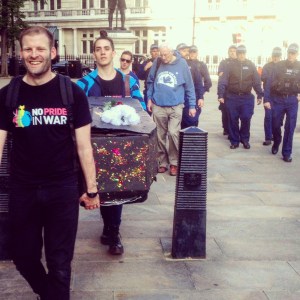
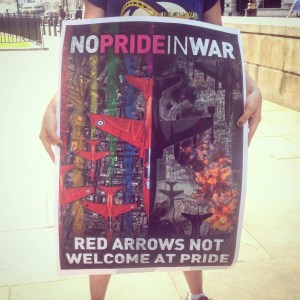
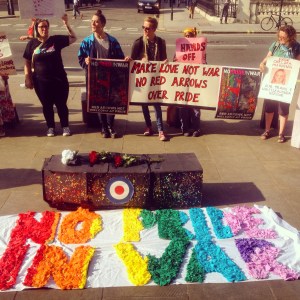

 On Saturday, 4th June a number of VFP members and supporters met together in a space offered to VFP to further our aims in Exeter, Devon.


 The armed forces should stop recruiting children under the age of 18, according to an open letter to the Ministry of Defence from national children’s organisations and rights groups.
 Where is the centre of England? its not Nottingham, Derby or Worcester, but a small Warwickshire village called Meriden, midway between Birmingham and Coventry. Some say that Meriden is a corruption of Meridian and historically all distance measurements in England were taken from the medieval trig point on the village green. On Sunday the 22nd of May two members of VFP Birmingham got on their bikes and pedalled to this small village to attend the cyclists annual peace rally, a ninety five year old remembrance ceremony in the centre of England. How did they know it was the centre of England? because it says so on the trig point. Alongside is a memorial obelisk and a plaque to all the cyclists who were killed in the First World War and a later addition from the Second World War.


 Since the Armistice of 1918 and the passing from living memory of WW1 veterans, there have been attempts by Historians, Politicians and the Military to rewrite history. Slowly and stealthily WW1 is being reinvented as a noble war for freedom and liberty and not the mindless slaughter of the young and naïve, in order to establish which Royal Families would reign over the worlds Empires.


 As dawn rose on Anzac Day in Wellington, the first rays of sun shone on one of war’s cruellest memories.


 Court Solidarity
 Solidarity Social


 Veterans For Peace will be speaking alongside
  In 1914-18 Britain, to protect its world interests and prevent Germany dominating Europe, had thrown all the resources of the country and empire into the First World War. Emerging triumphant, but weaker financially and militarily, Britain found itself losing markets and influence to the US – who gradually supplanted Britain as the dominant western power.


 Veterans For Peace UK