VETERANS FOR PEACE HELD IN IRELAND

Veterans for Peace, Ken Mayers (82) and Tarak Kauff (77) are being punished by the Irish state without trial. They are charged with a minor misdemeanor for having entered Shannon Airport on St. Patrick’s Day to stand up for Irish Neutrality and search a United States warplane. For that they were imprisoned for 12 days and then strict bail conditions were imposed including the confiscation of their passports.

For over 200 days they have been held hostage in Ireland without being found guilty of any offence. Their actual trial could be 2 or even 3 years away. This scandal must be stopped. It is time people started communicating with Charlie Flanagan’s Justice office to demand that these two elderly men be allowed to go home until their trial.

Have no fear they will return to prove that what they did was justified, because War is the Crime.

Email Charlie Flanagan:

charles.flanagan@oireachtacharles.flanagan@oireachtas.ie

THE SHAPE OF THINGS TO COME

In the past three months VFP have conducted silent protests against two of the largest military trade and hierarchy gatherings in Europe. Both were in London. Naturally VFP were only by the entrances as ‘Personae non gratae ’. Herewith, as reported by the arms companies and their media themselves, verbatim almost unredacted, is some of what VFP were against. (see sources)

A notable finding of our research indicated that in the combined seven days of both events, involving literally many hundreds of speakers, presentations and papers, not one comment was made on the environmental impact of these developments either in terms of ‘footprint’ carbon or otherwise; use of diminishing rare resources to make them ‘state-of-the-art’, or their contribution to emissions in manufacture (intensive) or testing. (for more on this issue, see the previous post by David Collins)

DESI 2019: The Sales Shop

Part 1 is from the military news highlights from this year’s DSEI “defence” exhibition, held on 9-13 of September in East London.

1. £100m Protector will be able to fly for up to 40hrs. (RAF)

DSEI saw the UK MoD announce a £100m contract to US General Atomics Aeronautical Systems (GA-ASI) to complete, just, testing and evaluation activities for the RAF’s next gen Protector RG1 armed UAV. Protector, a variant of the GA-ASI MQ-9B SkyGuardian, is set to be delivered to the RAF from 2021, with 16 air vehicles to be acquired. Unlike the current Reaper, it will be certificated to fly routinely in controlled civil airspace; meaning where airliners climb, descend and cruise.

2. Protector ground control station (GCS) source VFP

Unexpected news in the air sector from this year’s DSEI exhibition saw Italy sign up to become a partner on the UK’s Team Tempest future combat aircraft programme. Signing a government-to-government statement of intent (SoI) on the 10th September, Italy became the second nation (after Sweden in July) to agree to co-operate on the UK Tempest ‘sixth generation’ combat aircraft project. The agreement followed on from a joint government feasibility study launched last year in the wake of the release of the UK’s future Combat Air Strategy.

3. MBDA shows off potential Tempest weapons (MBDA)

On display alongside the Tempest fighter full-scale mock-up were potential weapon concepts from MBDA. While some of these, including the supersonic and stealth cruise missiles had appeared at the Paris Air Show in June; new at DSEI were tandem within-visual range air-to-air missiles, ‘increased calibre’ WVR AAM, hard-kill self-defence and ground attack micro-missiles and the SPEAR EW – appearing for the first time at a defence trade show. The tandem WVR AAM missiles are based on ASRAAM, but aerodynamically cleaned up and shortened to fit inside a Tempest internal weapons bay. Meanwhile the ‘last-ditch’ hard-kill self-defence micromissile, revealed in June, was accompanied by a new ground-attack micromissile. In further news about the SPEAR EW mini cruise missile, MBDA and Leonardo were been awarded a £10m contract for development of the SPEAR EW.
(MBDA feature again in DSEI below)

Dragonfire: Skirting The Grey Area, An Illegal Weapon?

4. Source VfP

As first reported by VFP two years ago at DESI 2017, last month saw a full-scale Dragonfire beam director on display in the DSEI Naval Zone (ND4) with a half-scale model on the Leonardo stand. According to the MoD the programme will develop technologies for a high energy ‘defensive’ laser weapon system in the 50 kilowatt category. The prototype is being delivered and live tested by late this year.

Dragonfire, a directed-energy weapon (DEW) damages its target with highly focused energy, including laser. DEWs are future weapon systems that emit such energy for target destruction. The potential applications of this advanced technology include: as a missile defence system, the disabling of lightly armoured vehicles, counter artillery / mortar rounds and even as anti-personnel weapons. The use of DEW systems is (only theoretically) much more cost effective than the cost associated with a single missile launch.

If successful, the first deployed-in-quantity laser weapons would come into service by the mid-2020s. Energy weapons are an increasing focus for defence firms and crucially for export. Notably they are lethal if not tuned properly; they are silent and offer plausible deniability of their use.

There is growing pressure in the USA to amend the Convention (signed ten years ago) on laser weapons so they can be used against personnel: “development was stalled because of international laws prohibiting the use of directed-energy weapons against personnel. It is crucial the defence industry find ways to harness the power of a discriminate laser weapon. If the Law of Armed Conflict is adjusted to permit directed-energy weapons use against personnel, which could minimize suffering to the most extent possible, using aerial lasers with the power to target personnel on the ground can redefine the way the U.S. Air Force utilizes airpower within the close air support, counterinsurgency, and counter terror attack missions.”

5. The cover page of a recent market study: “Directed energy weapons market worth $5.8 billion in 2019” says new Visiongain report.

Quo Vadis DEW Laser?

The idea of using high energy lasers (HELs) as weapons has been around almost as long as the laser itself invented in 1960. Initially, the systems were chemical lasers, which got their power from a chemical reaction. They are very large pieces of equipment and are very fuel hungry, requiring a significant quantity of chemicals to drive them. The fuel is frequently toxic, requiring operators to don protective clothing.

Solid state lasers, in contrast, consist of a glass or ceramic material to generate a laser beam. They are smaller, more compact but still require a large energy input to generate the beam. Although the energy required remains significant, however until recently, solid state lasers were not able to reach the same power levels as chemical lasers and so were not deemed suitable for military use. They first came to public attention when Ronald Regan proposed the Strategic Defence Initiative (SDI) program “Star Wars”, in the early ‘80s DEWs were deployed on various USN and RN ships in the nineties, especially those deployed to the Gulf of Arabia.

6. Impression of DEW onboard a RN ship (MBDA)

Microwave DEW and laser DEW both operate in the electromagnetic (EM) spectrum, however, laser wavelengths are about 10,000 times smaller than microwaves, which mean high-energy lasers direct more focused beams of lower-powered energy using the preferred mechanism of electric power to radiate energy and focusing it on a target, resulting in physical damage. On a ship, the power generator can be mounted inside and the beam fed up through fibre cables. It is the weight and size of the power source for the laser that for the foreseeable future limit them to Battleships and large wheeled trucks. They will not be seen on fighters or on the larger drones. Unless there is a quantum breakthrough, outsize military transports or heavy duty helicopters would be more likely.

7. (MBDA)
In this artwork a MIG is circled in red. Under battle conditions it will be near impossible from a ship to avoid the cockpit and pilots eyes or igniting his helmet sensors

Dragonfire, UK Arms Industry Who’s Who

The Defence Science and Technology Laboratory (DSTL) and UK arms industry are developing the weapon and the government announced that GKN and DSTL have developed an energy storage system for it. Again enormous amount of power is needed for it to fire.

8. Land based vehicle from Rheinmetall-MAN for MBDA

Likewise as above, a panicking crew or just plain indifferent, can easy re-direct at opposing personnel, especially if sold overseas

Led by MBDA of Stevenage & Filton, under contract to Dstl, is UK’s Dragonfire. MBDA is bringing weapon system- i. delivery experience and ii. advanced command and control (C2) plus image processing capability to UK Dragonfire, in addition to coordinating the overall effort. A key benefit according to MBDA is that the base system is highly adaptable and its effects are highly scalable. As such it offers a range of different engagement solutions depending on the tactical scenario, these include tracking, deterring, dazzling the sensors of a potential threat, up to damaging or destroying it.

Although led by MBDA as prime, this consortium has brought together the ‘elite’ of GB arms industry expertise to deliver the complex Laser. According to MBDA in a press release:

“UK DRAGONFIRE will achieve, through the Laser Directed Energy Weapons (DEW) Capability Demonstrator, a significant step change in the UK’s capability in High Energy Laser Weapon Systems and will provide the basis for technology-driven operational advantage. The programme will mature the key technologies for a high energy defensive laser weapon system and will include the engagement of representative targets in land and maritime environments in 2019. The programme will also provide the body of evidence for future procurement decisions. UK DRAGONFIRE is a collaborative consortium led MBDA with QinetiQ and Leonardo-Finmeccanica that has brought together the best of relevant UK industry expertise to deliver the highly challenging and complex programme. The team also capitalises on the strengths of the individual companies involved, which includes GKN, Arke, BAE Systems and Marshall ADG. This proposal builds on the significant MoD and Industry investment in the areas of laser coherent beam combining, weapon systems command and control, advanced pointing systems and high power storage.”

9. Slide Source Dstl / MoD

Welcoming the announcement, Dave Armstrong Executive Group Director Technical and UK Managing Director of MBDA said: “Under MBDA lead, UK DRAGONFIRE will put the UK at the forefront of high energy laser systems, capitalising on the experience of joint MoD/Industry working in the complex weapons environment. Furthermore it advances the UK towards a future product with significant export potential.”

The Design of the Turret known as a “beam director”, that will be used to trial this new technology, requires a large, very precise fragile mirror, mounted somewhat like a searchlight, requiring bulky machinery to slew the mirror to aim the laser. This beam director, will be provided by Leonardo, as well as electro-optics for target identification and tracking. Norman Bone, Managing Director of Leonardo Air and Space Systems said, “Leonardo will contribute the electro-optic beam director to the programme and support the trials and evaluation.”

QinetiQ is providing the powerful laser emitter. QinetiQ’s role is to provide the high-power laser technology for the programme and, using their testing and evaluation expertise (MoD Boscombe Down), will conduct trials over land and water at various trials sites that they operate for UK MOD. QinetiQ has completed building the weapon’s laser source in its purpose-built clean room. The laser source has undergone a process of evaluation before being integrated with Leonardo’s beam director.

QinetiQ are the only UK company to successfully operate a high energy laser weapon in the UK. Their team has direct experience of high power fibre lasers and therefore a clear understanding of the requirements that will be placed upon the fundamental optical sources for the Laser Directed Energy Weapon. Using their design for a coherently combined fibre laser and the associated phase control system, QinetiQ will provide this precision laser source that can be directed onto a dynamic target and achieve an enhanced power density on a target even in the presence of turbulence.

QinetiQ’s solution for the high-power laser has a scalable architecture that supports increasing the number of laser channels, offering a route map towards systems suitable for maritime, land and air use.

Dragonfire is now ready to deploy for testing on MoD Ranges this year. The project will culminate in operation at full-power under test conditions inside the facility “soon”, before it is transported to MoD Shoeburyness for long-range outdoor trials before the end of 2019; enabling the engagement of representative targets on land and at sea before 2020. These will provide the body of evidence developing UK industrial capability and know-how, so that collectively the UK can respond more effectively to both threats and the emerging business opportunities in the UK and overseas.

Dragonfire is basically “keeping-up-with-the-Joneses”, this news will see Britain join the laser weapons arms race after America has already extensively tested DEWs and deployed a DEW laser to the Persian Gulf on one of its own warships.

Air Power Conference July: The Doctrine

Part 2 is from this year’s RAF Chief of the Air Staff’s Air and Space Power Conference (ASPC) held on 17-18 July in central London. Attended by senior UK Government Ministers, international air and space power chiefs, business leaders and professionals from across the spectrum of the air and space industries.

The theme of this 2019 Air and Space Power Conference was: ‘Multi-Domain Operations (MDO) for the Next Generation Air Force’. As such the Conference revealed emerging technologies and opportunities for innovation in the air, space, cyber and artificial intelligence spheres and examined the potential for multi-domain operations to address the complex challenges posed by (their words) “competitor” states / “peer rivals”, above and below the threshold of war.

If last year’s Air Power Conference saw 100 years of the RAF as a major theme, this year’s event shifted into high gear, and was firmly focused on future threats, operations, technology and personnel. The two days of the conference attracted over 550 delegates, including 46 heads of air forces, including the USAF Chief of Staff, who told press at the event: “This is probably the best forum where I get access to fellow air chiefs, industry and thinktanks.” Organised by the Air and Space Power association, the conference has changed its name this year – adding ‘Space’ into its title – a tweak that will become obvious later in this report.

The two days of the event saw delegates hear from high-level speakers, with the packed event featured a range of presentations from the strategic context, to front-line operations, to personnel with speakers from MoD, coalition partners, industry and academia. This conference was regarded as a ‘timely’ one, as the UK and its partners face (they believe) hybrid threats, ‘sub-threshold’ conflict, rapidly changing technology and the erosion of the West’s traditional (perceived) qualitative advantage in military power.

Space As A Battleground

10. “Is a hostile satellite attempting to move into the orbital equivalent of your vulnerable ‘six o’clock’?”

In his presentation, the RAF’s Chief of Staff Capability, AVM Simon ‘Rocky’ Rochelle, also highlighted space as key a domain for the RAF. He noted that the threats to critical space assets ranged from attacks on ground infrastructure, to cyber, to kinetic strikes on friendly satellites. Holding ‘dogfight’ briefing sticks with satellites instead of fighters aloft as a visual aid, Rochelle told the air power audience that they “have to stop thinking about space as just collection.” Traditional air force fighter pilots make arguments about turn rates, climb performance and missile engagement zones will need a new generation of future ‘starfighter’ professionals who understand the basics of ‘space power’ such as orbital decay, DeltaV (changes in rocket velocity) and power ratings of satellites. This already a fact with the long established “Five Eyes” Anglophone intelligence alliance.

Grey Zone: Hypersonics And Fake News

As Rochelle had hinted at in an earlier presentation at the conference, in 2030 more than 80% of NATO’s fighter fleet will still be ‘fourth generation’ combat aircraft, but what if they could all fire Mach 5 missiles on Day 1 of the war? Rochelle has tasked the RAF’s innovation RCO with a very ambitious deadline – to see whether they can generate a Mach 5 weapon capability within four years.

Integrating hypersonic weapons into an air force, the challenges are not just ones of propulsion and thermodynamics, but of command and control, especially against peer nations armed with similar technology where decision times may be in the range of three seconds. Closing speeds of Mach 10 mean that targeting and C2 will be a major challenge and may have to be highly automated, much as ship defences are now computer-controlled against high-speed sea-skimming missiles.

“Sub-threshold hybrid warfare” is their euphemism that see the traditional three (air, sea, land) having been joined by space, cyber and the newest domain, information. Though the last domain might also be argued to be nothing new (previously being called propaganda). The emergence of a social media ‘landscape’ means that this art of persuasion can be weaponised having expanded exponentially (from dropping leaflets over enemy cities). Hybrid threats or conflicts, whether they are viral ‘fake news’, pseudo-legal challenges to freedom of navigation, can thus happen across multiple domains simultaneously, paralysing decision-makers.
A second difference is that AI and machine-to-machine communication now offer the possibilities of increasingly compressed and faster sensor-to-shooter ‘kill-chains’, already having been developed by the US to be staggeringly quick in the realm of close air support for COIN. MDO would like to see this expand into other missions and become even faster – with a digitised C2 able to understand the overall campaign plan, spot opportunities and re-task sensors, assets and weapons (“Skynet” type). Giving an example of this, USAF Chief Gen Goldfein revealed that recent USAF demonstration saw a machine-to-machine kill-chain against a naval target reduced to ‘minutes’ with information passed from satellite, to ISR, to C2 nodes – before being handed off to a human ‘shooter’.

11. Co-operation just some of the 46 heads of air force at ASPC19. (RAF)

Meanwhile, in personnel, it was claimed the last year had seen the best RAF recruiting figures in a decade. The service has raised its max recruitment age in some trades, encouraging re-joiners. ASPC itself is hyped as a global must-attend forum for air chiefs, air and space power professionals, industry, academics and the media. This year’s conference sought to answer perhaps their biggest question facing the ‘western’ allies: with the qualitative gap in military equipment between them and ‘competitor’ nations closing rapidly, how can they keep their air power edge in age of sub-threshold hybrid warfare?

ASPC will return next year 15-16 July 2020

BAE Systems Saudi Arabia Ltd

Apart from being a prime sponsor/partner of both DESI and ASPC, this month also saw the ongoing active marketing of BAE in specific recruitment for a specific customer. In the absence of rejoining the RAF (above), BAE Systems Saudi Arabia provides job opportunities through the Kingdom of Saudi Arabia Resourcing Team (KSAR) and are actively recruiting a number of positions in the following areas: Aircrew; Instructors/Teachers; Technical Specialists; Engineering and Maintenance; Project Management; Aircraft Maintenance; Finance/Commercial/Procurement; Legal; Supply Chain; HR; Quality Assurance; Strategy and Planning.

Many of BAE Systems Saudi Arabia contracts are within the Military and Technical Services area. They include the provision of contracted manpower for the support of, Hawk, Tornado and Typhoon aircraft. This activity covers flying instructors for training Royal Saudi Air Force (RSAF) aircrew, ground instructors for training RSAF technicians and a spares and repair service for Hawk and Tornado aircraft.

12. Cover of recruitment brochure

13. RSAF Airbase (AB) locations of BAE

1. AB Riyadh BAESA HQ
2. AB Dhahran Wings 3 & 11, Tornado
3. AB Tabuk Wing 7, Hawk
4. AB Khamis Mushayt Wing 5, closest to Yemen border
5. Jubail naval airbase and harbour
6. AB Ta’if Wing 2, Typhoon
7. AB Jeddah Wing 8

Wing nrs. according to RSAF. Most of these ABs also host US Military Training Mission (USMTM) and USAF specialists who likewise support American built aircraft.

The Kingdom of Saudi Arabia now has the world’s fifth largest military budget, ahead of both Russia and France. Without ‘contractors’ (mercenaries?) from both the UK and USA, the RSAF could not function.


Produced by VFP Working Group

VFP joined the protests at DESI last month and were the sole presence outside ASPC in July.

All publically sourced from open arms industry PR with sources including editorial features in the monthly magazine of The Royal Aeronautical Society.

If any VFP member wishes to assist this working group on the UKs own military-industrial complex or place articles according to VFP handbook code of practice, please contact Admin or the Policy Group.

THE LINK BETWEEN CLIMATE CHANGE AND MILITARISM

David Collins was invited by XR and CND to deliver a speech on “The link between climate change and militarism” outside the MOD in London at 10am on 10th October followed by an hour’s public discussion.  However, due to police action outside the MOD, denying access to XR with its stage and public address systems, the speech could not be given publicly at the time.  It is planned that the speech will be delivered on another occasion shortly.

I served for 9 years in the Royal Marines, leaving in 1979, and for the past 20 years have worked to promote renewable energy, helping to initiate the Feed-In Tariff and Renewable Heat subsidies which kick-started the industry in the UK from virtually zero to the current national energy share of 33% of electrical energy, together with liquid biofuels, biomass and renewable green gas from anaerobic digestion, replacing fossil gas.

I would first like to recall the preamble to the Charter of the United Nations signed in June 1945 which states a determination “to save succeeding generations from the scourge of war……and to re-affirm faith in fundamental human rights”. Surely the most basic of which is the right to live in peace in a healthy habitable world.

There is, of course, a massive direct military carbon footprint generated by domestic and foreign military bases, deployment in wars, manufacture of weapons, munitions, missiles, production of military equipment, use of aircraft, ships and land vehicles, for which efficient fuel use is the very least consideration. To name but a few, further vast emissions come from post-war reconstruction, healthcare for military and civilians, and restoration of war devastation such as oil-fires and de-forestation.  As an example, where central electricity generating stations are destroyed they are replaced by thousands of polluting domestic diesel engines.

Independent analysis by Professor Neta Crawford on the carbon emissions for the “War on Terror” from 2001-2017, based on both military operations and the US arms industry, estimated emissions of 3,000 million tonnes CO2e which is about equivalent to the total expected USA emissions over a given 6 month period.

These astronomical totals are hardly surprising when you recall that according to the 2006 Amnesty International report “Dead on Time”, the 2003 transport for the invasion of Iraq, for the US alone, involved 210 ships carrying 4.8 million m3 of cargo and 5.2 Bn gallons of fuel.

We should be outraged of course at the immense direct carbon footprint of the military-industrial complex, which is deeply embedded in many nations and which probably amounts to 5% of the total anthropogenic emissions in the world. However, it is the grotesque disparity between resource allocation for the military compared with that for the environment that I’d like to take on as my theme.

Here we are, in the shadow of the MOD, whose primary role is the security of the nation.  Inside this building, the military is engaged in assessing perceived security risks and making contingency plans to cope with them in advance.

A report by The Oxford Research Group has established that MOD advice to policymakers is governed by the principle that even a 1% chance of a security risk materialising is unacceptable. This goes a long way to explain the need for such immense sums spent by the military.  Whether large or small, fictitious or true, a tiny security threat means more ships for the Navy, more tanks, more aircraft and weaponry to “make us safe”.  It also creates an anxiety amongst the population that is necessary to create public support for military expenditure and wars.

One irony noted by Dr Leila Urekenova, while at the 2018 Munich Security Conference, is that this “1% doctrine” is for all practical purposes identical to the “precautionary principle” invoked by environmentalists. Yet the certainty of impending climate catastrophe is ignored in favour of the possibility of security threats.

Yet the unfolding climate catastrophe is not a 1% or a 20% or even a 90% risk.  At a time in the near future, it is plainly 100%.  We are past the moment when doubt gives an excuse for inaction; it has been in plain view for over a century with the work of Tyndall in 1859 and Arrhenius’s first calculation of global warming from human emissions of CO2 in 1896.  A question was recently posed to science students; “How many significant scientific breakthroughs in the science of global warming have made been since 1979.”  The surprising answer – none.  The basic facts of the science have been indisputable for over 40 years, and the children and youth of the entire world this year have rightly demanded that from this moment all resources should now be concentrated towards averting the extinction of human and animal life on earth.  That resource is readily available now from existing military budgets.

A holistic assessment would view the potential impact of climate change in individual countries, as being of a similar order of magnitude to a major nuclear war, both of course likely to lead to the eventual extinction of life on earth.  But whilst the major polluters and aggressive military powers are not individually faced with catastrophic damage, it will not be their priority.

International climate finance dedicated to mitigating and adapting to climate change is lower than military spending, by a ratio of nearly 12 to 1.  Yet there are huge variations in the amounts spent by each country.

The worst case is the USA where total climate finance amounts to 0.2% of military spending.  YES 0.2%.  Italy is only 0.9% with at UK 3.1% , yet Germany manages over 22%, Japan 18% and China 13.6%.   This is of course directly related to the foreign policies of each country; Germany and Japan being bound by their constitutions not to engage in aggressive wars, the USA and UK the very opposite.  But the ratios of even the best examples are still grotesque. A tiny gleam of light is Costa Rica – no army for 40 years, therefore adequate funding for social justice, education, health and common goods.

You might think that this waste of resources would cripple those economies but the revenue from arms sales and the opportunistic looting of resources in the aftermath of these wars is compensation enough for the failed diplomacy that causes these wars.  For the military-industrial complex, the misery of war is a very profitable business.

Imagine the reversal of these ratios; imagine basic defence spending at less than 10% of that spent on addressing the actual needs of the world.  The repatriation from the destructive military industries of talent, human energy and peaceful research to where it is really needed. People engaged in productive positive work, instead of killing other peoples while often harming their own sanity and health.   War can and often does destroy both the aggressor and the victim.

And of course even the existing modest outlays on preventative action to slow and reverse climate change represent overwhelmingly better value for money than a securitised military approach that seeks to address only the symptoms of a changing climate in the form of increasing conflict across the Global South.

This doctrine has kept the UK at war, somewhere in the world, every year since WW2.  No other country, including the USA, has this record.  Who is threatening us?  Anyone out there? Yet Britain has soldiers deployed in over 80 countries and has bases in 14.  In truth we ARE the threat – in Afghanistan, the recent conflict is known as the “British war”.  And how much carbon will be emitted and for how long, while each country rebuilds and recovers?

Vietnam lost a generation of progress following what they call the “American War” from 1965 to 1975.  In the aftermath, the country remained closed and in shock, losing in total 24 years, until tentatively opening up to the world in 1989.

Yet no regret for any wars has been shown by our government. To the contrary, Gavin Williamson, the former Defence Secretary stated in December 2018: “The UK could build new military bases around the world after Brexit – this is our moment to be that true global player once more – looking into new opportunities for the armed forces – our biggest moment as a nation since the second world war”

I love that word “OUR” – what he really means is “YOU”, because it is you, the youth of our country who will be sent to fight his wars, kill his enemies and return home with missing limbs and damaged minds.

It is clear that the current “season ticket” for continuous war which commenced following 9/11, has to expire following 18 years of failure and mayhem.  Decisions on war should be removed from the hands of politicians, who are plainly unfit for this task, to an impartial non-political body.

I’d like to quote part of a speech given by MEP Molly Scott-Cato from a MAW conference this year

“Climate change, social justice, displacement and war – all of these are in a nexus together, they are inter-related, and when you address one, I believe you address them all, because we will not solve the problem of conflict without having global justice. We will not solve the problem of conflict without addressing climate change, and my view is that we will not solve any of these problems unless we have properly functioning flourishing democracies, not just in this country but right across the world.”

Every year more young people become voters, core public support for dissent continues to build, and I hope that the demographic tide continues to run in favour of replacing war expenditure with the radical conservation policies that are needed.

I’d like end on a quote from Al Gore’s, acceptance speech for his 2007 Nobel Peace Prize awarded for his work on the Climate Emergency – “I call on all nations to mobilize with a sense of urgency and shared resolve that has previously been seen only when nations have mobilized for war.”

David is a member of the Committee of the Movement for the Abolition of War (MAW), which was founded in 2001 by Bruce Kent following the 1999 Hague Appeal for Peace. Run by volunteers, MAW challenges popular thinking about the acceptability of war and promotes the vision of a world in which conflicts are resolved without resort to violence; a world in which war is not considered inevitable.

David is also a member of Veterans for Peace which was founded in the USA in 1985 and in the UK in 2011.  VFP UK is a voluntary and politically independent ex-services organisation of men and women who have served in conflicts from WW2 through to Afghanistan.  As a result of their collective experiences, they firmly believe that War is not the solution to the problems we face in the 21st century.

David acknowledges material from Oxford Research Group, Scientists for Global Responsibility, and Molly Scott Cato MEP included in this article.

RETIREMENT LETTER: BEN GRIFFIN

Ben Griffin is a founding member of  Veterans For Peace UK serving as our National Coordinator from 2011 to 2018. He will retire from VFP at the conclusion of our Annual Gathering in November 2019.


Dear Veterans for Peace

Since 2005, I have been persistently engaged in anti-war activity. I have given my all and it has taken its toll.

When I summon the energy for one more meeting, one more speech or one more action, I no longer have the capacity to absorb the negative psychological by-products.

Difficult as it is, the time has come for me to accept that everyone has a limit and I passed mine some time ago.

At the conclusion of this year’s Annual Gathering, I will retire from Veterans for Peace.

The table attached to this letter spells out in detail the tasks I presently carry out for VFP and information helpful to the process of handover. I await instruction from the Policy group.

I look forward to seeing you all at our Annual Gathering.

I remain at heart a Veteran for Peace.

The future is unwritten.

Ben Griffin

[Read a PDF version with table attached by clicking here]


ANNUAL GATHERING 2019

VETERANS FOR PEACE UK: ANNUAL GATHERING 8/10 NOVEMBER 2019
LONDON

This is our main gathering of the year and attracts VFP members from around the world. Please scroll down for dates, times, locations and accommodation options.
PLEASE CLICK HERE TO REGISTER


SCHEDULE


MAP

Key locations are indicated on the map below, including accommodation suggestions.


ACCOMMODATION

County Hotel
8-11 Upper Woburn Place
London WC1H 0JW

T: +44 (0)20 7387 5544
E: info@imperialhotels.co.uk
web: https://www.imperialhotels.co.uk/en/county


Hostel at The Exmouth Arms
1 Starcross Street
London NW1 2HR

T: +44 (0)20 7387 5440
E: exmoutharms@publove.co.uk
Web: http://www.publove.co.uk/exmouth-arms-euston
Please mention you are VFP if you want to room with other VFP members.


Tavistock Hotel
48-55 Tavistock Square
London WC1H 9EU

T: +44 (0)207 278 7871
E: info@imperialhotels.co.uk
Web: https://www.imperialhotels.co.uk/en/tavistock


DONATE

Please consider making a donation to VFPUK to help with the costs of our Annual Gathering:

Paypal


PLEASE CLICK HERE TO REGISTER

ANNUAL GATHERING 2019: THE CENOTAPH

Date: Sunday 10 November 2019

Meeting time: 1300

Meeting point: Whitehall Place, SW1.

Bag Drop: 1200hrs
Secure bag drop available from 12 Midday at The Marquis Pub, 51-52 Chandos Pl, WC2N 4HS.

Meeting point: 1300hrs
Gather to form up at 1300hrs in Whitehall Place. Nearest tube stations are Charing Cross, Embankment or Westminster.

The walk to The Cenotaph: 1315hrs
Never Again banner at the front, wreath carried directly behind. Remainder in threes, bugler in the last row. VFP banner at the rear. All supporters follow behind the VFP column. Followers are not to enter the Cenotaph cordon or distract VFP members during the ceremony.

The Ceremony:1330hrs
VFP line up within the cordon facing The Cenotaph in the position of attention.
Jim Radford to sing the song “1916”.
TBC to read the Poem “Suicide in the Trenches”.
TBC to lay the wreath of red and white poppies.
Bugler to play “The Last Post”.
One minute of silence.
Bugler to play “Reveille”.

The walk back to Whitehall Place: 1345hrs
VFP banner at the front.
Remainder in threes, bugler in the last row.
Never Again banner at the rear.
All supporters follow behind the VFP column.

Dress:
VFP members: VFP UK sweatshirt, shirt, black tie, dark trousers / skirt, dark shoes, poppy of choice.

Followers: Dressed for a funeral, wearing Never Again clothing would be appreciated.

This is a solemn act of remembrance, no other banners, placards, symbols or megaphones.

Afternoon Social: 1400hrs
The Marquis Pub 51-52 Chandos Pl, WC2N 4HS

ANNUAL GATHERING FILM NIGHT: KAJAKI

Friday Night of our Annual Gathering is at The Prince Charles Cinema for a screening of “KAJAKI”.

Former members of 3 Para will be present afterwards to answer questions about their experiences, which are depicted in the film.

Friday 8 November 2019
1800-2030 hrs
Prince Charles Cinema
7 Leicester Pl, London WC2H 7BY

Directed by Paul Katis
Starring Mark Stanley, David Elliot, Malachi Kirby
2014 | 108mins | UK | rated (15)

KAJAKI – THE TRUE STORY is a British war film, based on events that took place in Helmand Province in Afghanistan in 2006.

A small unit of soldiers is positioned on a ridge overlooking the Kajaki dam. A three-man patrol sets out to disable a Taliban roadblock. In a dried out river bed at the foot of the ridge, one of the patrol detonates a land mine, blowing off his leg and setting into motion a desperate rescue mission.

The film captures the horrors and the human cost of modern warfare.

Hosted by the H-Hour Podcast and Veterans For Peace UK the film will be followed by a Q&A with:

Paul “Tug” Hartley GM
Born into a military family whilst his father was serving in Germany. Tug was raised in Huddersfield, leaving school at 14 to work on a fruit and veg stall until he turned 16 and could apply to join the Army.
He joined the Royal Engineers in 1997 and served for 6 years specialising in mine warfare, demolitions and combat engineering. In 2003 he transferred to the Royal Army Medical corps and became a Combat Medical technician (CMT), serving with 23 Air Assault Medical SQN and on attachment with 3 Para and 22 SAS.
He deployed 3 times to Afghanistan, Oman, Lebanon and completed a number of exercises and training operations worldwide.
Paul “TUG” Hartley was awarded the George Medal for Gallantry whilst serving on Op Herrick 4 with the 3 Para Battle Group for actions at the Kajaki Dam on 06/09/2006.

Luke Hardy
Luke was the military advisor on KAJAKI and his work included running the actors’ bootcamp and military advising on location in Jordan. Previously, Luke was a member of 3rd Battalion the Parachute Regiment, completing three tours of Afghanistan as a member of the sniper platoon. This included the first tour of Helmand Province by British Forces in 2006, when he served alongside many of the soldiers involved in the Kajaki incident.
He is now a Paramedic with London Ambulance Service.

All proceeds from the event will be donated to Veterans Aid.

CLICK HERE TO BUY TICKETS

ANNUAL GATHERING 2019: HANDBOOK AMMENDMENTS

The following Handbook ammendments have been submitted for the 2019 AGM.


Section 7.5 Trustees
Each trustee has previously served on the Policy Group for at least three terms.

[Explaination: This is to widen the pool of candidates available to fill Trustee vacancies]


Section 8.3 Term of office
Members shall have a term of office lasting one year, beginning January 1st, ending December 31st and be able to stand for re-election.

[Explanaition: Smooths the handover to the new Policy Group by placing the handover date beyond the Annual Gathering]


SECTION 13: AMENDMENT OF HANDBOOK

13.1 Proposed amendments
Amendments to the handbook should be submitted
before the 15th of September to be considered for the
AGM in November. Submissions can be made by
completing the form on the VFP UK website;
vfpuk.org/handbook-amendments/

13.2 Additions
Proposed additions are in green italics.

13.3 Subtractions
Proposed subtractions are in red italics and struck
through.

13.4 Approval
Amendments must be approved by two thirds of verified
VFP UK members in attendance at the AGM.


COSTS OF WAR: ANIMAL ABUSE

In the US the People for the Ethical Treatment of Animals (PETA) obtained some footage of a military training exercise in 2012, where live goats that had been anesthetised were having their legs cut off with heavy-duty tree branch loppers, so that medics could learn how to deal with serious medical injuries:

In Britain it is claimed that we are a nation of animal lovers and some Regiments in the British Army have a tradition of adopting a certain animal as their military mascot – to act as a symbol for the unit and take part in its ceremonies. Also, on special occasions, the Household Cavalry will parade their well-bred horses before admiring crowds in London. These are examples of what has become the acceptable military use of animals.

There is, however, another side to the MoD’s interaction with animals that the British people and tourists do not see. Earlier this year, in April 2019, the ‘Daily Mirror’ newspaper published the following exclusive article about the abuse of animals during military tests, which were a part of the MoD’s weapons research programme at the Defence Science & Technology Laboratory (DSTL) at Porton Down:

‘Almost 50,000 animals have been killed in military testing at a top-secret government research base, the Sunday Mirror can reveal. During a series of experiments, scientists blew up pigs, infected monkeys with biological weapons and poisoned guinea pigs with nerve gas. Figures seen by this newspaper show 48,400 animals were killed at the Defence Science and Technology Laboratory at Porton Down, Wiltshire, between 2010 and 2017.

Animal rights activists claim the tests are unnecessary and the numbers being killed are “alarming”. Guinea pigs were among the animals killed during a variety of barbaric tests.

Jessamy Korotoga, of Animal Aid, said: “Animals suffer and die in so many different types of experiments, but there is something especially dark and ­troubling about warfare experiments. “To deliberately expose live animals to compounds, simulated blasts and biological pathogens which are known, and indeed developed, to cause extreme suffering and death is morally unconscionable. “A civilised society, in the 21st century, should not be involved in such macabre and terrible practices.”

Our investigation found scientists shot, blew up, gassed and poisoned animals as part of the Ministry of Defence’s weapons research programme. In one experiment, guinea pigs had a nerve agent called VX applied to their backs to see how another chemical, known as bioscavenger, would alter the effects. The rodents were observed after being poisoned and given a score for their symptoms, which included “gasping” and “writhing”.  Animals not already dead at the end of the test were killed and dissected.

The Army has also taken part in “live tissue” experiments in Denmark involving pigs. The beasts were shot in different parts of the body with rifles. Army medics then fought to keep them alive. The MoD defends the practice, claiming it provides doctors with vital training, which has helped save the lives of British troops injured in battle.

Pigs were also killed in explosive tests at Porton Down as part of a research programme to develop more effective body armour for troops serving in Iraq and Afghanistan. The animals were wrapped in body armour material before being seriously injured or killed by explosives. Scientists then studied the animals to assess which parts had been damaged or protected.

In further tests monkeys were injected with “biological weapons” like anthrax, while researchers recorded their pain levels and how long they took to die.Others were forced to breathe mustard gas, which burns the lungs and causes severe blistering …

An MoD spokesman said of our findings: “DSTL is responsible for developing and creating indispensable technology to protect the UK and its armed forces.“This could not, currently, be achieved without the use of animals in research. DSTL is committed to reducing the number of animal experiments”.’

[Daily Mirror, 27th April 2019, by Sean Rayment].

Besides these obscene experiments, animals have always been among the victims of wars, even if this often remains hidden. When we see bombed cities, napalmed hamlets, Agent Orange destroyed jungle and land strewn with landmines, we rightly mourn the human victims – even if the military refer to them as ‘collateral damage’. But how many wild animals, domestic pets, flocks of sheep, herds of cattle etc. are lost and wounded by such actions? No one knows, because animal victims are hardly ever mentioned.

Horses & Conflict

In Britain the Metropolitan Police Act of 1839 had prohibited: ‘Fighting or baiting Lions, Bears, Badgers, Cocks, Dogs or other Animals.’ Three decades later, in ‘The Descent of Man’, Charles Darwin had stated that: ‘There is no fundamental difference between man and the higher mammals in their mental faculties’. Darwin’s work on evolution helped to change the way many humans viewed their relationship with animals and a more enlightened view started to emerge.

Some people, however, still call animals: ‘Dumb’, but it is human beings who create wars, including our modern ones. Animals do not brandish rifles, or don suicide-vests; nor do they drive tanks, or pilot warplanes, or drones. Their only involvement in conflict is after they have been co-opted and trained into specific roles by humans.

The creature most associated with combat is the horse, either for mounted fighting, or as a pack animal. Early use of ‘noble horses’ in warfare saw them pulling chariots, or carrying lightly armoured horsemen. Later, the knight and his powerful warhorse, both heavily armoured, dominated the wars in Europe for centuries.

Gradually, most armies developed cavalry units and the mounted charge often became the centrepiece of a battle. The coming of mechanization and modern weapons as we entered the 20th century pointed to the ending of horses in warfare. Britain, however, used cavalry charges throughout WW1, even after it had become evident that machine-guns would wipe out any mounted attack.

During one period of the ‘Great War’ as many as 1,000 horses per day were arriving at the front as replacements to make up for the animals lost in the British Sector. The Army Veterinary Corps (AVC) treated over 725,000 horses during the war and over two-thirds were returned to duty. During the Battle of Verdun, in March 1916, German and French units lost 7,000 horses in one day due to the intense shelling from both sides.

After the major battles in WW1 the ground was saturated with the blood, flesh and bones of the causalities, but along with the human dead and wounded there were often large numbers of horses too. While over 9 million soldiers died in the ‘Great War’, 8 million horses died also, some in cavalry units charging towards enemy defensive lines protected by machine-guns and barbed wire. Other horses, living in the mud and exposed to shellfire and mayhem, perished from diseases, or from wounds, exhaustion and terror.

Gas masks were developed first for the soldiers and then for the animals, but, after fitment, horses often confused them with feedbags. Symptoms of shell shock were detected among some horses at the front and they were treated for this condition at the AVC’s hospitals. Horses were considered to be so valuable that if a soldier’s mount, or workhorse, was killed, or died, one of its hoofs was ordered to be cut off and brought back to the commanding officer – to prove that the two had not just been separated.

While it is true that the horses were trained for their role, many were left traumatized and bewildered on the battlefield, as humans exerted extreme and inane acts of violence against each other. During WW1 there were pictures of wounded soldiers and sometimes indications of how they were affected by the warfare. Often, this was censored, but images of maimed and distressed horses were totally missing; to let a ‘nation of animal lovers’ see what was happening to their ‘noble horses’ on the battlefield could have caused war weariness and opposition to grow.

Various animals were used for the conflict in WW1, with dogs, pigeons, canaries, camels, horses, mules, oxen and elephants being trained and then harnessed to carry out certain tasks:

Hanging on the Butcher’s Hook

Some of the recruitment posters for WW1 attempted to manipulate the natural affection between man and horse to entice recruits. But the horses, unlike their riders, or handlers, had no say about taking part in the conflict. They also had no concept of war and lacked any means of understanding it.

During WW1 the transport costs were considerably more for horses than for men, due to the space required and the cost of fodder. Britain’s need of horses was so great, however, that as well as requisitioning them from UK civilians, the military also imported them from the US, Canada, Australia and Argentina. In its quest to keep up the supply of horses needed, the British Remount Department became a major international business, spending £67.5 million (equal to £6700 million today) in its task to purchase ‘noble horses’ for the war.

The Australia and New Zealand Mounted Division fought in the Middle East during WW1, helping to drive the Ottoman forces into retreat from Egypt back to Turkey. The Australians mainly used hardy Waler horses, which were a cross between workhorses and thoroughbreds. Over 130,000 Australian horses, mostly Walers, were shipped out to take part in the war.

When the ‘Great War’ ended only one Waler horse was ever returned to Australia. The costs of transporting the rest of the horses – that had always been found to carry the animals to war – was now: ‘Too costly’ to take them home (well, there was no profit in transporting them now, was there?) So, the surviving horses were just sold off to locals to be worked to death, or butchered for meat.

Many of the Australian veterans were heartbroken about having to leave their Walers to this fate and some took their horses out into the scrub, or desert, and shot them dead. A similar situation occurred with the horses from Britain that had travelled to the front in France. Some officers were granted the right to have their mounts transported home, but most of the horses were sold off – mostly to French butchers.

Humans have been fed lies and exploited as cannon fodder in wars since the history of organised combat started. Yet, as combatants, they mostly fight, either because they believe their ruler’s propaganda; or if not, because Homo sapiens at least have the capacity to adjust to their situation and come-to-terms with their predicament.

Conversely, animals, who have had their trusting nature exploited to take part in conflicts, can neither comprehend the human folly of war, nor rationalise their involvement in it. Conscripted and voiceless, they deserve to be regarded as fellow veterans and have better care taken of them, both during and after conflict. In WW1, however, very little concern was shown to any of the veterans at the front – animal or human.

The song, ‘Hanging On The Old Barbed Wire’, was composed by soldiers in the trenches. Designed to be sung whilst marching, it is one of many songs and poems showing the ordinary soldier’s dissent and disgust at the war, the inequalities within the army system and how the orders of the Politicians and Generals had left so many of their mates: ‘Hanging on the Old Barbed Wire’:

At the end of WW1, there were countless young men who had gone straight into the trenches and who knew no life save that of soldiers. Many were left traumatised and brutalised by their experiences. In London, shortly after the end of the ‘Great War’ on the anniversary of Armistice Day, 25,000 unemployed veterans marched past the Cenotaph in remembrance of the dead.

The veteran’s cry, written boldly on their banners, as they marched was: NEVER AGAIN! To protest about their own plight, many pinned pawn tickets beside their medals. One of the veterans, George Coppard, recalled:

‘Lloyd George and company had been full of big talk about making the country fit for heroes to live in, but it was just so much hot air. No practical steps were taken to rehabilitate the broad mass of de-mobbed men.’

As they marched, many of the disillusioned veterans remembered with a deep affection, not only their fallen comrades, but also those animals they had fought alongside throughout the war. Meanwhile, back in France, some of these fellow veterans were on display. They were some of Britain’s ‘noble horses’ that had also survived the war, but were now hanging on hooks in Butcher’s shops – as fresh meat for sale.


Information collated by Aly Renwick, a VFP member, who served in the British Army for 8 years in the 1960s.

ANNUAL GATHERING 2019: POLICY GROUP ELECTION

Please register by 15th of October to stand for election to our Policy Group at our 2019 Annual General Meeting.

← Back

Thank you for your response. ✨

Which position are you standing for?(required)

BOOTS ON THE GROUND FOR PEACE

US Veterans For Peace Tarak Kauff and Ken Mayers

This article by Charlie McBride was published in the Galway Advertiser on Thursday 12 September 2019

On St Patrick’s Day this year, two US military veterans, Ken Mayers and Tarak Kauff, aged 82 and 77 respectively, were arrested at Shannon Airport for protesting its continued use by the American military.

Charged with damaging the airport’s security fence and trespassing, they were held in Limerick prison for 12 days and had their passports impounded. Still awaiting their case to come to trial, Ken and Tarak have been using their extended Irish stay to take part in other anti-war protests against American militarism and to champion Irish neutrality.

The two men, former soldiers in the US Army and Marine Corps, now members of Veterans for Peace, have commenced a ‘Walk for Freedom’ which started in Limerick last Saturday and will end in Malin Head, Donegal, on September 27.

Before their epic trek commenced I met Ken and Tarak in Limerick and they related how they went from being soldiers to peaceniks and why they believe Ireland can be a strong voice against war in the world.

“My father was in the marine corps in World War II and the Korean War, so I grew up drinking ‘marine corps Kool Aid’,”
Ken begins. “The corps actually paid my way through college and when I finished I took a commission in it. At that time I
was a true believer and thought America was a force for good. I served on active duty for eight and a half years, in the
Far East, the Caribbean, and Vietnam, and I increasingly saw that America was not a force for good.”

Ken lists some of the things which eroded his faith in US virtue. “The first clue was in the spring of 1960 when we were doing exercises in Taiwan – this was before it had become a tiger economy and it was terribly poor. We’d be eating our C-Rations and there’d be kids begging for the empty cans to patch their roofs with. That made me wonder why an ally of ours was in such poverty when we could have been helping them. ‘I looked at what America was doing in Vietnam and it appalled me. That was the start of my activism and radicalism. When people thanked me for my service to my country I told them my real service didn’t begin until I got out of the military’

“A year later we were in Vieques Island, Puerto Rico, which the corps owned half of and used for gunnery practice. We were ordered to set up a live fire line across the island and if someone tried to pass we were to shoot them – and the islanders were American citizens. I learned later that the US was training Cubans on the island for the Bay of Pigs invasion. That incident was another.

“The final straw was when I got back to Asia in 1964. I was tasking destroyer and submarine missions along the Vietnam
coast when the Tonkin Gulf incident occurred. It was clear to me that was a fraud being used to justify a major war to the American people. We were violating Vietnamese waters  constantly, sending boats close to shore to provoke a reaction.
That’s when I decided I could no longer continue to be an instrument of this kind of foreign policy and in 1966 I resigned.”

Tarak did three years in the 105th Airborne Division, from 1959 to 1962, and readily admits to feeling grateful that he got out not long before his unit was sent to Vietnam. Immersed in the febrile currents of the 1960s he became a staunch peace activist. “I was part of that sixties culture and it was a big part of me,” he declares. “I looked at what America was doing in Vietnam and it appalled me and that was the start of my activism and radicalism. When people thanked me for my service to my country I told them my real service didn’t begin until I got out of the military.”

During the interview Ken speaks calmly while Tarak is apt to be more fervent, jabbing the table top with his finger for emphasis – though he also smiles in self-awareness and jokes about how the contrast makes the two of them a good double act. They are both long-time members of Veterans for Peace, which was founded in Maine in 1985 and now has chapters in every US state and several other countries, including Ireland.

It was Ed Horgan, founder of Veterans for Peace Ireland, who alerted Ken and Tarak about Shannon. “We met Ed a few years ago and we had thought Ireland was a neutral country but he told us about all the US military flights, and rendition flights, coming through Shannon. By facilitating those, Ireland is making itself complicit in America’s wars.”

Tarak highlights the terrible damage of American militarism, which includes climate destruction. “Today, America is waging wars in 14 countries while within the country there are mass shootings every day. The violence we export is coming home,” he says. “More Vietnam vets have taken their own lives than were killed in the entire war. And young kids coming back from the wars in Iraq and Afghanistan are taking their lives as well. Why is that happening? That’s blow-back, that’s guilt!

“And today we’re not just killing people and destroying countries like we did in Vietnam and Iraq, we are destroying the very environment. The US military is the biggest destructor of the environment on earth; they are the biggest user of petroleum, they are huge toxic polluters with over a thousand bases around the world. People don’t often connect the military with climate destruction but it is intimately linked.”

Ken and Tarak have previously been arrested in protests as far apart as Palestine, Okinawa, and Standing Rock in the US. “When you do these protests and oppose government policy they don’t like that and you do tend to get arrested,” Tarak notes wryly. “But this is the longest we have been held in one place due to our passports being taken six months ago,” Ken adds. “We’ve been outside the Dáil with banners advocating Irish neutrality and opposing US wars, speaking at gatherings, been interviewed on radio and television, and we thought maybe we should get out on the road and walk and talk and meet people, put boots on the ground for peace. We’re excited about it and will be walking in different parts of Ireland until the 27th of this month. We’ll also be speaking at the World Beyond War conference in Limerick on October 5/6 which you can read about at worldbeyondwar.org

The two men have a court hearing later this month when they will request to have their case moved to Dublin, though it could still be another two years before their trial proper is heard. Their passports were impounded because they were deemed to be a flight risk, a decision which denies them their civil rights and which Ken believes was politically motivated.

“It’s illogical to think we wouldn’t come back from America for our trial if we had our passports and could go home,” he says. “A trial is part of the action; it is what we do to expose the issues and what’s going on. We realise the enormous potential for good that can come about if the Irish people – over 80 per cent of whom support neutrality – demanded it and forced their government to ensure it is properly applied. That would send a message to the whole world.”

Both Ken and Tarak are grandfathers and most men their age would be passing their days in more sedate ways than globe-trotting protests, arrests, and court cases. What do their children and grandchildren make of their activism? “That’s why we do it, because we want these kids to have a world to live in,” Tarak asserts passionately. “People have to understand the very existence of life on earth is being threatened. This isn’t some guy walking around with a placard saying ‘the end is nigh’ these are our best scientists saying we don’t have much time. “Your children won’t have a world to grow up in, this is what young people are trying to do with Extinction Rebellion, etc, and Ireland can play a powerful role in this. Since being here, I have come to love this country and its people. I don’t think you all realise how respected Ireland is internationally and the impact it can have around the world, especially if it takes a strong stance as a neutral country and plays that role. Doing the right thing for life on the planet means something, and the Irish can do that and that’s what I want to see happen and that’s why we go around talking to people.”

Ken and Tarak’s walk is expected to arrive at the Galway Crystal Factory at 12.30pm on Monday September 16.

Those wishing to join them for part of the walk or offer support can find details at Galway Alliance Against War’s Facebook
page: https://www.facebook.com/groups/312442090965.

ANNUAL GATHERING 2019: REGISTRATION

VETERANS FOR PEACE UK: ANNUAL GATHERING

Friday 8 to Sunday 10 November 2019

LONDON


Our main gathering of the year attracts VFP members from around the world.

Please complete this form to register:


[yikes-mailchimp form=”3″]


Please check your email inbox to confirm registration.

TO READ THE FULL PROGRAM: CLICK HERE


SILENT PROTEST AT THE LONDON ARMS FAIR

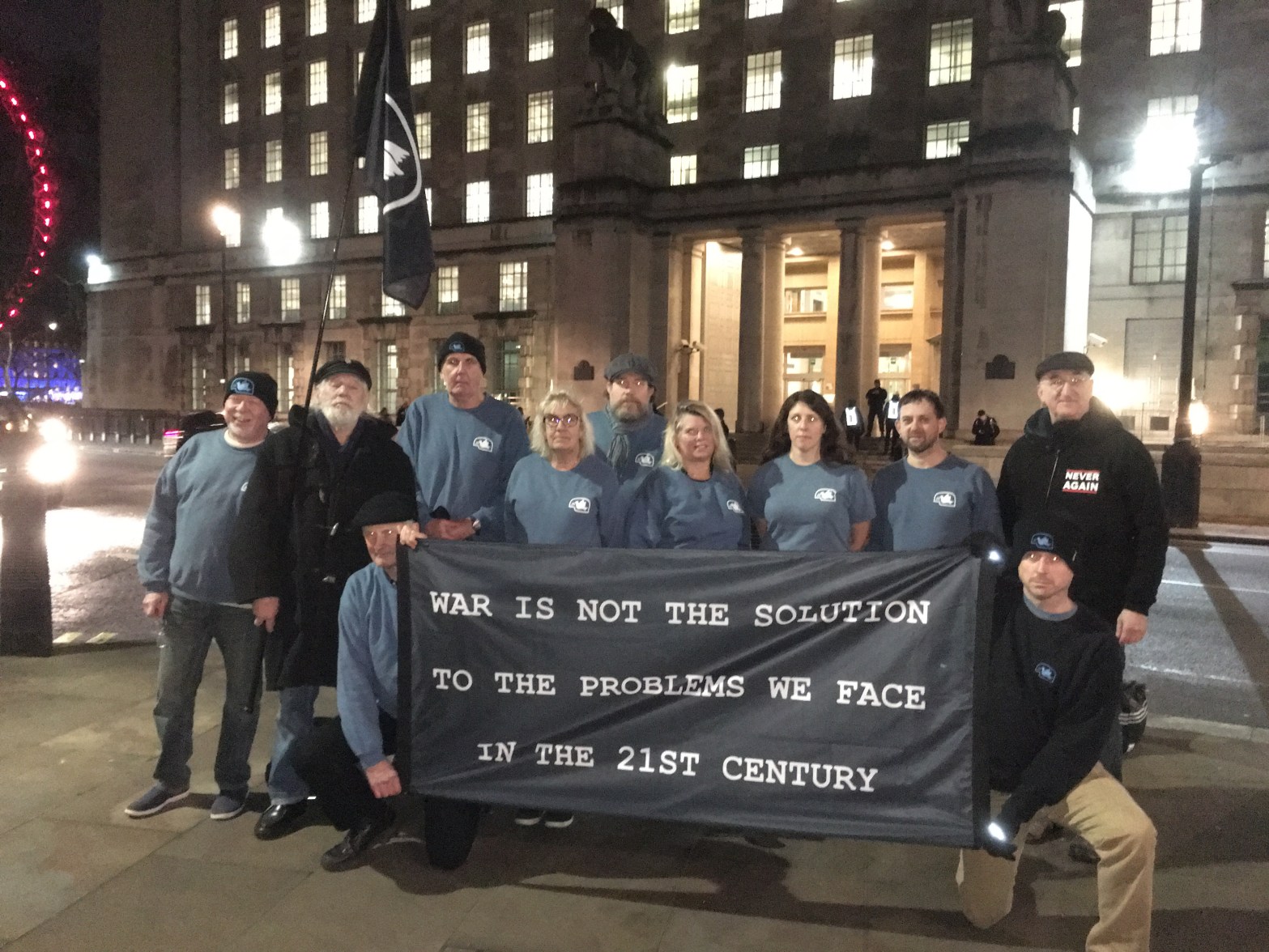
Today, 10 members of Veterans for Peace UK staged a silent protest outside the 2019 DSEI arms trade fair. The aim was to turn our backs on people attending the arms fair while wearing VFP Blue so that people attending could read the message on the back of our VFP sweatshirts and T-Shirts where the words are clearly printed – “War is not the solution to the problems we face in the 21st Century.”

After an informal briefing near Canning Town Station, we boarded a DLR train to Custom House Station. Here we formed a line at the side of the tube entrance to the Arms Fair. DSEI (Defence and Security equipment International) holds this event in London once every 2 years.

As stated on their website, DSEI is – “The world leading event that connects governments, national armed forces, industry thought leaders and the global defence & security supply chain on an unrivalled scale. With a range of valuable opportunities for networking, a platform for business, access to relevant content & live-action demonstrations, the DSEI community can innovate, share knowledge, discover & experience the latest capabilities across the Aerospace, Land, Naval, Security & Joint domains.” (Source: https://www.dsei.co.uk/).

What the website doesn’t say is that they are there to sell weapons, some which are (or at least were 2 years ago) in defiance of the Arms Trade Treaty (See: https://www.armscontrol.org/factsheets).

One of the aims of Veterans for Peace UK, as stated in our handbook (Section 2c.), is to work to end the arms race. Despite the interferance of DLR staff who tried to move us on (the police informed them that we were doing nothing wrong – much to our surprise!) the protest went ahead and was clearly seen by many hundreds of arms trade delegates.

We hope that our presence planted at least a few seeds in the attendees minds. Thank you to all members that made the effort to attend.

VFP LONDON: GUIDED WALK “WOMEN IN WAR”

Date: Wednesday 21 August
Time: 1900hrs
Location: Portcullis House, Westminster,  SW1A 2JR

If you missed the walk back in April this is another chance to attend this guided walk led by VFP James Florey. Taking in locations revealing the history of British women and their wide ranging interaction and involvement with war.

Meet outside Portcullis House to begin the walk at 1900hrs (junction of Westminster Bridge and Victoria Embankment) .

VFP members to wear VFP blue.

The walk is open to the public, unfortunately the route of one mile is not wheelchair friendly.

Phone Inquiries: James Florey 07709 855175
Email Inquiries: Julio Torres southeast@vfpuk.org

COSTS OF WAR: PETERLOO

Two hundred years ago in Britain the industrial revolution was transforming manufacturing, but also producing a slum living environment and inhumane working conditions in the new mills and factories. Fewer than 2% of the population had the vote and, up and down the country, there were occurring mass popular meetings calling for parliamentary reform. On August 16th 1819, four years after the battle of Waterloo that had defeated ‘Boney’ (Napoleon Bonaparte), a crowd of 60,000 people gathered at St Peter’s Field in Manchester to hear a reforming speech from Henry ‘Orator’ Hunt.

Three local magistrates, two of whom were Clerics, ordered the local Manchester and Salford Yeomanry Cavalry to arrest the speaker and these civilian troopers, backed by the regular army 15th Hussars, drew their sabres and charged the crowd, leaving an estimated 18 dead – including 4 women and a child – and some 700 injured. Samuel Bamford, the weaver-poet, who had taken part in the protest, spoke-out about what he had seen:

‘Sabres were plied to hew a way through naked held-up hands and defenceless heads; and then chopped limbs and wound-gaping skulls were seen and groans and cries were mingled with the din of that horrid confusion.’

John Lees died three weeks later from the injuries he sustained at St Peter’s Field. He had joined the army at 14-year-of-age and at 17 had been one of the British Army ‘heroes’ who had fought at Waterloo to defeat ‘Boney’. Lees then left the army and returned to Oldham in Lancashire and his old job as a cotton spinner. A number of witnesses stated that John Lees was sober and had offered no violence as the troopers attacked him.

Ironically, it is probable that this Waterloo veteran had his mortal wounds inflicted by his former comrades in arms, the 15th Hussars, some of which were proudly wearing their Waterloo medals as they charged the crowd:

‘Before he died John Lees said he was never in such danger at Waterloo as he was at the meeting, for at Waterloo it was man to man but at Manchester it was downright murder. He was not alone in that assessment. Other people seized upon the presence of Waterloo veterans such as himself in the unarmed crowds, and upon the actions of the 15th Hussars … [and] the savage sobriquet “Peterloo” was bestowed.’
[The Peterloo Massacre, by Joyce Marlow, Panther Books 1971].


Control & Struggle

Many centuries before in England, the early Norman monarchs had ruled with a curia regis (royal court), but in the 13th century the barons had challenged the royal ‘divine right’, demanding that the king’s rule be subject to the ‘common council’ of the realm. Their Magna Carta, however, was only intended to allow the barons a say in decision-making – and the ordinary people, or peasants as they were called, were not included.

There were frequent indigenous revolts against the feudal ‘Norman Yoke’, especially against serfdom, excessive taxes, and a corrupt judicial system. Another issue was the dispossession of the poor from public land by an aristocracy who were intent on securing large estates for private profit. In England, the ancestral memory of this resistance has become embodied in folk legends like Robin Hood.

In 1381 workers and peasants from Kent and Essex revolted against a new poll tax and marched on London. John Ball, a radical priest, questioned why there should be lords and vassals by asking: ‘When Adam delved and Eve span, who was then the gentleman?’ Ball then told the rebels:

‘Good friends, matters cannot go well in England until all things be held in common; when there shall be neither vassals nor lords; when the lords shall be no more masters than ourselves’.

Some tax collectors and nobles were assassinated, but the revolt was suppressed after its leader, Wat Tyler – who was a former soldier in the king’s army – was killed. John Ball was captured and hung, drawn and quartered, but the poll tax was removed.

The Tudors, who ruled through a coterie of royal appointed advisors and administrators, then set England on the road to a centralised – and London, the merchant capital, dominated – strong state. Parliament, which gradually evolved with a House of Lords and the House of Commons in the Palace of Westminster, was at first only called to gain public support for the monarch’s will on matters of national importance. As it evolved, however, parliament threatened to become an alternative form of rule and its victory in the English Civil War opened the way for the domination of emerging capitalism.

Oliver Cromwell’s semi-revolution did break ‘the divine right of kings’, but the following suppression of the Levellers and Diggers ensured that a new elite emerged and dominated. The Levellers, who had fought with Cromwell, had attempted to bring real democracy to England and among their aims and aspirations was to see a broadly based government elected annually on democratic principles.

The Levellers had also wanted Parliament to become a debating and decision-making forum for all the people. Their defeat, by Cromwell, ensured that Westminster instead became a chamber where new establishment factions, with their vested interests, ironed out their differences and then took decisions and made laws that maintained their control and increased their wealth. After Cromwell’s death, these forces made an accommodation with the defeated monarchy and aristocracy – forming a ruling elite who have controlled the life of the nation ever since.

Before the English Civil War, the church and monarchy had determined most people’s lives and afterwards the state gradually assumed the pre-eminent role. The constitutional monarchy, which emerged from 1688, had little to do with democracy and everything to do with keeping power in the hands of the merchants, financiers, land owners and the aristocracy. Those that fought for the rights of the ordinary people, like the Levellers and Diggers, were hunted down and repressed:


The Threat of Revolution

Towards the end of the 18th century Britain’s ruling-class faced revolutions abroad and unrest at home, which proved the greatest threat to their power since the Levellers. In 1781, as an army band played ‘The World Turned Upside Down,’ defeated British solders had marched out of their Yorktown encampment in Virginia and surrendered their weapons. Some of the victorious Americans
thought that many of the British soldiers were drunk, because they ‘were disorderly and unsoldierly’ and ‘their step was irregular and their ranks frequently broken’.

Eight years after the colonial revolt in America, which resulted in the loss of that colony, the Bastille was stormed and the French Revolution of 1789 with its slogans, ‘Liberty, Equality, Fraternity,’ inspired a rapid spread of democratic ideas throughout Europe and the world. William Wordsworth, who had lived in France at the start of the Revolution, recollected the mood of those times in these lines from his poem ‘The Prelude’:

‘Bliss was it in that dawn to be alive,
But to be young was very heaven’.

Tom Paine, who had supported America in its fight for independence from Britain and the upsurge in France, wrote ‘Rights of Man’ in support of the two revolutions:

‘Never did so great an opportunity offer itself to England, and to all Europe, as is produced by the two Revolutions of America and France. By the former, freedom has a national champion in the western world; and by the latter, in Europe. When another Nation shall join France, despotism and bad Government will scarcely dare to appear. To use a trite expression, the iron is becoming hot all over Europe. … The present age will hereafter merit to be called the Age of Reason, and the present generation will appear to the future as the Adam of the new world.’
[Rights of Man, by Thomas Paine,
London 1791].

Paine, who had also condemned England for cruelty towards East Indians, American Indians and African slaves, championed national independence, popular rights and revolutionary war. In ‘Rights of Man’ he stated:

‘When the Governments of Europe shall be established on the representative system, Nations will become acquainted, and the animosities and the prejudices fomented by the intrigue and artifice of Courts will cease. The oppressed soldier will become a freeman; and the tortured sailor, no longer dragged along the streets like a felon, will pursue his mercantile voyage in safety.’
[Rights of Man, by Thomas Paine,
 London 1791].

The French Revolution had shown that the old order could be overthrown. Paine’s writings, in the tradition of the Levellers, supported this sentiment. In England, he was condemned for ‘treason’ and his book was promptly banned:

‘Paine was not writing academic exercises: he was calling the dispossessed to action. The Levellers had proclaimed the rights of man in the English Revolution, and were promptly suppressed. Paine wrote in a situation little less revolutionary, and potentially far more dangerous to the ruling class. The most enthusiastic response to the French Revolution came from the victims of the industrial revolution, the small craftsmen and the uprooted countrymen – just those classes among whom the tradition of lost rights lingered longest. To them the rights of man furnished a telling criticism of the constitution from which they were excluded. The tramp of their feet and the mutterings of their illegal discussions is the essential background to Paine’s writings. Despite savage repression, although men were sent to jail for selling it, 200,000 copies of Rights of Man were distributed: a circulation beyond the Levellers’ wildest dreams.’
[Puritanism and Revolution, by Christopher Hill, Panther 1968].

The apprehensive authorities in London then set about constructing an efficient spy network. The Home Office’s Alien Office, originally set up to keep tabs on refugees from revolutionary France, gradually expanded until it was running agents across Europe, including in Britain and Ireland. Information from spies, informers, Bow Street Runners, watchmen, the Customs and the Post Office opening of mail was systematically collected – and regularly used to launch state repression and the activities of agent provocateurs.

The ‘Great Mutiny’ in the Royal Navy

In 1795, six years after the storming of the Bastille in Paris, crowds in London mobbed King George III in his carriage as he rode down Whitehall. This was no show of affection, as his coach was stoned and rocked, the king heard the crowd chanting ‘Peace!’ ‘Bread!’ ‘No War!’ ‘No King!’ A shot was also fired at the king’s coach and some windows of the prime minister’s house in Downing Street were broken.

William Pitt’s Tory government then extended the treason laws to include the articulation of republican philosophy and banned mass meetings. Two years later, in 1797, Royal Navy ships at anchor at Spithead and the Nore hoisted blood red flags. This was normally the signal that ships were about to engage the enemy – but in this case indicated a mutiny that included almost the entire fleet.

This revolt of the ‘Floating Republic’ was not surprising as many seamen were forced into service by press-gangs and treated like prisoners once on board a ship. Under savage discipline, they endured abominable conditions and were often owed large sums of back pay. Many of the sailors who died during the war against revolutionary France, lost their lives from disease or accidents on the large but cramped warships.

Richard Parker was elected President of the ‘Floating Republic’ and he and the delegates from the ships produced a statement to explain their predicament and their subsequent actions to their ‘Fellow-subjects’:

‘Countrymen, it is to you particularly that we owe an explanation of our conduct. His Majesty’s Ministers too well know our intentions, which are founded on the laws of humanity, honour and national safety – long since tramped underfoot by those who ought to have been friends to us – the sole protectors of your laws and property.
The public prints teem with falsehoods and misrepresentations to induce you to credit things as far from our design as the conduct of those at the helm of national affairs is from honesty or common decorum.

Shall we who have endured the toils of a tedious, disgraceful war, be the victims of tyranny and oppression which vile, gilded, pampered knaves, wallowing in the lap of luxury, choose to load us with?
Shall we, who amid the rage of the tempest and the war or jarring elements, undaunted climb the unsteady cordage and totter on the top-mast’s dreadful height, suffer ourselves to be treated worse than the dogs on London Streets?

Shall we, who in the battle’s sanguinary rage, confound, terrify and subdue your proudest foe, guard your coasts from invasion, your children from slaughter, and your lands from pillage – be the footballs and shuttlecocks of a set of tyrants who derives from us alone their honours, their titles and their fortunes?
No, the age of Reason has at length revolved. Long have we been endeavouring to find ourselves men. We now find ourselves so. We will be treated as such.

… You cannot, countrymen, form the most distant idea of the slavery under which we have for many years laboured. Rome had her Neros and Caligulas, but how many characters of their description might we not mention in the British Fleet – men without the least tincture of humanity, without the faintest spark of virtue, education or abilities, exercising the most wanton acts of cruelty over those whom dire misfortune or patriotic zeal may have placed in their power – basking in the sunshine of prosperity, whilst we (need we repeat who we are?) labour under every distress which the breast of inhumanity can suggest …’
[The Great Mutiny, by James Dugan, A Mayflower Paperback 1970].

This communication was intercepted by the Admiralty and kept secret from the public. The mutiny was put down with Richard Parker and 29 other ‘ringleaders’ hanged and many other seamen flogged or jailed. But afterwards, pay and conditions for sailors were improved; this became the authorities formula for handling soldiers and sailor’s unrest – savage repression followed by a few limited concessions.


The United Irishmen

In Ireland, by 1798, the numbers of British forces had risen in a few years from around 14,000 to over 80,000, many in yeomanry and militia units. The reason for this expansion of troops was the emergence of the United Irishmen, who were known to have links with revolutionary France and to be intent on uniting the Irish people and creating a free and independent Ireland.

Many of the Scottish settlers who had flooded into the north east of Ireland from 1609 were Presbyterians. They had also suffered from oppressive landlords and experienced religious discrimination under the Anglican establishment. Some Presbyterians formed their own secret societies to fight back, but they did enjoy some privileges over the native Irish, with their land rights protected by the ‘Ulster Custom’ system of tenure.

A linen industry was also allowed to develop, which gave rise to a prosperous business class. These descendants of the settlers, who had now been in Ireland for generations and regarded themselves as Irish, had developed their own cultural and economic interests, which were different not only from the native Irish but from the English establishment also.

Extensive numbers of Presbyterians had already moved on from Ireland to America, where many had volunteered to join with other colonists to declare, then fight and win, their independence from Britain. Protestant United Irishmen similarly wanted to be rid of British imposed economic restrictions and corrupt political rule. The movement’s leader, Theobald Wolfe Tone, stated that his aims were:

‘To subvert the tyranny of our execrable government, to break the connection with England, the never-failing source of all our political evils and to assert the independence of my country – these were my objects. To unite the whole people of Ireland, to abolish the memory of all past dissensions and to substitute the common name of Irishmen in place of the denominations of Protestant, Catholic and Dissenter – these were my means.’

Many Presbyterians and Dissenters (non-conformist Protestants with a strong anti-authoritarian tradition) now supported the United Irishmen. This situation, however, created a dilemma for many of the descendants of the settlers in Ireland, who had been planted in the country to keep it safe for English rule. Tone wanted to resolve their contradictions in a progressive direction and gain Ireland’s independence by uniting them with the native Irish. For a short period, Belfast became a revolutionary centre. On the streets, enthusiastic supporters of the French Revolution had celebrated the fall of the Bastille with parades and flags.

As support for the United Irishmen grew, the city became a haven of enlightenment and religious toleration. Thomas McCabe, a United Irishman who was also a Belfast jeweller, persuaded local businessmen to give up the chance to take part in the slave trade:

‘In 1786, some of Belfast’s richest merchants met to discuss ways in which to become involved in the lucrative British slave trade. As they prepared to sign a document forming a slave-trade company, they were interrupted by McCabe: “May God wither the hand and consign the name to eternal infamy of the man who will sign that document.” The threat worked. Unlike Bristol and Liverpool, Belfast was not drawn into the slave trade.’
[The New Internationalist, No. 255 / May 1994, Article ‘The Riotous and the Righteous,’ by Bill Rolston].

General Lake, the commander of the British forces, said: ‘Belfast ought to be proclaimed and punished most severely as it is plain every act of sedition originates in this town.’

Repression at Home and Abroad

The British authorities then took steps to curb the United Irishmen, closing their papers the Press and the Northern Star, and declaring such publications ‘illegal’. Martial Law, under the 1797 Insurrection Act, was enacted in Ulster and British troops were used to attempt to pacify the country and suppress the United Irishmen:

‘As early as March 1793, General Richard Whyte encouraged his troops, his “charming boys” as he called them, to go on the rampage through Belfast attacking the homes and business premises of known radicals and beating anyone who got in the way. “There are no lives lost” reported Whyte, “but many marks of the sharp edge of their sabres.”
[Indiscipline and Disaffection in the armed forces in Ireland in the 1790s, by Thomas Bartlett, 1985].

Many ‘troublemakers’ were arrested and deported to the colonies or forced to join the Royal Navy. During the protest actions at Spithead and the Nore some 15,000 sailors were Irish – many were former United Irishmen, impressed into the navy, who enthusiastically joined in the mutiny.

In Scotland, the Friends of the People Society and later United Scotsmen societies, organised radical opposition to the establishment status-quo. But the leaders, including Thomas Muir of Huntershill, were arrested and tried for ‘sedition’ or ‘high treason.’ Muir was sentenced to fourteen years’ transportation to Australia. Robert Burns, meanwhile, tried to keep the radical tradition alive through poems like: ‘The Tree of Liberty’ and ‘A Man’s a Man for a’ That.’

In ‘Thanksgiving For a National Victory’ Burns expressed sentiments that could have been about wars in our own time:

Ye hypocrites! are these your pranks?
To murder men, and give God thanks?
Desist, for shame! Proceed no further:
God won’t accept your thanks for Murder!

There was close contact between revolutionary organisations in Britain and those in Ireland. Muir was made an honorary member of the United Irishmen and, in 1792, the Address of the United Irishmen of Dublin to the English Society of the Friends of the People suggested how the future relationship between Britain and Ireland could be created:

‘As to any union between the two islands, believe us when we assert that our union rests upon our mutual independence. We shall love each other if we be left to ourselves. It is the union of the mind that ought to bind these nations together’.

In Ireland, the military authorities were becoming concerned about the increasing evidence of support among the militias for the United Irishmen. At Blaris barracks, near Lisburn, County Antrim, four men from the Monaghan militia were shot after a court martial. The men, Daniel Gillan, Owen McCanna, William McCanna and Peter McCarron were alleged to have made contact with the United Irishmen and to have organised a secret officer structure within their unit. The rest of the soldiers were ordered to witness the executions and to march past the bodies afterwards.

Britain’s rulers had found that holding onto empire often proved more difficult than conquering it in the first place. Gradually strategies, that later would become known as counter-insurgency, were developed. One of these was to harass freedom movements and force them into premature rebellion, which could then be crushed by the superior state forces. Another was the old favourite – divide and rule – and so, in Ireland, the sparks of segregation lit during the plantations were now used by the establishment in attempts to ignite the smouldering animosities between the native Catholics and the descendants of the Protestant settlers.

Predominately Protestant militias were used against Catholic areas, which supported the United Irish, and vice versa. The anti-Catholic Orange Order was formed in 1795 and General John Knox, an Ulster landlord who like Lake advocated taking a hard-line, said that his military operations were designed ‘to increase the animosity between the Orangemen and the United Irishmen … Upon that animosity depends the safety of the centre counties of the North’.

The authorities then helped to arm the Orange Order and encouraged its members to join the state forces. Local ‘loyal’ armed forces of Yeomanry were formed and used to attack the United Irishmen.

In Britain similar units were formed to protect the rich and suppress the poor:

‘The Yeomanry, a mounted force drawn from the upper and middle classes, were created at the beginning of the French wars. Quite useless from a military point of view, the yeomanry was, and was intended to be, a class body with the suppression of “Jacobinism” as its main objective. This objective they pursued with an enthusiasm and an unfailing brutality which earned them universal hatred.’
[A Peoples History of England, by A. L. Morton, Seven Seas 1965].

In Ireland, like at Peterloo, the Yeomanry quickly earned a reputation for cruelty and barbarism as they were used against the United Irish and the population of areas thought to be supporting them.

Rebellion and Defeat

In early 1798 Ireland stood on the edge of rebellion, waiting for the arrival of the French troops, which ‘Boney’ had promised to Wolfe Tone. British attempts to crush the United Irishmen intensified, with hangings, floggings, pitch-cappings, incarcerations and killings becoming commonplace. The authorities were determined to cow the movement into submission – or force it into an early rebellion before the French arrived:

‘In March 1798 the British authorities extended the repression southwards to the province of Leinster. They first arrested the United leaders, then unleashed a systematic terror against the peasantry, burning houses and farms, aiming to terrify them into giving up their weapons. Unable to wait any longer for the French to arrive, and facing a choice of rebellion or being destroyed, some 100,000 people rose in revolt in May and early June 1798.
They rose first in the midlands and southwest, and were followed by the Presbyterians of Antrim and Down. In some places it was as if the whole countryside was on the move. … But within weeks the rebellion began to collapse, overcome by the lack of central organisation, the failure of the French to arrive, and the superior military force of the opposition. At the end of August 1,000 French troops led by General Humbert … landed in Killala, County Mayo. They won some initial victories … but they were too few and too late. The peasantry in much of the country were already crushed.’ [The Cause of Ireland, by Liz Curtis, Beyond the Pale 1994].

Another wave of savage repression followed the defeat of the United Irishmen. Tone was captured and died in prison, with his throat cut, while awaiting public execution.

In the American Revolution the radicals, who had helped initiate it, were marginalized and revolutionary principals – like ‘all men are created equal’ and that the purpose of government was to safeguard these rights – while still being voiced, were never to be fully implemented. Instead, those representing land and business interests took control and under George Washington, a major landowner, the fight was then fuelled by land-hunger and the business opportunities it was thought would accrue if British rule, taxation and restrictive laws were removed. Afterwards, the exploitation of black slaves persisted and the extermination of the native American Indians – and the taking of their land – continued apace.

Like the revolutions in America, France and in the English Civil War, the United Irishmen were composed of a variety of forces with differing motives. The radicals wanted all of Irish society to be reorganised in a democratic way, but others were motivated by hoped for business opportunities. The latter were often inclined to give up in the face of repression and some even changed sides, while the former were inclined to fight to the bitter end and often paid the supreme sacrifice for their temerity.

In 1803, a second rising was launched in Dublin but was soon crushed and the rebel leaders, including Robert Emmet, were executed. Thomas Russell, a former British Army veteran who had served in India, had been a close friend of Wolfe Tone. He was known to be one of the most socially radical Protestants among the United Irish and was detained for 6 years after the first uprising.

After he was released in 1802, Russell, as the Ulster commander, worked with Emmet towards a second uprising. Thomas Russell appeared all over the country covertly organising and promoting revolt, until he was arrested, tried and hanged at Downpatrick in October 1803. But his memory lives on as: ‘The Man from God-knows-where’:


The Enemy Within

Also in 1803, a few months before Emmet and Russell were hanged, Colonel Edward Despard and 6 guardsmen were executed in London, after being found guilty of ‘high treason’. A government spy later claimed that at one time 200 armed soldiers had been ready to launch a coup in the capital. Despard had been a member of the London Corresponding Society (LCS), which in 1798 had appealed to soldiers in Ireland to refuse to act as ‘Agents of enslaving Ireland’.

The LCS went on to say that they sympathized with Irish suffering and stated that:

‘When a People once permits Government to violate the genuine Principles of Liberty, Encroachment will be grafted upon Encroachment; Evil will grow upon Evil; Violation will follow Violation, and Power will engender Power, till the Liberties of ALL will be held at despotic command …’

Ireland had proved a productive laboratory for the development of colonial tactics and repressive methods. The subsequent process of conquest and colonisation around the world made fortunes for those who promoted and controlled it, by plundering natural resources and exploiting native work forces. Those who profited also ensured that laws were enacted back home that allowed British workers to be exploited in a similar way:

‘The great power of the state and the employing class was brought to bear against any attempt by working men to organise to protect their position. In 1719 workmen (but not inventors) were forbidden to take their skills into another country. By an act of 1726 combinations of workers were severely repressed: fourteen years transportation for using violence in labour disputes, death for wilful machine-breaking. But employers had the right to combine, “with the utmost silence and secrecy,” says Adam Smith, to “sink the wages of labour”. … In 1719, when the keelmen of Newcastle struck for higher wages, a regiment of soldiers and a man-of-war were sent to answer them’. [Reformation to Industrial Revolution, by Christopher Hill, 1967].

As the army fought rebellion in Ireland and the French in Europe, the Industrial Revolution, bankrolled by money made from slavery, was to provide a new internal role for the troops. As wool earned huge profits, landowners started turning tenants off the land to make way for sheep and new laws were allowing more and more sections of ‘common land’ to be enclosed.

This greatly increased poverty in the countryside and farm workers joined handicrafts people, who had lost their livelihood to the new methods of production, and others fleeing starvation, including Irish emigrants, to crowd into the disease-ridden industrial towns. There, they were exploited mercilessly by the new captains of industry, who required a plentiful supply of cheap labour for their mines, mills and factories. On starvation wages adults worked long hours in terrible conditions, while children, male and female and as young as seven, were even cheaper to hire and were forced to labour a 15-hour-day.

When efforts were made to better conditions Pitt’s Tory Government brought in the ‘Combinations Laws’, which banned workers from forming trade unions. Inevitably, food riots, machine wrecking and strikes became widespread and by 1812 there were 12,000 soldiers occupying the disturbed counties of Nottinghamshire, Lancashire and Yorkshire:

‘For weeks whole districts on the Lancashire-Yorkshire border were virtually under martial law. And one military command, in particular, established a reign of terror, with arbitrary arrests, searches, brutal questioning, and threats, for which we must turn to Irish history in search of a comparison.’
[The Making of the English Working Class, by E. P. Thompson].

Making Soldiers Deaf

Inside Britain, soldier sometimes sided with the people and government agents repeatedly told of links between soldiers and sailors and revolutionary organisations. In 1795, soldiers were reported to have been the ‘abettors of food rioters’ in Devonshire and in 1800 the Oxfordshire Blues were thanked by the people of Nottingham for their sympathy for the rioters.

In 1816 a Home Office informant said he heard a soldier tell his friends in a pub in Rowley about a letter from his unemployed father who was starving with his family:

‘Charging him if any riot took place in this country for want of work not to hurt none of them. But if compelled to fire, either to fire over their heads, or to shoot the Tyger that gave the order, and to persuade all his comrades to do the same’.

Until 1793, when Britain joined the war against revolutionary France, soldiers stationed in England were billeted among the people in houses and inns. The only barracks were in garrison towns and fortresses. Pitt, the Tory Prime Minister, arguing for a policy of covering the manufacturing districts with barracks, said:

‘The circumstances of the country, coupled with the general state of affairs, rendered it advisable to provide barracks in other parts of the kingdom. A spirit has appeared in some of the manufacturing towns which made it necessary that troops should be kept near them’.
[Parl. Debates, House of Commons, Feb. 22nd, 1793].

In another debate, a few years later, the building of barracks was defended as a means of isolating the soldiers from the people:

‘The Government should act on the maxim of the French comedian: “If I cannot make him [the people] dumb, I will make you [the soldiers] deaf”.’
[Parl. Debates, April 8th, 1796, speaker W. Windham].

After taking up this idea, one hundred and fifty-five barracks had been built by 1815. They were damp and cold with overcrowded living conditions for the soldiers. Life for recruits was to be as harsh and brutish as the buildings in which they were billeted:

‘Once he had taken the Queen’s shilling, the recruit was tamed and cowed into submission by savage drill and remorseless bullying by non-commissioned officers, and the process of “breaking” men, often of poor physique and low health standards, coupled with unhealthy living conditions, gave the army a death-rate many times higher than that of the civilian population. … The common punishment for even the smallest misdemeanour was “pack-drill”, often imposed so ferociously and for so long that the victim was reduced to a state of complete exhaustion. … Deserters were flogged and then branded with gunpowder massaged into the flesh to ensure that the letter ‘D’ remained indelible’.
[Colonial Small Wars 1837-1901, by Donald Featherstone, 1973].

The use of barracks, coupled with cruel discipline and indoctrination, helped to separate soldiers from the feelings of the population. The Army now proved to be an effective instrument for the suppression of popular movements at home. The historian, Professor George Rudé, looked at over a century of popular protests and their suppression by the state forces:

‘From my (no doubt) incomplete and imperfect record of the twenty odd riots and disturbances taking place in Britain between the Edinburgh Porteous Riots of 1736 and the Great Chartist demonstration of April 1848, I totted up the following score: the crowds killed a dozen at most; while, on the other side, the courts hanged 118 and 630 were shot dead by troops’.
[Paris and London in the Eighteenth Century, by G. Rudé, 1970].

Waterloo and Peterloo

In France, the revolution had swept away the monarchy, feudal oppression and fiscal mismanagement – and helped spread democratic ideas across the world. But from the start it had been beset by outside opposition and internal factionalism, which descended into large-scale bloodletting – the terror. Towards the end of the 18th century, the revolutionary leaders, seeking to stem the chaos and terror, began to rely on the army for a measure of stability.

Taking advantage of this situation, Napoleon Bonaparte, then an army general, seized power in a coup d’état. Bonaparte then set France on 15 years of military rule and led the French Army on a course of aggressive imperialism that would see it win many battles and come to dominate much of continental Europe. Britain had been prominent in the opposition to the French revolution and continued that stance against Bonaparte and his French forces, fighting them on
land and at sea.

The decisive battle of the Napoleonic Wars occurred on 18th June 1815, as the armies of the competing imperial powers met at Waterloo. Afterwards, the defeated ‘Boney’ was captured and exiled on the remote island of Saint Helena, in the southern Atlantic Ocean. He died there at the age of 52 on May 5, 1821.

Although there was mass public outrage in Britain after the Peterloo massacre, including sympathy expressed for the victims in some papers, the Tory Government backed the magistrates by implementing new legislation giving them even greater powers. Under the Six Acts, magistrates could: Summarily convict political suspects; Prevent arms training; Search anywhere and Ban meetings. An increased tax was also put on newspapers and radical journals faced drastic penalties for ‘blasphemy and sedition’.

The following year, in April 1820, there occurred a radical revolt in Scotland, when members of Workers’ Union Societies and Radical Committees armed themselves and issued the proclamation of a ‘provisional government’ in Glasgow. The rising was put down and three of its leaders executed. Two of them, Andrew Hardie and John Baird, were army veterans, who had organised a band of armed followers and led them into battle against Yeomanry and 10th Hussars cavalry at Bonnymuir.

Fifteen years later, in 1835, John Wade’s ‘The Extraordinary Black Book – an Exposition of Abuses in Church and State’ stated about the MPs of that time:

‘It is apparent that the vast majority were connected with the Peerage, the Army, Navy, Courts, Law, Public Offices and Colonies. And, in lieu of representing the people, only represented those interests over which it is the constitutional object of a real House of Commons to exercise a watchful and efficient control’.

Ironically, something similar to Wade’s ‘Extraordinary Black Book’ could be written today, as this modern take of the old song ‘The Hard Times of Old England’ shows:


The Struggle Continues

In Britain and Ireland, the suppression of the democratic ideals thrown up by the French Revolution culminated in the defeat of the United Irishmen. The British ruling class survived this revolutionary period by utilising all the means at their disposal. In 1815 at Waterloo the British establishment had finally defeated their greatest external enemy on the continent of Europe; four years later, in 1819, they attacked their enemy within at Peterloo.

To maintain their dominance and control, they unleashed a wave of repression, augmented with draconian laws, spies, informers and agent provocateurs. Police forces in Ireland and Britain were initiated and the army and navy reorganised, with establishment control over all the state forces strengthened. In Britain, in 1824, the Vagrancy Act was decreed to: ‘act for the punishment of idle and disorderly persons, and rogues and vagabonds.’

Actually, it was enacted mainly to deal with the problems that were occurring in England following the Napoleonic Wars, as large numbers of soldiers were discharged on to the streets with no job and no accommodation. The Act, which made it an offence to sleep on the streets or to beg, is still in force – although, it has been amended several times by later legislation.

In our own time, in the second half of the1900s, Britain, again fighting a war in the north of Ireland, also defeated an Argentine invasion force on the Falklands. And many homeless veterans were again on the streets, liable to be prosecuted under the Vagrancy Act. This has happened again and again down the centuries, as youngsters are recruited, then trained and indoctrinated and sent to fight in wars overseas. Afterwards, often suffering from physical and mental wounds, they are left to fend for themselves in Civvy Street – as abandoned cannon fodder.

From the early days of Empire, both at home and abroad, Britain’s establishment had its ‘old boy’ system to help perpetuate its power and control. In the early 1970s, a survey of Britain’s elite found that a large percentages were still ‘old boys’ from public schools:

Army – 86% of officers of the rank of major-general and above.
City – 79.9% of directors of clearing banks.
Church of England – 67.4% of assistant bishops and above.
Judiciary – 80.2% of high court judges and above.
Ambassadors – 82.5% of heads of embassies and legations.
Civil Service – 61.7% of under-secretary level and above.

In 1979, of Margaret Thatcher’s first Tory Cabinet, 19 of the 21 ministers were public school old boys, 6 had been at Eton. Leading up to the Falklands War, opinion polls had shown Margaret Thatcher to be one of the most unpopular Prime Ministers ever. After the ‘great victory’ of the British forces over ‘the Argies’, her popularity soared, allowing her to call a general election in 1983, which she won by a landslide.

The next year, 1984, the ‘old boy’ Tories then inveigled a fight against the strongest section of their enemy within – the miners. Vested interests still prevail and the late Tony Benn, when a Labour MP, explained how the system still controls us today:

‘The British Constitution works in a very subtle way to keep us in our place … And guarantee that the privileges of the powerful are protected from any challenge … The Crown, the Lords, the Honours List and all the paraphernalia of state power play an important part in preserving the status quo.

… We are not citizens, but subjects, for everyone in authority must, by law, swear an oath of allegiance to the monarch before taking up a position. MPs, Cabinet Ministers, peers, judges, police chiefs, and even arch-bishops and bishops, have to swear their homage to the Crown before they can be enthroned. All those in high office got there by an elaborate system of patronage, all done in the name of the Queen. The actual decision in every case is made by the Prime Minister or other Ministers, giving them immense and unaccountable political power.

The power to go to war is a Royal prerogative and Parliament does not even have to be consulted. … Compare a British subject with an American, French, German or Irish citizen and you will find they elect their head of state and both houses of their own parliaments. We are only allowed to elect one house of our Parliament while the Throne and the Lords are occupied by hereditary right of patronage.’
[Sunday Mail (Scotland), 21st April 1996].

There are similarities between Peterloo and the Bloody Sunday shootings of Civil Rights demonstrators in Derry in 1972. The two occasions had only occurred in the first place because people were being denied their basic rights. After both events, ‘Official Inquiries’ were quickly set-up, which cleared the authorities and the troops of any wrongdoing – and instead apportioned blame to those protesting.

Twenty-two years after Peterloo, in 1841, Charles Dickens, one of England’s greatest authors, wrote a satirical new version of the song ‘The Fine Old English Gentleman’ – which has been sung and adapted ever since:

Today, the media, mainly owned by moguls, still plays a key role in maintaining the status quo and in ensuring that only those who are friendly to the interests of big business will get near to the seat of power. We are faced, though, with the presentation of a more sophisticated deception of social equality, because on the surface it would appear that we live in a much more egalitarian society. We still have a long way to go, however, before we can claim that we live in a true democracy – even some of the demands made by the Levellers in the mid-17th century have still to be achieved.

Nowadays, the establishment still battles to maintain their control and fight against their enemies without and within. And we find our lives are increasingly dominated by the neoliberal economic and political agenda, with banks being bailed out with tax-payers money, while those who pay that tax face increasing austerity. In the background multinational companies make obscene profits – and often pay no tax – as the US led ‘New World Order’ forces itself on the rest of the world.

Meanwhile, Westminster Governments are subserviently backing this new market-led imperialism, passing acts and laws to placate the corporations’ requirements and sending our armed forces to fight wars for their benefit. Behind a facade of bourgeois democracy – which gives the illusion of democracy but none of its substance – the ruling class still maintain their supremacy by controlling the state apparatus, including all their forces of repression, as well as the two parliaments at the Palace of Westminster.


Information compiled and written by VFP member Aly Renwick, who served in the British Army for 8 years in the 1960s. His latest novel, Gangrene, is about how the neoliberal economic and political system came to dominance in the UK.

COSTS OF WAR: COUPS D’ÉTAT

Forty-six years ago, in 1973, Victor Jara was murdered after the military coup d’état in Chile that overthrew the country’s elected president, Salvador Allende. With the New Song movement, Jara was a popular Chilean guitarist and folk-singer who was rounded-up with thousands of others and imprisoned in the Chile Stadium. When Jara sang to keep up the spirits of the detainees, the military guards dragged him out and smashed the bones in both his hands, before shooting him dead.

In ‘Manifesto’, one of his last songs, Victor Jara sung about the essence of the New Song movement:

‘My guitar is not for the rich
no, nothing like that.
My song is of the ladder
we are building to reach the stars.
For a song has meaning
when it beats in the veins
of a man who will die singing,
truthfully singing his song.’

Last year the music magazine ‘Billboard’ published the following article:

‘Remembering Chilean Folk Singer Victor Jara 45 Years After His Murder Soldiers crushed his fingers to symbolically silence his guitar, and then shot him 44 times. They did not succeed in muting his music or his message. Victor Jara, was, in his words, a man “who will die singing the true truths.”

Jara was murdered in Chile on September 16, 1973. The 40-year-old folk singer was detained after the coup that placed dictator Augusto Pinochet in power, and, along with about five thousand university students, professors, activists and others was brought to Santiago’s Chile Stadium.

Soldiers crushed his fingers, stepping on his hands and smashing them with the butt of a gun, to symbolically silence his guitar, and then shot him 44 times. They did not succeed in muting his music or his message. His songs have been covered by numerous artists since his death, and he is an important influence on artists in Chile today, including Ana Tijoux and Gepe. Bruce Springsteen sang Jara’s song “Manifiesto” during a 2013 concert in Santaigo.

An estimated 3,200 people were killed and 28,000 tortured during Pinochet’s military rule, which ended in 1990. The details of Jara’s torture and death were revealed by a Truth and Reconciliation Commission created later that year by the new government of Patricio Aylwin. But it was not until July 2018 that eight former military officers were sentenced for killing Jara, to just 15 years each. The stadium where the artist was killed was renamed Victor Jara Stadium in 2004.

Victor Jara made a last statement in the stadium, which appeared, a year after his murder, in the album Manifiesto [Canciones Póstumas]. Joan Jara translated the statement and here the English poet Adrian Mitchell reads it:

Britain and the US have a long history of interfering in other people’s countries, often carried out by invasions and occupation. Direct colonisation, however, was often costly to carry out and then run, so a new form of control, neo-colonialism, emerged. This involved the coloniser interacting covertly with reactionary indigenous forces to create regime change, which results in a pro-West local elite taking control.

Post-WW2, anti-communist hysteria became widespread in the West. The US had come through the McCarthy era, when even liberals were subject to ‘anti-red’ purges and forced to take ‘loyalty oaths’. In the UK in the late 1960s and into the 70s the Labour PM, Harold Wilson, was subjected to treasonable covert activity – by a plethora of clandestine groups set up by ex-military brass and retired intelligence officers and from elements in the Security Services – which included plots to overthrow him.

Abroad, the Cold War became hotter during the Korean War, 1950-53, the Cuban Missile Crisis, 1962, and the Vietnam War, 1955-75. In the 1960s, around the world there were over sixty attempts to engineer regime change that brought mainly reactionary regimes to power. There were more governments changed by military coups than by the ballot box.

The following are eight examples of British and US interference in other countries – in the twenty years from 1953 to 1973:

Iran
In 1953 the democratically elected Iranian Prime Minister, Mohammad Mosaddegh, was overthrown in a coup d’état. It was orchestrated by the intelligence agencies of the UK and the US to protect their oil interests. Declassified documents in the US describe how some of the most feared mobsters in Tehran were hired by the CIA to stage pro-Shah riots that helped the constitutional monarch, Mohammad Reza Pahlavi, to gain control. Backed by the military, under General Zahedi, the Shah then presided over an authoritarian pro-west regime until his overthrow in 1979.

Cuba
In 1960 the US unleashed Operation Mongoose against the Government of Cuba. It included economic warfare, psychological exercises and armed sabotage by CIA infiltrators. A number of assassination attempts were made on the life of the Cuban leader Fidel Castro by the CIA, including one with the collaboration of the mafia in the US. The Bay of Pigs invasion in 1961 by CIA-trained Cuban exiles was defeated after three days. All these plots ended in failure and Castro remained in power.

Democratic Republic of Congo
In 1961, Patrice Lumumba, the Democratic Republic of Congo’s first popularly elected Prime Minister, was deposed and later murdered in a coup organised by the CIA, with support from Belgium (the coloniser), France and the UK. Lumumba, like many of the other leaders deposed and murdered at this time, was a nationalist with leaning towards social justice, egalitarianism and human rights. To the US and others in the West, that made him a dangerous communist. The CIA station chief in the Congo urged that Lumumba be eliminated and channeled money and arms to the army Chief of Staff, Colonel Mobutu, who seized control as a military dictator and set up a totalitarian pro-West regime. His rule became notorious for corruption, nepotism and human rights violations that led to the country’s impoverished and war-torn state, which is still evident today – enabling the efforts of corporations in the West to plunder the republic’s abundant mineral assets.

Brazil
In 1964 the government of President João Goulart was overthrown in Brazil by the army Chief of Staff, General Humberto de Alencar Castelo Branco, in a coup instigated by the US. General Branco declared a state of siege and arrested some 50,000 political opponents, which the US welcomed with approval and by re-instating aid and investment.

Indonesia
In 1967 President Sukarno was forced from power in Indonesia and replaced by General Suharto. Sukarno’s overthrow had been attempted two years before, with an attempted military coup organised by the CIA. But some junior officers and the palace guard thwarted it, by killing six senior generals thought to be behind the coup. The military, aided by civilian right-wing gangs, then went on a spate of massacres against moderates and leftists. It has been estimated that somewhere between 500,000 to three million civilians were murdered. The lists of names of many of those killed had been passed to the death squads by US officials who: ‘Then checked off from their lists those who had been murdered’. With his followers decimated Sukarno was then overthrown.

Greece
In 1967 a group of right-wing army officers overthrew the elected government in Greece and brought in military rule. Arrests were made of anyone thought to be hostile to the coup, from lists prepared in advance. In the US critics of the coup included a Senator, Lee Metcalf, who criticised the Johnson Administration for providing aid to a: ‘Military regime of collaborators and Nazi sympathisers’.

Bolivia
In 1971 the President of Bolivia, Juan Torres, was overthrown in a coup led by General Hugo Banzer. After jailing, torturing and killing thousands of dissidents, the General was given extensive military and economic aid by the US. Torres fled the country, but was tracked down and assassinated in 1976 under Operation Condor, the US orchestrated campaign of state-terrorism in South America.

Chile
In 1973 the democratically elected President of Chile, Salvador Allende, was overthrown in a military coup d’état, organised by the CIA. It came after a period of economic and psychological warfare waged by the US, which caused political and social unrest. When the Chilean Army Chief of Staff, General René Schneider, indicated his loyalty to Allende, he was assassinated in a CIA operation. This left the way clear for General Augusto Pinochet to oust Allende and take control. Tens of thousands of political dissidents were rounded-up, imprisoned, tortured and many were ‘disappeared’.

After the coup in Chile, Adrian Mitchell wrote a poem to commemorate the life of Victor Jara. Arlo Guthrie then set the words to music, which are sung here by Dick Gaughan:

Victor Jara of Chile
He lived like a shooting star
He fought for the people of Chile
With his songs and his guitar
And his hands were gentle,
His hands were strong
Victor Jara was a peasant
He worked from a few years old
He sat upon his father’s plough
And watched the earth unfold
When the neighbours had a wedding
Or one of their children died
His mother sang all night for them
With Victor by her side
He grew to be a fighter
Against the people’s wrongs
He listened to their grief and joys
And turned them into songs
He campaigned for Allende
Working night and day
He sang, “Take hold of your brother’s hand
The future begins today”
The bloody generals seized Chile
They arrested Victor then
They caged him in a stadium
With five thousand frightened men
Victor stood in the stadium
His voice was brave and strong
He sang for his fellow prisoners
Until the guards cut short his song
They broke the bones in both his hands
They beat his lovely head
They tore him with electric shocks
After two long days of torture they shot him dead
Now the generals rule Chile
And the British have their thanks
For they rule with Hawker Hunters
And they rule with Chieftain tanks.

The last four lines of the poem / song – ‘Now the generals rule Chile / And the British have their thanks / For they rule with Hawker Hunters / And they rule with Chieftain tanks’ – highlights how dictators and despots, like Pinochet, are supported by the West with them being sold, or given, armaments and other military aid.

Victor Jara was only one of the hundreds-of-thousands of victims of coups d’état around the world, which were organised and supported by the UK and the US. These types of covert actions went on behind a curtain of radio, TV and newspaper misinformation, which was intended to justify the means, and obscure the reality, of what was happening. Similar events, and the accompanying media propaganda, are still going on today; but in the past Britain was a prime coloniser – now this country is a craven deputy to the US, who acts as the self-appointed world sheriff.


Information compiled by Veterans For Peace member Aly Renwick, who, in 1966/7, took part in the UK / SEATO Operation Crown in north-east Thailand, during the period of the US Operation Rolling Thunder mass bombings of North Vietnam and the Ho Chi Minh Trail in Laos.

RAMSTEIN PROTEST 2019

VFP UK and Ireland members attend international protest against US bases at Ramstein, Germany.

On the last weekend of June, Veterans For Peace gave solidarity to the German ‘Stopp Ramstein’ campaign (conference and demonstration), now in its 5th year.

Ramstein US airbase is the largest outside of the continental USA and is central to conducting UAV ‘drone’ strikes in the Middle East.

An estimated 5,000 protesters attended on Saturday, including delegates from the US, Italy, France, Switzerland, Ireland and the UK  who reported on the worldwide problems of US and NATO bases.

Dr John Lannon (Peace and Neutrality Alliance) from Limerick spoke about ‘Shannonwatch’ and the daily use of Shannon civil airport by United States military transports. He mentioned the two VFP members from the USA who have had their passports taken by the Irish court for their protest at Shannon airport in March.

Dr Dave Webb chair of CND GB from Leeds informed the conference about USAF bases in England and UK bases overseas, supported with materiel from VFPUK.

Pat Elder; World Beyond War from Maryland US, highlighted the environmental damage caused by US bases (more below).

Prominent German speakers included Oskar Lafontaine SPD elder statesman; Prof. Hubert Weiger president of the federation of environment and nature protection Germany and Emeritus Prof. Reiner Mausfeld Uni Kiel, Social Psychologist

This major theme from the German speakers was the environmental damage caused by US bases worldwide. Groundwater pollution is rife all around the Kaiserslautern military complex. Pat Elder mentioned that since 2014 poisonous extinguishing foams (PFCs) were used on Ramstein Air Base and other US airforce bases in the region. These are now contaminating lakes, rivers and the ground water in the region. In one river the contamination was 500 times higher than the safety limit of the European Union. These contaminations are linked to cancer and birth defects.

For more information about the Ramstein base please see: https://en.wikipedia.org/wiki/Ramstein_Air_Base


Compiled by VFP member Ged

WAR WITH IRAN IS NOT A SOLUTION

THURSDAY 20 JUNE 2019
1700HRS
MINISTRY OF DEFENCE LONDON

On Thursday 20 June in response to the suggestion of war with Iran members of Veterans for Peace deployed outside the Ministry of Defence building on Whitehall and displayed the banner “War is not the solution to the problems we face in the 21st Century“.

Since 2001 the United Kingdom has chosen to initiate and or particpate in a number of disastrous military interventions; Afghanistan, Iraq, Libya, Syria and Yemen. These interventions have cost untold billions of pounds and lead to the deaths of hundreds of thousands, life changing injuries to countless thousands, torture, the destruction of homes, infrastrutcture and the environment.

With politicians and the media now ramping up the ongoing tension between the USA/UK and Iran we say that the UK should in no way participate in another futile and destructive intervention in the Middle East.

Ramping up for war?

This week there have been two polar opposite statements from British politicians on the tanker attacks in the Straits of Hormuz which have been attributed to Iran by the USA and the UK:

“….Britain should act to ease tensions in the Gulf, not fuel a military escalation that began with the US withdrawal from the Iran nuclear agreement…….”

The response from the Foreign Secretary: “Pathetic and predictable. From Salisbury to the Middle East, why can he never bring himself to back British allies, British intelligence or British interests?”

As for the motivation for the attacks on tankers in the Straits of Hormuz – former senior diplomats have questioned as to why Iran would attack a Japanese oil tanker at the very moment that the Japanese Prime Minister was sitting down to friendly talks in Tehran on economic cooperation that could help Iran survive the effects of US economic sanctions. Or damage a Norwegian, largely Russian-crewed, vessel owned by a firm that has a specific record of being helpful to Iran in continuing to ship oil despite sanctions?

These tankers are, however, very much the targets that USA allies in the region – the Saudis, and their Gulf Cooperation Council colleagues, and Israel might select for a convenient ‘false flag’ incident to divert attention from reports such as recently provided by the United Nations Development Programme on the humanitarian disaster in Yemen; “The current conflict in Yemen is one of the greatest preventable disasters facing humanity, and the conflict has turned into a war on children, with a Yemeni child dying every 12 minutes.” This is a war which Saudi Arabia could not wage without US & UK weapons, command and control and logistical support.

Guardian article 18th June – “Britain does not merely supply the bombs that fall on Yemen; they couldn’t do it without us – the UK supplies the personnel and expertise to keep the war going”

In 2017, John Bolton, now US National Security Advisor, publicly briefed leaders of the Iranian exiled dissident group, MEK, that the Trump administration should support their goal of immediate regime change in Iran and recognize the MEK as a viable alternative. Bolton said “the declared policy of the United States should be the overthrow of the mullahs’ regime in Tehran. The behaviour and the objectives of the regime are not going to change and, therefore, the only solution is to change the regime itself. And that’s why, before 2019, we, here, will celebrate in Tehran!”

When questioned about regime change in Iraq he stated “I think the military overthrow of Saddam Hussein was a resounding success. The chaos that followed in Iraq, he said, was caused by a poorly executed occupation that ended too soon. On the bright side, the mistakes the U.S. made in Iraq offered lessons about what to do after a regime is overthrown in the future.”

And from Trump, even before the tanker incidents, a tweet : “If Iran wants to fight, that will be the official end of Iran. Never threaten the United States again”

In 2015, after years of painstaking international efforts to build trust, Iran agreed a long-term deal on its nuclear programme with the group of world powers known as the P5+1 – the US, UK, France, China, Russia and Germany. Under the accord, Iran agreed to limits on its nuclear activities and to allow rigorous international monitoring, verification, and inspection in return for the lifting of many years of crippling economic sanctions which had led to the near collapse of Iran’s economy and privation for its people.

Then on 7 July 2017, an overwhelming majority of the world’s nations adopted the Treaty on the Prohibition of Nuclear Weapons, a global agreement to ban nuclear weapons, which has legal force once 50 nations have signed and ratified it. Already 23 have ratified it and 70 signed it.

The USA (6,800 nukes) and United Kingdom (215), did not even participate in the negotiation of the Treaty. Neither intends to join the treaty. Both voted against the UN General Assembly resolution in 2016 that established the mandate for nations to negotiate the treaty. Both failed to fulfil legally binding disarmament obligations under the Non-Proliferation Treaty.

In contrast, Iran participated in the negotiation of the Treaty and on 7 July 2017 voted in favour of its adoption.

Yet in May 2018, US President Donald Trump reneged on the Iran Nuclear agreement, reinstated sanctions on Iran and threatened severe economic reprisals on states that continued to trade with that country.

Ironically Iran’s nuclear programme is a creation of the  US, which in 1967 built a reactor on the campus of Tehran University, including the comprehensive transfer of nuclear technology, the supply of weapons-grade enriched uranium fuel and the training of Iranian scientists at the Massachusetts Institute of Technology (MIT).

Iran’s subsequent interest in developing nuclear weapons, as its defence of last resort, is hardly surprising given its historic experience of aggressive interference by the US and UK.  From 1901 onwards the UK has invaded and repeatedly plundered Iranian oil, firstly for its own use in two world wars, and afterwards by means of a UK/US coup in 1953 deposing the democratically elected Prime Minister of Iran Mohammad Mosaddegh and installing Shah Reza Pahlavi.

Following the demise of the Shah in the 1979 Iranian Revolution, initial US aggression towards the new government was muted because of the hiatus created by the detention in Teheran of US diplomats for 15 months.  However in 1980, as a convenient proxy, the then friend of the West, Saddam Hussein of Iraq, was encouraged to invade Iran to annex oilfields, while Iran was largely isolated without support from other states.  The ensuing war has been compared to WW1 in terms of its crude tactics and trench warfare which resulted in over 500,000 deaths and ended after 8 years of futile conflict without any reparations or any settlement of border changes or disputes.

Returning to the statements made by US Secretary of State John Bolton in 2017 it looks as though his 2017 decision to go to war with Iran is merely waiting for a reason. In which case there is a dynamic either to invent or to amplify convenient incidents which convey fear in the population, in this case the interruption of oil supplies. An unstoppable chain of events may then unfold, increasing public fear of an imminent threat and eventually narrowing choices for a resolution to one single option: WAR

We therefore urge the UK to adopt the diplomatic option that “….Britain should act to ease tensions in the Gulf, not fuel a military escalation that began with the US withdrawal from the Iran nuclear agreement…….”

War is not the solution to the problems
we face in the 21st Century.


Analysis by Veteran for Peace, David Collins.

VFP UK SUMMER CAMP 2019

FRIDAY 28 TO SUNDAY 30 JUNE
BLACKPOOL

Annual summer camp for VFP members and family held at a private campsite outside of Blackpool.

Music, outreach activities, BBQ and campfire.

This was a fantastic weekend last year, friendly and relaxed.

Bring your own tent, food and drink. Cooking facilities on site.

Toilets and showers on site.

The event starts at 15:00 Hrs on Friday 28 June

The address is as follows:

Crossing Cottage, Green Dicks Lane, Pilling, Preston, PR3 6HS

Please fill out the form to register for this free event.

← Back

Thank you for your response. ✨

HOW SLEEP THE BRAVE

In the directors cut of ‘How Sleep the Brave?’ the filmmakers focus on how PTSD is impacting the lives of former soldiers of the UK Armed Forces. Here soldiers and their families recount stories of depression, loss and suicide to expose a deeply disturbing truth – that the warriors of today are more likely to die at their own hand, than in combat with the enemy.

Both Her Majesties Government and the Ministry of Defence continue to abdicate responsibility for this, very real, crisis. So, if you have have watched this – and share the sentiments of the filmmakers – you can do your bit by simply sharing and recommending it to your friends and colleagues.

VETERAN FOR PEACE TOPS UK SINGLES CHART


A song about the Allied forces landing at Normandy, written and sung by 90-year-old D-Day veteran Jim Radford has beaten songs by artists like Taylor Swift, Justin Bieber and Ed Sheeran on Amazon’s singles chart in the United Kingdom.

Jim Radford, who was a 15-year-old galley boy in the British Merchant Navy at the time, said he has been “overwhelmed by the response” to the song, “Shores of Normandy,” he wrote 50 years ago.

The Normandy Memorial Trust rereleased the song he penned after returning to the French beaches on the 25th anniversary of the landings to raise funds to build a memorial at the invasion site.

“I didn’t know when I went that my first trip was going to be the invasion of Europe,” Radford said. “The song is to remember the brave lads that didn’t come back.”

​The youngest of three brothers who served in the British Merchant Navy, Radford was aboard a tug boat during the D-Day invasion.

​He still clearly recalls the brotherhood ​that existed among those fighting that day.

​”Your main concern ​i​s not to let your comrades down,” ​he said. “You’re not thinking about king or country, you’re not thinking about democracy. You’re thinking about, ‘My mates depend on me, as I depend on them.’ That stayed with me. Anyone who was in Normandy, we all feel that bond to each other. And especially to all the lads who didn’t come back.”​

He now belongs to the anti-war organisation, Veterans for Peace, and hopes the song will alert a new generation to the horrors of war.

“The significance and seriousness has been forgotten,” ​Radford said. “I don’t think youngsters nowadays realize just how serious it was … 1 in every 4 merchant navy seamen was killed during the war.”

​He said when he returned to Normandy he saw children playing where soldiers had died and tried to capture that in the song. ​

​”And those of you who ​were unborn, who’ve lived in liberty, remember those who made it so on the shores of Normandy,” he sings.

Acknowledging his recent fame won’t last, he encouraged ​others to download the song from the trust’s website and help build the memorial.

“The message I want to get across is that we must not let this happen again​,” he said.

You can download the single via the usual digital music services that can be accessed via the Normandy Memorial Trust web site:

COSTS OF WAR: THE AMRITSAR MASSACRE

One hundred years ago, in the Indian city of Amritsar, Brigadier-General Reginald Dyer led some of his troops into the Jallianwala Bagh, a garden enclosed by high walls. Dyer then ordered his soldiers to open fire into the mass crowds of thousands of Indian people who were taking part in a peaceful protest meeting.

Twenty-two years before, in 1897, Queen Victoria had been applauded by large crowds in London as she travelled from her palace to St Paul’s Cathedral to celebrate her jubilee. Accompanying her in the vast procession were soldiers from all parts of the Empire.

Reporting this event, the ‘Daily Mail’ commented on the troops:

‘White men, yellow men, brown men, black men, every colour, every continent, every race, every speech – and all in arms for the British Empire and the British Queen. Up they came, more and more, new types, new realms, at every couple of yards, an anthropological museum – a living gazetteer of the British Empire.

With them came their English officers, whom they obey and follow like children. And you began to understand, as never before, what the Empire amounts to … that all these people are working, not simply under us, but with us – we send out a boy here and a boy there, and the boy takes hold of the savages of the part he comes to, and teaches them to march and shoot as he tells them, to obey him and believe in him and die for him and the Queen’. [Daily Mail, 23rd June 1897].

Just 17 years later, During WW1, a then undivided India was ruled by Britain and the country contributed over a million personnel to serve under the British flag. Many Indians volunteered, but the British authorities had required more men. They considered introducing conscription, but instead ordered Indian officials to produce a quota of men or risk losing their jobs.

Indian soldiers fought in France, Egypt, Mesopotamia, Palestine, Aden, East Africa, Gallipoli and Salonika. They were awarded 9,200 decorations, including 11 VCs, and over 60,000 of them died in the fighting. Indians at home bought War Bonds and sent 170,000 animals and 3,700,000 tons of stores and supplies to the war.

When the ‘Great War’ ended it was clear that now not everyone shared the Daily Mail’s attitude towards the Empire. In both Ireland and India opposition was building up and challenging British rule – which responded with repressive legislation and military force.

At the end of the WW1 many Indians had expected positive moves towards ‘self-governing institutions’ as a reward for the men and money they had supplied for Britain’s war in far off places. Instead, new repressive measures were introduced.

In 1919, twenty-two years after Victoria’s jubilee parade and 5 months after the end of the ‘Great War’, outraged people across India joined mass protests against the coercive Rowlatt Act, which brought in internment without trial and introduced no-jury courts for political trials.

One of these protests, in the Indian city of Amritsar, took place in the Jallianwala Bagh. The thousands of protesters were hemmed in by the garden’s high walls, and could not escape as the soldiers started firing into the mass of Indian people. After given the order to fire Brigadier-General Reginald Dyer watched his 90 Sikh and Gurkha riflemen continued shooting for over ten minutes.

They fired directly into the crowd until their ammunition ran out, many of the heavy bullets passing through the bodies of their first victims to claim others beyond. When the firing had ceased thousands of men, women and children lay dead or wounded. Forty-two children were among the dead, the youngest victim was a 7-month-old boy.

Two days later another protest occurred in Gujranwala in solidarity with those who had been killed at Amritsar. Armed police and aircraft were used against the demonstrators killing 12 and wounding 27. The Officer Commanding the Royal Air Force in India, Brigadier General MacEwen, boasted:

‘I think we can fairly claim to have been of great use in the late riots, particularly at Gujranwala, where the crowd when looking at its nastiest was absolutely dispersed by a machine using bombs and Lewis guns’.

A century before the Amritsar Massacre, during the British conquest of India, the Gurkhas of Nepal had been defeated after a period of bloody conflict with the East India Company. Impressed by the fighting qualities of the Gurkhas, the company, following the British tradition of employing the ‘martial races’ it had defeated, secured the rights to raise battalions of Gurkhas for their forces in India.

During the ‘Indian Mutiny’, of all the native troops it was the Gurkhas who proved to be the most loyal and dependable. Indeed, the Gurkhas loyalty to British interests was so highly rated that after Indian independence, while most native troops joined the Indian army, Britain ensured that some Gurkha battalions would stay within the British Army.

Nepal, an independent state between north-east India and Tibet, continues to supply soldiers for Britain. Famed for their stealth and silent killing techniques, these Gurkha troops have subsequently been used to protect British interests in other parts of empire.

In 1974 when Gurkhas were sent to reinforce the British sovereign base areas in Cyprus, local papers objected to the ‘Mercenaries in Her Majesty’s uniform.’ At that time there were 6,500 Gurkhas serving in the British Army.

With nearly half the population living below the poverty line, the money earned by Gurkhas serving as British soldiers was Nepal’s largest source of foreign currency. Sympathy for the economic reasons that were a factor in why so many men from Nepal joined the British Army, however, should not blind us to the role the Gurkhas were happy to play for their English masters.

After taking part in the Amritsar killings some Gurkha soldiers gloatingly told a British official: ‘Sahib, while it lasted it was splendid: we fired every round we had’.

Brigadier-General Dyer, who ordered his troops to open fire on the crowd at Amritsar, said that: ‘For me the battlefield of France or Amritsar is the same.’ However, while Dyer clearly saw his military actions as part of a war, Indian independence activists who were captured knew they would not be treated as PoWs.

At the end of the ‘Indian Mutiny’ the British authorities had established a penal colony on the remote Andaman Islands in the Bay of Bengal. After 4 years, 3,500 prisoners out of 8,000 transported to the islands had been killed or had died from fever because of the unsanitary conditions.

For the next 80 years the brutal prison regime attempted to break the will of a constant stream of Indian political prisoners by subjecting them to forced labour, torture, executions and medical experiments.

The prison was finally closed after the deaths of several prisoners during a hunger strike in 1937. Mohandas ‘Mahatma’ Gandhi, one of the leaders of the movement for Indian independence, sent the prisoners a telegram saying: ‘… TRYING BEST TO SECURE RELIEF FOR YOU’ and a wave of support swept across India forcing the authorities to repatriate the prisoners and close the prison.

After the Amritsar Massacre the Indian National Congress had purchased the Jallianwala Bagh to ensure the victims would be remembered. On the site is recorded these words:

THIS PLACE IS SATURATED WITH THE
BLOOD OF ABOUT TWO THOUSAND HINDU,
SIKH AND MUSLIM PATRIOTS WHO WERE
MARTYRED IN A NON-VIOLENT STRUGGLE
TO FREE INDIA FROM BRITISH DOMINATION.
GENERAL DYER OF THE BRITISH ARMY
OPENED FIRE ON UNARMED PEOPLE.
JALLIANWALA BAGH IS THUS AN
EVERLASTING SYMBOL OF NON-VIOLENT
AND PEACEFUL STRUGGLE FOR FREEDOM
OF INDIAN PEOPLE AND THE GROSS
TYRANNY OF THE BRITISH.

The British Government tried to suppress the information about the massacre, but the news could not be quelled in India and widespread outrage ensued. A decade after the massacre Gandhi visited England and was asked for his view on ‘Western civilization’. He replied: ‘I think it would be a good idea’.


Aly Renwick served in the British Army on operations in South East Asia, he is now a member of Veterans For Peace.

VETERANS FOR PEACE AT D-DAY EVENT

On Wednesday 5 June David Collins of Veterans For Peace UK gave the following speech at a D-Day event in Portsmouth.

I am a member of Veterans for Peace UK and we do not believe that war is the solution to the problems of the 21st Century.

This is a day to respect and remember those soldiers sailors and airmen and countless civilians, women, men and children who died or were injured both physically and mentally during the allied invasion of Europe.

I served 9 years in the Royal Marines and I am not here to criticise those men and women who have served in past wars or those serving in the armed forces of today, unless they are responsible either personally or by giving orders, for war crimes or breaches of the Geneva convention. We need sound defence, however we do not need the aggressive foreign policies which have resulted in a series of futile and catastrophic interventions and wars since WW2.

As for the visit by the President today, we don’t get involved in politics however at VFP we do resist the recent actions of US intervention in the internal affairs other nations such as Venezuela and many others, signing off $8 Bn of arms sales to Saudi Arabia that will probably be used in the bombing of Yemen, increasing the US military budget by $200 billion by 2029, which is already 50% of the entire US 2020 discretionary budget, militarisation of space with the ‘space force’, ongoing deployment of US troops and air strikes in Syria, sabre rattling with China, reneging on the hard won Iran agreements and tweeting: “If Iran wants to fight, that will be the official end of Iran. Never threaten the United States again”

But what of the UK – the only country in the world that has been involved in military conflicts every year since WW2. Who is threatening us? Anyone out there? Yet Britain has soldiers deployed in over 80 countries and has bases in 14.

Gavin Williamson former Defence Secretary stated in Dec 2018: “The UK could build new military bases around the world after Brexit, this is our moment to be that true global player once more, looking into new opportunities for the armed forces – our biggest moment as a nation since the second world war”…“Our former colonies & dominions and many nations across Africa would look to the UK for the moral leadership, the military leadership and the global leadership”.

Of course the reality is that we do not even have control of our own military strategy, that is largely dictated by our ally the US,  the price for access to nuclear arms, weapon systems and a slice of the lucrative arms trade.

What of the civilians, the collateral damage as these war crimes are described. The compounded experiences of many Syrian children caught up in the violence has given rise to a new medical condition called Human Devastation Syndrome which describes the level of PTSD severity suffered by the children of Syria and other states such as Iraq and Afghanistan. These children of war have experienced more trauma, physical and emotional,  than the medical professionals who care for them have ever seen: the shredded remains of their mom or dad, blown apart by a regime barrel bomb, a Russian cruise missile or increasingly, U.S. airstrikes. Yet the children of the entire world this year have demanded that from this moment all resources should be concentrated towards averting the extinction of human and animal life on earth.

Sometimes there is progress. On 7 July 2017 an overwhelming majority of the world’s nations adopted the Treaty on the Prohibition of Nuclear Weapons, a global agreement to ban nuclear weapons, which has legal force once 50 nations have signed and ratified it. Already 23 have ratified it and 70 signed it.

The USA (6,800 nukes) and United Kingdom (215), did not even participate in the negotiation of the Treaty. Neither intends ever to join the treaty. Both voted against the UN General Assembly resolution in 2016 that established the mandate for nations to negotiate the treaty. Both failed to fulfil legally binding disarmament obligations under the Non-Proliferation Treaty.

In truth though, nuclear weapons have always been illegal under International Law, Hague Conventions, Geneva Gas Protocol, Genocide Convention and Geneva Conventions. Because they do not discriminate between civilian and military targets.

As for the UK, with our Continuous at Sea Deterrent (CASD), the new sanitised name for our own Armageddon, our response on May 3rd this year was to hold a Christian Service of Thanksgiving at Westminster Abbey celebrating 50 years of nuclear weapon submarine deployment to outrage from many clergy.

Whilst we remember D Day let’s hear again the words of another President of the USA, and the Supreme Commander of the Allied Expeditionary Forces in Europe, General Dwight D. Eisenhower, who worked tirelessly to defuse the Cold War and avoid nuclear conflict following World War 2.

• “I hate war as only a soldier who has lived it can, only as one who has seen its brutality, its futility, its stupidity.”

• “I think that people want peace so much that one of these days government had better get out of their way and let them have it.

• We will bankrupt ourselves in the vain search for absolute security.”

• “War settles nothing.”

Veterans for Peace, including men and women from several countries, marches each year at the cenotaph under a banner with just two words chosen by the generation that fought in the First World War. NEVER AGAIN. Yes, NEVER AGAIN. But In Bob Dylan’s words – When will they ever learn? When WILL they ever learn that war is NOT the solution to the problems of the 21st Century.

David Collins served with the Royal Marines and is now a member of Veterans For Peace. 

SHORES OF NORMANDY

VFP UK member and D-Day Veteran Jim Radford has released his song ‘Shores of Normandy’ as a single to raise money for the Normandy Memorial Trust.  This is to build a lasting memorial for the  22,442 men who died during the D-Day landings and the Battle of Normandy.  This memorial will overlook ‘Gold Beach’ in the town of Ver-sur-Mer.  People will be able to view the beach and remains of the Mulberry Harbour.

Jim wrote the song in 1969 after a visit to the D-Day beaches.  The song tells the story of Jim’s experiences on D-Day, as the ‘galley-boy’ in the 33-man crew of a tug that was used to build the Mulberry Harbour.

Jim regularly sings at VFP UK events, especially over our events for Remembrance Weekend.  The highlight is Jim’s moving rendition of Lemmy Kilmister’s tribute to the young soldiers who fell during the Battle of the Somme, “1916”.

You can download the single via the usual digital music services that can be accessed via the Normandy Memorial Trust web site:

INTERNATIONAL CONSCIENTIOUS OBJECTOR DAY

Wednesday 15 May 2019
Tavistock Square, London

Members of VFP joined the annual International Conscientious Objector Day event supported by Pax Christi, Peace Pledge Union, Quakers, Conscience, Anglican Pacifist Fellowship, War Resisters International and others. A brief ceremony was held at the Commemorative Stone Tavistock Square London, during which the names of representative people who ‘maintained the right to refuse to kill’ were read out and white flowers laid on the Stone for each of the people remembered.

GUIDED WALK: WOMEN IN WAR

Thursday 18 April 2019
Lambeth & the City of Westminster

An evening guided walk was led by VFP member & London walking tour guide James Florey. He took VFP members & supporters around many central London sites commemorating & connected to the story of women in war over 2000 years.

VFP London occasionally conducts free guided walks in London to help increase public awareness of the cost of war. Check website calendar for any future events.

WHY I SUPPORT JULIAN ASSANGE BY MIKE LYONS

In the summer of 2010 Julian Assange and Chelsea Manning had a profound impact on my life. I had been in the Royal Navy as a submariner medic for 5 years when Wikileaks, in collaboration with The Guardian, New York Times and Der Spiegel, released the Afghan War Diary and Iraq War Logs. This huge cache of information exposed the true human cost of the wars in the Middle East.

The wars in Afghanistan and Iraq were not popular but I had never questioned the official line. We were there to get the ‘bad guys’, empower women and build a safer future abroad and at home by ‘winning hearts and minds.’ The people putting forward the antithetical argument, in my eyes then as a serving member of the armed forces, lacked credibility with regards to their expertise, knowledge and experience. To me, and I’m sure other servicemen and women, they were hippies who didn’t understand.

Wikileaks changed all this. The information released, and processed through various news media outlets, detailed the human cost of war in the Middle East with cold hard data. Data that was legitimate as it originated from the military itself. I trawled through countless spreadsheets, reports and infographics highlighting the underreported civilian casualties. Some of these were corroborated with witness testimony such as air strikes ordered on a wedding party and family compound. I remember unashamedly shedding a tear the first time I saw the Collateral Murder video. To see such callousness and disregard for human life by the crew of the Apache helicopters made me question the part I played in the military machine.

After extensive soul-searching and discussions with people close to me I arrived at the conclusion that I could no longer, in good conscience, continue to serve in the military. I could either go AWOL (as many war-resisters have in previous conflicts), get myself kicked out for drug use (I did not use drugs, but there is a zero-tolerance policy, so one joint and a trip to the military police would have done it) or declare myself a conscientious objector. I decided, due to the strength of my feelings on the matter and the large amount of evidence to back up my position, to go through the official channels and opt for the latter choice. A choice which ultimately meant losing friends, my livelihood and for 7 months, my freedom.

It was a long drawn out process during which I was called a cancer by my commanding officer and grilled by a strangely aggressive chaplain. He denied me conscientious objector status on the grounds that, as an atheist, I couldn’t possibly have a moral opinion on the war. I also received death threats from people I had never met but who had heard rumours and half truths about what I was doing. All these people, however, refused to debate the real issue. The incredibly high levels of civilian casualties being completely at odds with our ‘hearts and minds’ strategy.

I felt this was an important debate that needed to take place, as the wars had been ongoing for nearly a decade with little progress and no foreseeable end. The data released was devoid of emotion and rhetoric. It had no party allegiance and it did not use civilians or soldiers as political footballs. It simply detailed the number and nature of civilian casualties in the military’s own words.

Without these leaks, the victims would have remained unrecognised outside of their local area. For this Julian Assange, Chelsea Manning and everyone else involved in the release of these documents deserve our gratitude, not a prison cell. I lost my freedom for speaking out and was sentenced to 7 months in military prison before being dishonourably discharged. Assange and Manning, however, have faced treatment tantamount to torture since the release of those files. I will be eternally grateful for their bravery and sense of morality in unveiling the true human cost of our wars in the Middle East.


Michael Lyons served in the Royal Navy, he is now Chair of the VFP UK Policy Group.

JULIAN ASSANGE – VFP UK STATEMENT

British Veterans call on our government to respect the rights of journalists and whistle-blowers and refuse to extradite Julian Assange to the US.

We oppose the extradition of Julian Assange to the United States and are deeply concerned that journalism and whistleblowing is being criminalised by the US and actively supported by British authorities.  The indefinite detention of Chelsea Manning and the persecution of Reality Winner and John Kiriakou have demonstrated that a whistle blower will not receive a fair trial in the US court system. We believe the authorities are seeking a show trial for the purpose of revenge and to intimidate journalists.

The release of the Iraq War Logs and The Afghan War Diaries revealed the true human cost of our wars in the Middle East.  Wikileaks acted in the public interest by releasing these documents and Julian Assange, as a journalist, was right to publish in association with newspapers including The Guardian, The New York Times, Le Monde, and Der Spiegel.  Without these documents, the public would have remained ignorant about the true number of civilian casualties and deaths, the torture and abuse of detainees, the killing of two Reuters journalists by US military personnel in helicopter gunships, the killing of Iraqi soldiers trying to surrender, and the abuses and civilian deaths caused by private military contractors.

VFP UK feel that the personal insults the judge made at Westminster Magistrates Court about Assange highlight a lack of fair and unbiased treatment.

We call on our government to refuse the extradition of Julian Assange to the US, and to respect the rights of whistle blowers and journalists.

Statement made and issued Fri 12 April 2019.

VFP LONDON: GUIDED WALK “WOMEN IN WAR”

Date: Thursday 18 April
Time: 1800hrs
Location: St Thomas Hospital Gardens, SE1 7EP

Guided walk led by VFP James Florey taking in locations revealing the history of British women and their wide ranging interaction and involvement with war.

Meet in St Thomas Hospital Gardens under the VFP flag to begin the walk at 1800hrs.

VFP members to wear VFP blue.

The walk is open to the public, unfortunately the route of one mile is not wheelchair friendly.

We will finish in The Chandos pub at 1930hrs.

Phone Inquiries: James Florey 07709 855175
Email Inquiries: Addrienne Beever southeast@vfpuk.org

HIDDEN STORIES OF WORLD WAR 1

Members of Veterans For Peace will be at this festival in Bristol on Saturday 27 April and will take part in:

VFP Stall
10.30am-4.30pm, M Shed BS1 4RN

Veterans panel on PTSD
10.30am-4.30pm, M Shed BS1 4RN

Screening of the film War School, Q&A with VFP.
Time and venue TBC.


RACISM IN THE BRITISH ARMY BY ALY RENWICK

Three months ago, in November 2018, the British Government announced that the Armed Forces were: ‘To step up Commonwealth recruitment.’ And Mark Lancaster, the Minister for the Armed Forces, said:

“As an outward-looking nation, Britain has always counted on the dedicated service of our friends from the Commonwealth to keep this country safe … So we’re stepping up the numbers of recruits from the Commonwealth, knowing that they will bring key skills and dedicated service to our military.”

What was not stated, however, by either the Government – or the Minister, is that the Armed Forces, especially the Army, are very short of recruits and they are, therefore, desperately seeking out new sources of cannon fodder.

This reminded me of a similar situation that had occurred around 44 years ago, when British Army units serving in Northern Ireland were losing soldiers and finding it difficult to recruit replacements. So the Government and MoD had frantically turned to the ‘Ethnic-Minorities’ in Britain in the hope that they might provide a supply of new soldiers.

As a veteran I had watched this saga unfold with some interest. I knew that all armies stereotype and demonise their enemies in order to make it easier for their solders to kill them. The British Army’s main role, however, had been as an army of Empire, where stereotyping and racism had gone together like a hand in a glove.

Often this included racist feelings towards foreigners, or anyone considered inferior and I couldn’t help wondering – and dreading – how any new recruits from the ‘Ethnic Minorities’ would be treated in the British Army.

Slavery and Racism

While the British Empire was built by violence, superior arms and ‘divide-and-rule’, the justification for it was usually made in racist terms. Conquest and colonisation had always brought with it changes in attitude towards the conquered and the slave trade, which required ignoring and justifying the suffering of the slaves, deepened that process.

In his book, Reformation to Industrial Revolution, the historian, Christopher Hill, wrote:

“Early references in English literature to people with non-white skins – Pocahontas, Othello, Massinger’s The City Madam, many early seventeenth-century poems about flirtation between black and white, Mrs Aphra Behn’s Oroonoko – all suggest that an attitude of racial discrimination was the result, not the cause, of the profitable slave trade: in the seventeenth century far greater generalized contempt seems to have been shown for the Irish than for Negroes.

The consequences of the slave trade in brutalizing English opinion, and in fostering the Puritan tendency to hypocrisy, should not be underestimated.”

[Reformation to Industrial Revolution, by Christopher Hill, Weidenfeld and Nicolson 1967].

Control of the West Indies had opened the way for the slave trade as conquest and exploitation went hand in glove. From 1500, over the next three-and-a-half centuries, some twenty million African slaves were shackled in irons and forced aboard ships so they could be transported to the ‘New World’. About a quarter of the slaves did not even survive the journey, dying from trauma and illness due to the conditions in which they were kept – and from the brutal treatment of their captors.

The City of London boomed with wealth and ports like Bristol and Liverpool expanded dramatically during the slave trade, which also became a major source of funding for the industrial revolution. Slavery, the ultimate exploitation of human beings, made fortunes for those who ran and controlled it – as Hill pointed out:

“All this great increase in our treasure proceeds chiefly from the labour of negroes in the plantation’, said Joshua Gee in 1729, with a frankness that few historians have emulated. The slave trade was essential to the triangular imperial trade which grew up under the Navigation Acts. It seemed to economists an ideal trade, since slaves were bought with British exports, and transported in British ships …

When I think of the colossal banquets of the Barbados planters [wrote Richard Pares], of the money which the West Indians at home poured out upon the Yorkshire electorate … of the younger William Beckford’s private orchestra and escapades in Lisbon, of Fonthill Abbey or even of the Codrington Library, and remember that the money was got by working African slaves twelve hours a day on such a diet, I can only feel anger and shame.” [Reformation to Industrial Revolution, by Christopher Hill, Weidenfeld and Nicolson 1967].

Captured Africans were treated like animals, with slave traders even using branding irons to brand their initials on slaves and this was justified by calling the Africans ‘barbaric heathens’ and saying they were not Christians.

Ottobah Cugoano was a 13-year-old when he was kidnapped in Ghana and shipped to the West Indies as a slave. After he was eventually brought to Britain and freed, he questioned the morality of those who had enslaved him:

“Is it not strange to think, that they who ought to be considered as the most learned and civilised people in the world, that they should carry on a traffic of the most barbarous cruelty and injustice, and that many … are become so dissolute as to think slavery, robbery and murder no crime?”

[Staying Power: The History of Black People in Britain, by Peter Fryer, Pluto Press 1984].

Slavery continued as a lucrative trade for Britain until the early 19th century, when parliament passed the Abolition of the Slave Trade Act in 1807. But it wasn’t till 1838 that it was abolished in British colonies.

While many sincere people campaigned against slavery, it also came to an end because industrialisation demanded an ever-expanding exploitable labour market for the workshop and factory system. And it was considered that a pool of wage-slaves – workers who were free, but unorganised and poverty-stricken – best provided this.

When slavery ended, the British Government paid out £20m in compensation. Not a penny of this money was paid to any slave; the total sum, almost £17bn in today’s money, was paid to the slave owners.

The ‘freed’ former slaves did not receive any help towards integration, or social and financial improvements. They were, however, often forced to work on as slaves for a set number of years – to reduce the distress that the ending of slavery was causing to the slave owners.

‘Scientific’ Racism

During the Victorian expansion of empire suspicious and hateful attitudes towards foreigners became widespread in Britain, sustained by jingoism and new pseudo-scientific theories of race. A hierarchy of races was proclaimed, with white Teutonic Anglo-Saxons at the top and black ‘Hottentots’ at the bottom.

In between were the Irish, the Jews and the British working classes – about whom it was claimed that they had darker skin and hair than the upper classes. Even an ‘index of nigrescence’ was produced, so the racial components of any population could be deduced.

Britian’s upper class establishment hailed the quest for empire as a civilising mission and took it upon themselves to become the arbiters of world morality – representing conquest as a duty and exploitation as a noble task. ‘Scientific’ racism fuelled these prejudiced views, which were propagated in the music halls and in the writings and poetry of the pro-imperialists.

In 1899, Rudyard Kipling encapsulated this sanctimonious ideology in a poem:

Take up the White Man’s burden –
Send forth the best ye breed –
Go bind your sons to exile
To serve your captives’ need;

To wait in heavy harness
On fluttered folk and wild –
Your new-caught, sullen peoples,
Half devil and half child.

Take up the White Man’s burden –
The savage wars of peace –
Fill full the mouth of Famine
And bid the sickness cease;

And when your goal is nearest
The end for others sought,
Watch Sloth and heathen Folly
Bring all your hope to naught.

In this establishment view of the world, the Irish occupied a position well below themselves, but just above the Africans. The two were often compared, as in these verses from the ‘Punch’ magazine, during the worst years of the famine in 1848:

“Six-foot Paddy, are you no bigger –
You whom cozening friars dish –
Mentally, than the poorest nigger
Grovelling before fetish?
You to Sambo I compare
Under superstition’s rule
Prostrate like an abject fool.”

[Nothing But the Same Old Story – the Roots of Anti-Irish Racism, Information on Ireland, 1984].

During the expansion of Empire, as the superiority of British weaponry and technology over native peoples became greater, so racist feelings increased. Where there had been interest and sometimes admiration for aspects of other peoples’ culture and religion, there was now only contempt. Britain was to remain permeated by these attitudes and all too often traces of them still appear today.  

The Remnants of Empire

Inside the British Army’s regimental system, which glorifies past colonial battles and is steeped in the traditions of Britain’s imperial legacy, anyone considered an outsider would often experience hostility. Even the more modern regiments sometimes conveyed these attitudes.

The history of 45 Commando Royal Marines, which was formed in 1943, stated proudly that at the end of WW2 one of its ‘favourite’ marching songs was: ‘Sambo was a Lazy Coon’.

[FourFive – The Story of 45 Commando Royal Marines 1943-1971, by David Young, Leo Cooper Ltd 1972].

In 1955 the British WW2 film ‘The Dam Busters’ was made about the famous RAF bomber raid on German reservoirs in 1943. Wing Commander Guy Gibson, who led the raid, had a black Labrador retriever, which he called ‘Nigger.’ The dog’s name was the code-word used by Gibson to confirm that the Möhne Dam had been breached.

In the film the dog was seen quite a lot and its name was frequently mentioned, but no one seemed concerned. Decades later, when ‘The Dam Busters’ was often seen on TV, the dog’s name was either censored, or viewers were warned: ‘That some might find it to be racially offensive.’

In 2005, Richard Todd, who played Gibson in the film said: “With political correctness which is a new concept of a way of life in this country – and I think all over the world – it didn’t exist when we made the original film so Nigger was Nigger, but nowadays you can’t say that sort of thing.”

[Today – BBC Radio 4, 13th December 2005].

At the time the film was made xenophobic attitudes were all too common in Civvy Street and racist terms were often expressed in a casual manner. Work applicants often found that after a jobs’ description the words: ‘No coloureds’ would be written. Similarly, those seeking lodgings would often see on notices offering ‘Vacations’ – the words: ‘No Blacks, No Dogs, No Irish.’

From the end of WW2, to the first use of British soldiers on the streets of Derry and Belfast in late 1969, the British Army had been continually fighting rear-guard actions to keep control over the remnants of Empire.

In places like Malaya, Cyprus, Kenya and Aden a pattern kept being repeated: after civil-rights, or pro-independence protests, an emergency would be declared; troops were then sent in; internment was introduced and mass conflict would break out.

In 1952 it was the turn of Kenya, a country dominated by an elite minority of racist white settlers. After some moderate agitation for black rights an emergency was declared and troop reinforcements were rushed in, many of them conscripts doing their National Service.

Army officers found they had a natural affinity with the white Kenyans and spent much of their time-off at settlers’ homes and clubs. Most ordinary soldiers knew nothing about Kenya, or why the ‘Emergency’ was happening, but many had similar views to the settlers:

“Most of these officers and men had left Britain with firm convictions about the racial superiority of whites (especially those from the British Isles), and their service overseas in places like Egypt, Cyprus, Palestine, and Malaya had only confirmed for them that ‘wogs’ and ‘niggers’ were a lower form of life.

These attitudes were incorporated in a British Army Handbook, which was distributed to all officers. Under a section discussing the handling of African trackers assigned to Army units, it read: ‘The African is simple, not very intelligent, but very willing if treated in the right way. Do not regard him as a slave or an equal. You will find that most Africans have an innate respect for the white man’.” [Mau Mau: An African Crucible, by Robert B Edgerton. The Free Press, Collier Macmillan, London 1989].

In July 1958 the British Prime Minster, Harold Macmillan, visited Cyprus during its ‘Emergency’. Macmillan had succeeded Sir Anthony Eden as the Tory leader after the Suez debacle and his trip included several meetings with the troops:

“One of the Premier’s calls was to Lyssi village, which lay under a ten-day curfew, but he spoke to no one there except soldiers and police, departing with ten copies of ‘The Grenadier’, a Guards magazine … Breaking into verse at one point, the cyclostyled magazine declared:

Sergeant Clerk is the Acorn’s clerk
But is prone to get in rages.
If the Wogs give any trouble
He puts them into cages.

The cages were the barbed-wire pens where men waited their turn for questioning – another name for them was ‘play-pens’; the Wogs, of course, were the Cypriots. The visitor wrote across a souvenir copy: ‘With best wishes from an old Grenadier – Harold Macmillan, Prime Minister’.”

[Legacy of Strife – Cyprus from Rebellion to Civil War, by Charles Foley, A Penguin Special 1964].

In the late 70s a Scottish veteran handed over to the Scottish ‘Sunday Mail’ paper a dossier containing information on up to forty killings carried out by fellow soldiers in Aden – about a decade-and-a-half before. Some of this was printed by the paper in early 1981 and a controversy ensued, with the ‘Sunday Mail’ being inundated with letters.

Some veterans and serving soldiers complained bitterly about their former mates telling tales out of school and attacked the paper for printing material detrimental to the ‘honour of the regiment’. Others, mainly ex-soldier veterans, wrote in telling how the terrible events in Aden had been on their minds. Unable to forget, they welcomed the opportunity to unburden themselves and wrote of their own experiences, some of which the paper printed as: ‘The Aden File’. The following is taken from what they said:

1] The Yellow Card instructions – which laid out the circumstances in which soldiers could open fire – were abused. To detain an Arab, soldiers were taught to shout ‘waqaf’ – pronounced ‘wakeef’ – meaning halt. If three warnings were ignored soldiers were then entitled to shoot, but some treated this as a joke and shouted ‘fuck off’ or ‘corned beef’ instead. Not surprisingly, most Arabs did not understand this and several were just gunned down.

2] The Army had set-up machine gun emplacements overlooking the Crater district and on nights – after attacks on soldiers – those heavy guns were fired into this deprived area as a punishment. The heavy velocity bullets ripping through the thin walls causing untold death and destruction.

3] The bodies of Arabs killed by soldiers were taken in a three-ton truck and dumped off a bridge into the bay, some of the dead were suspects who had been arrested, or wounded Arabs who had been taken to the army medical centre. A soldier who had carried out the ‘dumping’ of the bodies stated: “Some of the prisoners’ bodies had gunshot wounds, but some had been given injections.”

4] The officers had initiated inter-platoon rivalry by awarding Robertson’s Jam ‘golliwog stickers’ to the squads for each killing of an Arab. An ex-soldier recollected: “At one stage my platoon had notched up 13 kills and another platoon were one kill behind. Their corporal even told the privates to use their bayonets, for it was to be that sort of killing. They went into an alley and killed a young Arab who was out after curfew.”

The ‘Sunday Mail’ passed the dossier to the Scottish Lord Advocate who promised an investigation. Two years later the ‘Sunday Mail’ printed a tiny article saying the Lord Advocate had decided no proceedings should be instituted in this case.

[Sunday Mail (Scotland) on 26th April, 3rd May, 10th May and 17th May 1981; also see the edition of 17th Dec. 1978].

The military unit involved in those incidents in Aden was the Argyll and Sutherland Highlanders, a regiment with a history as ‘proud and honourable’ as any in the British army. They were led in Aden by Lt-Colonel Colin ‘Mad Mitch’ Mitchell, who became a ‘war hero’ in the British media. After leaving the military Mitchell became a right-wing Tory MP.

Ireland – a Rising in the North

Towards the end of the 60s, General Sir Walter Walker, a former commander of NATO, who had fought in Malaya and Brunei, made a call: ‘To save Britain from the Communist Trojan Horse in our midst’ and claimed that Harold Wilson, the Labour Party leader: ‘Was a proven communist.’ On Northern Ireland Walker said:

“I have engaged in campaigns against blacks, yellows and slant eyes. Why should we have one rule for whites and one for coloureds? We have to decide if Northern Ireland is part of Britain or not – and if so, act accordingly.”

Many in the officer-class had similar opinions and, after a brief ‘honeymoon period’, the army, while claiming to be ‘peacekeeping,’ launched a series of assaults against Nationalist areas. These included ‘The Falls Curfew’ (July 1970), ‘Internment’ (August 1971), ‘Bloody Sunday’ (January 1972) and ‘Operation Motorman’ (July 1972).

Over this period active membership of an almost defunct IRA rose dramatically – as did the support in Nationalist areas for its armed struggle. Decades of conflict followed as the army was equipped with CS gas, plastic bullets and other weapons of social control, which were subsequently sold on by the armament firms to repressive regimes around the world.

After the British Army’s provocative actions, military and political  resistance became entrenched in nationalist areas. A huge repertoire of songs and poems, with posters, graffiti and wall paintings, reflected that opposition, including the experiences of locals at the hands of soldiers.

In the early 70’s, the IRA had received a consignment of Armalite rifles from America and many British soldiers were killed or wounded by this weapon. In Nationalist areas this weapon became the subject for a song: ‘My Little Armalite’:

I was stopped by a soldier,
said he, ‘you are a swine’,
He beat me with his baton
and he kicked me in the groin,
I bowed and I scraped,
sure me manners were polite
But all the time I’m thinking
of me little Armalite.

Chorus:

And it’s down in the Bogside [or any local Nationalist area]
that’s where I long to be,
Lying in the dark
with a Provo company,
A comrade on me left
and another on me right,
And a clip of ammunition
for me little Armalite.

Chillingly, for British soldiers, graffiti started to appear in Nationalist areas, proclaiming: ‘GOD MADE THE CATHOLICS – BUT THE ARMALITE MADE THEM EQUAL’.

1972, especially after Bloody Sunday in Derry, was a year of extreme violence that claimed 496 lives. 108 soldiers, 26 UDR and 17 RUC members were killed, as were 74 republicans and 11 loyalists. In the mayhem, 258 civilians also died, many caught up in shootings and bombings.

Some soldiers, like Lance Corporal Kevin Cadwallader, deserted to Sweden rather than face another tour of duty. He said:

“I came to Sweden for asylum because of Northern Ireland. I do not think that what is happening there is very good. As I see it, there must be a simpler way of ending the fight without more people being killed. So I have left rather than fight in something I think is wrong.”

[Peace News, 8th June 1973]

Other soldiers who had fled from the army went on the run in Britain. Terry, a deserter from the Royal Artillery, was interviewed by the London ‘Time Out’magazine:

“At 15 it [the army] seemed to appeal to me – it seemed to offer more and regular pocket-money and when I re-joined for a further six years I was still hung up on money and I hadn’t given any serious thought to whether the army was the right place for me.

… In the army I was trained to kill and to cope with riots. About 8 or 9 weeks into your training you’re shown human targets on the rifle range and you’re told to shoot for the centre of the target to achieve maximum damage. You’re not taught to injure someone so they can’t escape arrest – you’re just taught to kill. … Any non-essential violence I disagree with completely and I call the army’s violence in Ireland non-essential.

… Since I deserted I’ve been worried and depressed because the army gets you into their routine, so you don’t have to think for yourself. I’m used to walking into the mess hall, for example, getting a meal, eating it and leaving the plates and cutlery for someone else to wash. The army tells you to stop thinking for yourself. They don’t like people thinking for themselves – that’s why they lay everything on for you. The only thing a soldier does for himself is, once a month, wash his civvies at the launderette.

I want to say the best of British luck to any army deserter who may read this. Second, to those people thinking of joining – don’t do it. My message to anyone already a soldier is that I am a lot happier out of it.”

[Time Out, 7th to 13th April, 1972].

Of course the great majority of soldiers did not go to these extremes, but the dissatisfaction of British soldiers with tours of duty in Northern Ireland did dramatically increase over the years. An ex-marine recalled this period, when feelings of disaffection were building among the troops: 

“Years ago when the troubles first started soldiers viewed the conflict in Northern Ireland as an opportunity to get some active service in. To many young soldiers who had not served in Aden and Malaya, despite the dangers, Northern Ireland seemed very exciting, it was the real thing, something to boast about back home.

However, the novelty wore off. By 1975 when I was discharged a tour of Northern Ireland was the worst thing that could happen. The number of soldiers deserting or going AWOL would increase, alcoholism and violence was prevalent, and the cost to family relationships was immeasurable.

Apart from very new recruits who had never been there the attitude of most soldiers is that we should get out – though it is usually expressed by saying that we should let them fight it out.”

[Chris Byrne, ex-Royal Marine, in: British Soldiers Speak Out On Ireland, Information On Ireland 1978].

England’s Vietnam

By the end of 1974, 232 British soldiers had been killed in the conflict and over 2,500 wounded, many seriously. In Britain, disenchantment with the war, due in part to the high level of soldiers’ deaths and injuries, continued to grow.

The previous year, in early 1973, Peggy Chaston, a Reading housewife and a soldier’s relative, had started a public petition calling for: ‘Our boys to be brought home’ from Northern Ireland:

“Opposition MPs at Westminster have been talking for months about the growing resentment in the country against the rising death toll of British soldiers in Ulster, but it has taken a housewife to present the feeling in concrete terms … With a minimum of national publicity, she has secured in four weeks more than 42,000 signatures for the petition. … Mr William Whitelaw and other political leaders have warned Mrs Chaston that her campaign can only have the result of encouraging the IRA.

… She steadfastly refuses to listen to criticisms about the effect her campaign could have on the ordinary civilians of Ulster. ‘This is their struggle, and British people should not be made to die for it’, she said. ‘Neither should their wives and mothers be forced into nervous breakdowns’.”

[The Times, 2nd July 1973].

After the fall of the Sunningdale Agreement, calls for the ‘withdrawal of troops’ were increasingly heard back home. Opinion polls were clearly showing that over half the British population favoured this option and an edition of the London ‘Evening Standard’ had carried the headline: “Ulster: Back-bencher makes a startling claim – HALF LABOUR MPs WANT TO PULL OUT.”

On June 3rd 1974, the ‘Daily Mirror’, which claimed ‘Europe’s biggest daily sale’, started to campaign for British withdrawal from Northern Ireland, saying: that: “Britain must face the most sombre option of all – to pull out the troops and abandon sovereignty.”

In the face of mounting casualties, it was evident that many of the soldiers were fed up with their role in Northern Ireland. In April 1974, Christopher Dobson – ‘With the troops in Ulster’s ugly world of terrorism’  – had filed this report in the ‘Sunday Telegraph’:

“To walk along Belfast’s Royal Avenue today is like walking in the past – along Ledra Street in Nicosia when Eoka’s murderers were at work. Venturing into the Bogside in Derry is like taking a patrol into Aden’s Crater district, and dropping by helicopter into a border fort is like visiting a fire-base in Vietnam.” 

Under the sub-heading – ‘ANGER OF ARMY THAT FEELS BETRAYED’ – Dobson continued:

“So far more than 200 British soldiers have been killed while many more have been maimed. The soldiers’ work is hard, their pay is low and more often than not they receive curses instead of thanks from the people for whom they are dying.

There can be no surprise therefore that the average soldier is thoroughly fed up with Ireland and everything to do with it. But what surprised me was the extent and depth of the bitterness that exists among the troops, some of whom are on their fifth tour of duty in Ulster.

I met a section who had just returned from an ‘Eagle patrol’ – lifted in by helicopter to set a snap road block. They were tired, dirty and remarkably frank. I said to them: ‘Tell me what it is all about’. Their officers were present and I believe that they were also surprised at the depth of feeling that the troops displayed.

Soldiers are expected to grumble, but these men genuinely felt that they were being misused and ill-treated. Their complaints ranged over pay, excessively long hours, of being ‘forgotten’, and in particular the inability of ‘the bloody politicians’ to settle the appalling mess in which the soldiers found themselves targets of both sides.

… Just as the American soldiers in Vietnam used to divide their existence between ‘the Nam’ and ‘the World’ so do the British soldiers in Ulster, with only the world outside seeming real while they lead a surrealistic existence in an unreal world punctured by the brutal reality of bombs and bullets.

They feel that the people outside cannot understand this strange world of theirs and they feel cut off, forgotten. The impression they have is of people in safe England, so very close, watching their television sets, seeing the explosions and the bodies, saying, ‘How terrible’, and then turning to something really interesting like the price of petrol.”

[Sunday Telegraph, 7th April 1974].

The New Recruitment

In July 1974, the British Government published their latest White Paper on Northern Ireland: “In the past five years over 1,000 people – men, women and children; soldiers, policemen and civilians – have died by violent means. There has been great continuous and widespread suffering and destruction. … In August 1969 there were only 2,500 (troops) stationed in Northern Ireland. This figure rose to 22,500 by the end of July 1972 and has never been fewer than 14,500 since that time.”

[Government White Paper: The Northern Ireland Constitution, July 1974].

As the pressure for troop withdrawal mounted and soldiers’ disaffection increased, a search was put in motion for a new political and military strategy:

“At the Northern Ireland Office Sir Frank Cooper approached a senior civil servant, John Bourne, and asked him to start thinking about what should be done. After the chaos of the past years, with political initiatives and power-sharing executives falling like autumn leaves, it was considered time to take stock.

… On John Bourne’s committee sat Jack Hermon of the RUC; some senior Army officers including the Chief of Staff; various civil servants and a representative from MI5. It did not meet regularly like a normal committee, but all the members had their opinions canvassed, and finally its report appeared, under the title ‘The Way Ahead’. It was never published, but it was mentioned by Merlyn Rees the following year when he announced the new policy of ‘Ulsterisation’ and police primacy.”

[Pig in the Middle – The Army in Northern Ireland, by Desmond Hamill, Methuen London Ltd. 1985].

Some soldiers, including many who were – or others who would have become – NCOs, began to leave the army in large numbers – either purchasing their discharge or refusing to re-enlist. This caused a recruitment crisis, a problem that was still evident in later years, as ‘Hansard’ reported:

“£26 million was spent on recruitment last year [1976]; during this period there were 40,243 recruits – an average of £654 per recruit was thus spent … Of this £1,050,000 was spent on press ads for officers; 2,135 were recruited in this period, an average of £500 per recruit.”

[Hansard, 2nd May 1977].

Many British Army regiments, serving tours of duty in Northern Ireland in the early to mid-70s, found their soldiers were leaving the army in unprecedented numbers. And, when new soldiers to fill the gaps proved hard to procure, it was decided a new recruitment policy was required. So, desperate to replenish the ranks, a special effort was then made to gain recruits from the ‘Ethnic Minorities’ in the UK.

In 1971 a survey of the popular television show, The Comedians, had revealed that jokes against the Irish were the second most frequent in the repertoire, with jokes against Pakistanis, or other black people, heading the list. A comedian just had to say: ‘There was this Paki’ or: ‘There was this Paddy’ – and the audience would howl with laughter; before the joke, or punch-line, was spoken.

And now, one section of these maligned minorities was to be recruited into the British Army and used against the insurgent Irish other. Once in the Army, several of the new black soldiers quickly became aware of the predicament they were in. They were subject to discrimination and prejudice within the ranks and some, like Lloyd Hayes, became disturbed by the situation they were thrust into in the north of Ireland:

“Black soldiers were being used for night foot patrols while the whites would do the cushy vehicle patrols. Some soldiers committed suicide because they were sick and tired of being in Ireland. Most of the soldiers had the following attitude to killing Irish people: ‘Ours is not to reason why, ours is to do or die.’ And many did die!

On several occasions myself and a few others would try to get an explanation as to why the IRA were always ‘terrorists’ and the Protestant Paramilitary groups were never mentioned. Why the Protestants were always implied to be on the side of law and order? We were always ignored.

One of the most vivid things I remember about Northern Ireland was a chat I had with a couple of other black soldiers who had just returned from a house search. They had felt so ashamed and disgusted with the whole thing in Ireland that they had felt like leaving their rifles in the house they had just smashed up.

They had gone to this house, bust down the front door, waking up the mother and the father and the five kids living there (including a one-year-old baby). They had ripped up all the mattresses on the beds, they had ripped up the floor boards, and smashed the cistern in the toilet, flooding the bathroom. After all this – all they found was a kid’s catapult and a rubber bullet that was fired through the front window by a soldier.

The thing that really got to me was the hatred with which the Catholics looked upon us – the blacks in the British Army. It was only those of us into Black Power who understood that although we were on the other side of the wire, both blacks and Catholics faced the same enemy. We, an exploited and oppressed minority like themselves, were helping our own oppressors to oppress them.” [Flame, 6th May 1977, by Lloyd Hayes].

The Racist Abuse of Black Soldiers

Inside Britain there were often reports about incidents of abuse and violence being used against black members of the population. This coincided with the growth of right-wing neo-Nazi groups, like the National Front (NF) in the 70s and later the British National Party and Combat 18. These organisations often sought to have contact with serving soldiers and veterans:

“Two soldiers were among more than a dozen individuals whose homes were raided after a year-long investigation into the activities of neo-Nazis … The soldiers … served with The Parachute Regiment and the King’s Regiment. The first is said to be a private who did tours of duty in Northern Ireland and Bosnia…

… Links between C18 and the UDA and the UVF loyalist paramilitary groups had been strengthened recently … the man responsibly for the links, a former soldier from Portadown, brought seven UVF members to Wigan for a C18 concert.

Such concerts and music sales are a lucrative source of income for C18, now headed by a former Royal Marines Territorial member from south-east London …”

[Soldiers recruited by violent far-right, by Andrew Buncombe, The Independent, 8th March 1999].

In the Armed Forces there were probably about the same percentage of racists and bullies as there were in Civvy Street. The confined, extreme and tribal atmosphere of a British Army regiment, however, was one where racist behaviour, if not stopped, could grow and become malignant.  

A few British Army regiments had a history of not wanting, or welcoming, black soldiers – and often those in charge turned a blind eye towards any reports of racist ill-treatment. And gradually it became clear that many of the new recruits from the ‘Ethnic Minorities’ were suffering from increasing levels of racism and abuse while serving in the British Army.

In 1981, the journalist Ian Jack visited an army regiment while writing a series of articles on British youth:

“The dozen boys I spoke to were all white, from working-class homes in London, the Midlands and the West Country. The Green Jackets, however, do recruit a fair number of black youths. Slowly the conversation drifted through patriotism (‘We’re English, aren’t we? I mean, we’re God’s gift’) and the riots of this summer (‘daft – just to get yourself noticed’) towards the thorny and ever-present subject of race.

‘Yeah we got coloured geezers, sambos and that,’ said one of the louder boys, “but we take the piss. I mean last month we pretended to be the Ku Klux Klan. We put pillow cases over our heads and went around the barracks at night moaning and wailing and telling them that Maggie Thatcher was going to kick ’em all out. But everybody gets the piss taken out of them, they know it’s only a joke like. There’s this Paki, we call him Abdul. We say, ‘Give us a fag, Abdul, you nig-nog’ and he says, “Aw piss off or I’ll get my tribe down to have a go at you”, ‘I mean it’s a joke for him as well. We all do it. The corporals take the piss just as bad’.

They do. The next day Donald McCullin was photographing a black recruit behind the parade ground. A corporal passed them. ‘Oi’, he shouted, ‘remember to show ’im your lips’. I asked a young officer if this kind of behaviour presented problems. He said: ‘Well occasionally we do get blacks ganging up together in a black power kind of thing – we call them coon clans – but fortunately we’ve got some excellent black NCOs and they sort things out pretty quickly’.

In fact the Green Jackets tend to be regarded as a sloppy, pinko outfit by other units in the British Army; by, for example, the Household Regiments who appear to such stunning effect in royal pageants. The Household Regiments do not accept black recruits. ‘It’s not official policy, you understand’, said a cavalry officer, ‘it’s just that we won’t have them’.”

[The Sunday Times Magazine, 1st Nov. 1981 – report on British youth by Ian Jack].

Of course, not all black soldiers were subjected to abuse, or attacks. Nigel Benn, who later was to find fame as a world champion boxer, had earlier served in Northern Ireland with the 1st Battalion of the Royal Regiment of Fusiliers. Later, in Civvy Street, when he was the Commonwealth middleweight boxing champion, a journalist asked Benn if he was ever afraid in the ring? In his reply he talked about his service in Northern Ireland:

“Christ, I remember the day we arrived in Ulster. All the Rambos in our regiment were loving it – they were crazy – they thought this was all some film, like. I knew it was no film. For every single moment I was there, for two whole bloody years, I was terrified, man, sheer terrified!

Even today, man, when I hear a click, my ass hits the floor! I lost four of my best mates there, blown to bits, and I wonder now just what the hell it was all for.

No, man, I have no fears in the ring, absolutely none at all.

After two years crawling around Tyrone and South Armagh, it don’t frighten me none.”

[You – The Mail on Sunday magazine, 23rd April 1989].

As a boxer Nigel Benn was a fierce fighter, who ‘liked a good tear up.’ So, as racists and bullies are often cowards, most would probably have had second thought about having a go at him.

Other were not so lucky and often incidents of bulling and abuse   occurred inside the training barracks, just after recruits had first joined up:

“A bullying corporal made life hell for army recruits, it was claimed yesterday … At barracks where three young soldiers have died in the last three months … The incidents are alleged to have taken place at Shorncliffe Barracks, Kent, last summer. At the barracks in December, 17-year-old soldier Nicholas Burnup apparently shot dead a corporal and turned the gun on himself. A month later another 17-year-old, Jeffrey Singh, was found hanging dead.’

[Daily Record, 5th March 1987].

A Labour MP, Sid Bidwell, asked the Secretary of State for Defence about the death of Jeffrey Singh, but was told: ‘It would be inappropriate for me to comment in advance of the coroner’s inquest’.

Six months later the ‘Independent’ paper reported on the inquest:

“The inquest into the death of private Jeffrey Singh heard allegations of bullying and that he had been called a ‘black bastard’.”

[Independent, 12th Oct. 1987].

Stephen Anderson was another black soldier subjected to abuse and discrimination while serving with the Devon and Dorset Regiment in Berlin and Wiltshire. He was beaten up for refusing to go drinking with white soldiers, and his life was threatened:

“He had to lock himself in a bathroom to sleep at night, and was called ‘nigger’ or ‘coon’ by NCOs. He is serving 112 days at the Army’s correction centre in Colchester after being court martialled in December for absence without leave. His mother, Mrs Joyce Anderson, said yesterday that he had absconded because officers had refused to listen to his complaints.”

[Guardian, 5th Feb. 1988].

After his discharge, Anderson fought for justice with the help of the Commission for Racial Equality. After a four year battle he was awarded just £500 compensation and the black paper, ‘The Voice’, reported his ordeal:

“Stephen Anderson phoned a local radio station while he was wandering about Birmingham city centre last week in a distressed state. Thousands of listeners to BBC Radio WM heard him say: ‘I can’t cope, I’ve had enough.’ He told of the injustices he suffered at the hands of fellow soldiers in the Devon and Dorset Regiment.  

Anderson had just been awarded £500 by the Army for the verbal and physical abuse he suffered while serving in Germany. He had been called a ‘black bastard’, ‘nigger’, ‘coon’, and ‘Rastus’ by some of his colleagues, a corporal and a sergeant. He also claimed the corporal held a knife at his throat.

In September 1987 Anderson had brought 13 complaints of serious racial abuse to the notice of his commanding officer, but in 1989 a military hearing dismissed his claims. In November 1990 a High Court judicial hearing, held in response to pressure from the Commission for Racial Equality, quashed the Army’s decision. Five of the complaints were proved, but only one of the incidents took place while Anderson was on duty.”

[The Voice, 22nd Oct. 1991].

‘Unpalatable Facts’ about Racial Discrimination

After the murder of 18-year-old Stephen Lawrence at a south London bus stop in 1993 a report by Sir William Macpherson delivered a damning assessment of ‘institutional racism’ within the Metropolitan police. Similarly, in the Army there was often indifference from those in command to the abuse suffered by black recruits at the hands of white fellow soldiers and NCOs.

It was hardly surprising, therefore, that there was a fall-off of recruits from the black communities. And in 1989 a secret report into ‘why black and coloured people shun the Armed Forces’ was ‘sending shock waves through the Ministry of Defence’:

“It is said to contain ‘unpalatable facts’ about racial discrimination in all three branches of the Services. Armed Forces Minister Archie Hamilton admitted last night that a massive marketing campaign was needed in ethnic communities to counter the ‘alienation’ felt by black and Asian groups.”

[Daily Mail, 12th June 1989, full-page report by Paul Maurice].

A week after the secret report was presented, journalist Kate Muir visited the Guards as they rehearsed for Trooping the Colour. A guardsman was telling her about a recent posting:

“He is interrupted by another soldier who has clearly not been invited to speak by the press officer. ‘We didn’t really like Belize ’cos of all the coloured people’. The others laugh. ‘Notice that I say coloured, not Pakis and wogs. That’s because the army isn’t racist any more’.”

[Independent, 19th June 1989].

As racist abuse continued, a succession of stories appeared in papers highlighting the way black soldiers were being mistreated. Like Winston Clay in the Royal Artillery:

“A black soldier who went AWOL after racist bullying said yesterday: ‘Being in jail was better than my regiment.’ Scot Winston Clay put up with the abuse for several years – but eventually he couldn’t take any more. He went on the run for six months before being captured … And the 23-year-old squaddie was banged up in the glasshouse for 56 days.

He said: ‘It was better in prison because people knew they couldn’t get away with racism’. … Winston, whose dad comes from Sierra Leone, joined the regular Army in 1992 after a spell as a boy soldier. But racist bully-boys made his life hell and picked on him because he was black – and Scottish. He was told he couldn’t march because of the colour of his skin and fellow soldiers’ sick taunts included the name ‘Porridge Wog’.”

[Daily Record, 13th Jan. 1997].

It is four-and-a-half decades since the MoD and Government turned to the ‘Ethnic Minorities’ in the UK to provide a supply of new recruits. And now, short of soldiers once more, they are turning to the Commonwealth. So, once again, I wonder what might happen to these new recruits?

No doubt the MoD will claim that the Army has cleaned up its act and left behind bigotry and any kind of racial discrimination? But will that prove to be true? Or will it be the same old story – all over again?

Winston Clay had a message for the Army, so I will leave the last word to him:

“I wanted to do my bit for my country but now I feel let down: There needs to be a system of taking care of racism – teaching people the do’s and don’ts – but that is the last thing the Army worries about.”

[Daily Record, 13th Jan. 1997].


Info by VFP member Aly Renwick, who served for 8 years in the British Army in the 1960s.

WAR SCHOOL SCREENING: STOCKPORT

FRI 5 APRIL 2019
1800 – 2130
Quaker Meeting House, 2 Cooper Street, Stockport SK1 3DW

Stockport for Peace will be hosting a screening of War School in Stockport . After the screening, there will be a Q&A with a panel consisting of representatives from VFP UK, Child Soldiers International, and a local peace education project.

More details of the film War School: https://www.war.school/

Venue details: https://www.stockportmeetinghouse.org.uk/

Facebook event details: https://www.facebook.com/events/288849171764100/

WAR SCHOOL SCREENING: LEEDS

THU 7 FEB 2019
19:30 hrs -22:00 hrs
The Wardens, 188 Woodhouse Lane, Leeds, LS2 9DX


Leeds Quakers will be hosting a screening War School on Thu 7 February 2019 at their Carlton Hill Meeting House. The screening commences at 19:30 hrs.

After the film there will be a Q&A with veteran and VFP UK member Norman Lynch. The Q&A will conclude at 22:00 hrs.

There is limited car parking at the venue so public transport is advised.

Details of the film can be found at https://www.war.school/

Details of the venue: http://www.leedsquakers.org.uk/meetings/central-leeds

Details of this event are also on facebook: https://www.facebook.com/events/304141620446878/

VFP LONDON AT THE MOD

Date: Friday 25 January 2019

Time: 1700

Location: Ministry of Defence

Today members of VFP London met at Trafalgar Square and after a short briefing made their way to the Ministry of Defence off Whitehall.

The aim of the action was to display the banner “War is not the solution to the problems we face in the 21st Century” as MOD workers left the building for the weekend.

We hope that our presence and the message on our banner suggest an alternative to the current defence and foreign policies enacted by those working in the MOD.

PODCAST: SOLDIERS DISCUSS THE WAR ON TERROR

H-Hour Podcast: Ben Griffin (VFP / 2 Para / SAS) and Hugh Keir (H-Hour / 3 Para) discuss the “War on Terror” from the point of view of soldiers deployed “on the ground”.

They talk tactics, ethics, the rules of engagement and ask the question “what did we achieve?”

LEAVING OR LEFT THE ARMED FORCES?

Leaving or left the Armed Forces?

Struggling to find a way in life?

Navy Veteran Chris Paling offer a few thoughts on the struggles service personnel face when leaving the military.

Many former service personnel struggle to settle back into a safe and peaceful life when they leave the military. Many are left without proper access to resettlement services; suffer with post-traumatic stress disorder (PTSD), are unemployed and use drink and drugs to cope; often leading to homelessness.

This is in spite of the much publicised UK Armed Forces Covenant designed to support serving personnel and their families. It often fails to do this, in realty once a person leaves the military they are on their own.

There are plenty of charities to help people out of the the void, from the governments lack of care. But these often promote militarism; they have become part of the propaganda that the military actually cares about its former employees. 

Former employees of the military are more likely to get this help if they donate an arm, leg or even all of their limbs. Then they can be sure of an invitation to the Invicta games and a chance to win even more medals.

The following provides some simple but key information to highlight the need to de-programme what the military has done to the people when they were in its charge.

Why does this happen and how can people avoid problems to have a successful life out of the military?

Thousands of Armed Forces personal leave the services every year. Each person has served somewhere of the region of between 4 and 30 years. The military has its own unique:

  •  environment
  •  language (slang)
  •  methods
  •  personality and lifestyle

These start from day one; some may see this as ‘brainwashing’ or an institutional way of life, it is indeed how the military operates.

It’s common that living and working this way for many years when people try to live back in the community it often leads to setbacks:

  • Feeling isolated
  • Alienation
  • Not coping with daily living tasks
  • A lack of direction
  • Excessive alcohol use
  • Experimenting with illicit drugs
  • PTSD
  • Anger management and other emotional distress issues

What can be done to help people have a peaceful and successful life? What are the likely pitfalls?

Three of the biggest pitfalls that affect people’s well-being are PSTD, substance misuse and homelessness. Any of these (or a combination) prevents people from integrating back into new social and workplace environments.

Discipline is one of the first things taught. In basic training, personal are programmed to think it’s this that helped make them good service personnel functioning in the forces. What it really meant was they would follow orders without question. It’s not easy for people who have been through the process to recognise this. Once they have left the military it’s one of the things that slips once back in the community.

There are no organisation or daily orders prepared for a day’s activities, no Sergeant, Corporal or Leading Hand around to give orders; for a successful life people have to assume their own responsibility to make decisions. On the surface this is not always as straight forward as it may seem.

A good example is what’s needed to find a new job. People don’t necessarily have the life skills to be self-focused. They may not understand the need to take practical steps such as

  • establishing a routine (waking up early/ eat breakfast/ shower/exercise)
  • preparing a timetable for the day
  • listing of tasks to be completed that day
  • job research/CV building/applications
  • networking (don’t’ become isolated)
  • gaining civilian qualifications

It’s important (for everyone) in life to set goals and have clear objectives, to make a successful life, goals need to be SMART:

  • specific
  • measurable
  • achievable
  • realistic
  • time bound

Once plans and goals are made it’s important that effort is made to stick to them otherwise what’s the point of making them? At times living back in the community is going to be stressful. Family and friends can be an important part to finding peace. It’s important to take time to make connections with them; they are the ones who will help adaption into a new phase of life.

Trying to find work and establishing new social bonds is difficult. Keeping physically fit is one of the best ways to relieve stress and keep focus, so it’s important to stay active and eat well. All seem so simple? Not so, if it was then I wouldn’t be writing this article!

Often leavers feel they are the only ones struggling to cope, but there are thousands of ex forces personal who are going through, or have been through the process. Veterans for Peace (UK) are all former military men and women who have been through this. It’s important that the people know about the organisation, it can help to prevent isolation and increase support networks. People who want a peaceful life can find a positive outlet and turn trauma and despair into positive action and hope. 

Chris Paling is a Veteran of the Royal Navy and now our Midlands Coordinator and a member of LEAP UK.

REPORT: 2018 ANNUAL GATHERING

Thu 8 Nov 2018

This year’s annual gathering started on the morning of Thursday 8th November with a coordinator’s workshop hosted by our outgoing National Coordinator, Ben Griffin. The goal of the workshop was to share communication tools and action development strategies, while highlighting our VFP UK Handbook as a key reference, to regional coordinators in support of their work with members across VFP UK. This workshop will be offered again for regional coordinators who were unable to attend.

On the afternoon of Thursday 8 Nov, VFP UK member and London tour guide James Florey led a guided tour around Whitehall. The walk ‘100 years of Never Again’ was attended by VFP members & supporters from the UK and overseas.

In the evening, members of VFP and supporters attended the premier screening of War School – a film by Mic Dixon. War School reveals how the British government is spending £100m of new public funding and using more than 40 new strategies to promote military values to the public and entice children into the armed forces.

The film’s release coincided with the centenary of the 1918 Armistice ending World War 1 – “The War to End All Wars” and, with revelatory testimony from veterans of the numerous conflicts Britain has joined since, tells an untold soldier’s story of the country’s century of perpetual war.

Structured around the journey from child to soldier to peace worker, War School features the work of Veterans for Peace, Quakers and Forces Watch becoming, ultimately, a film about the battle for the hearts and minds of Britain’s children.
More information can be found at www.war.school

Fri 9 Nov 2018

On Friday, after the welcome, outgoing VFP UK Chair Phillip Clarke briefed our members on our activities in 2018. We took some moments to remember the tragic passing of VFP UK member Stuart Richards. Stu was one of our youngest members who was very active in VFP UK. He was always so positive and happy and a total pleasure to be around. Stu will be sorely missed by our organisation.

Following the moments of reflection for Stu, Phillip presented the review of the year. Phil covered some of the bigger actions that VFP UK had been involved with throughout the year.

Next was the start of the AGM and important business of ensuring our members voices are central to our organisation. First the handbook changes that had been submitted throughout the year were discussed. The VFP handbook is our governing document so any changes had to be voted on; attendees agreed the changes. The new handbook is available online and printed handbooks will become available as soon as we can have them printed.

After a break for lunch, the elections for the Policy Group positions took place. This year (as voted on during the previous session and handbook changes) members stood for defined positions on the policy group. The results of the election are as follows:

Chair – Mike Lyons
National Coordinator – Phil Clarke
Treasurer – Norman Lynch
Membership – Adrienne Kinne
National Events Coordinator – Danny Beever

We thanked the outgoing members of the policy group – Kathryne Piquette, John Bourton and Ben Griffin for all of their hard work.

It was decided upon at this year’s AGM that VFP UK would appoint 3 trustees of the organisation. These trustees must have served at least 3 terms on the policy group. For more information on the role of the trustees please refer to the handbook when it becomes available. The new trustees of VFP UK are Ben Griffin, John Bourton and Kathryn Piquette.

Following the elections, Ed Horgan (VFP Ireland), Ben Griffin and Phil Clarke gave a talk on what it means to be a neutral country and how the UK could potentially achieve this. Read more here: https://vfpuk.org///articles/suggestions-on-neutrality/

There was an interesting discussion, and members voted on whether VFP UK should continue its priority campaign to make the UK neutral. The motion was passed.

For the last hour, we split into regional groups to discuss how each region would go forward during the next year.

In the evening, VFP UK hosted our Band Night at the famous “The Water Rats” in King’s Cross. U.S. veterans James Toler and Arte Harpman opened the event with a fantastic set. This was followed by our one and only Jim Radford who, in my opinion, gave his best ever performance. James and Arte then performed the second half of their set with Arte and James giving a couple of solo performances. Next, we were privileged to have Fenya and Daniel on stage. Fenya released our Christmas single 3 year’s ago (Christmas Truce). The band night was closed by our very own amazing band Batang Kali.

All of the bands performed for us for free and we would like to extend our sincere gratitude to them. Also, through the generosity of James Toler and a small contribution from VFP UK, the night was professionally recorded with sound and video. Once editing has taken place, the sets will be made available via our website.

Sat 10 Nov 2018

On Saturday 10th November we hosted our public conference at Friend’s House. Phil gave the review of the year again as many people attending had not been able to see it the previous day.

The first session of the day were two German veterans; Florian Pfaff and Jürgen Rose from Darmstädter Signal gave a fascinating presentation on their experiences in the German military. Florian spoke about the legal obligations that German soldiers should adhere to. and Jürgen gave a presentation on conscientious objectors, both of their personal stories were also incredible to hear. Florian’s presentation is here; https://vfpuk.org///annual-gathering/audio-german-armed-forces-and-the-law/

To see the Darmstädter Signal website, please follow this link:

U.S. veterans Dennis Stout and Barry Ladendorf then gave a presentation on their very differing experiences of the Vietnam War. Dennis’s presentation was extremely hard-hitting and very difficult to listen to at times but really brought home the true horrors of war. This short video outlines his experience.

Barry’s presentation showed us that, by compartmentalising the war machine, no single person lower down the chain of command really knows what is going on and, therefore, the war continues as per the government’s bidding.

Silvia Binenti was our final speaker. She gave a lecture on her research into the poppy titled: “The Poppy Brand: Fitting National Remembrance in a Shopping Cart”. Her engaging lecture was extremely interesting and the text is available here: https://vfpuk.org///articles/never-again-1918-2018/never-again-the-poppy-brand/

The public conference was concluded by Mike Lyons and Ben Griffin giving instructions for the Cenotaph.

In the evening, VFP members and supporters had a chance to socialise at The Exmouth Arms, Euston.

Remembrance Sunday – 11 Nov 2018

The walk to the Cenotaph is VFP UK’s biggest and most important day of the year. This year was no different. We formed up in Whitehall Place with the original message that WWI veterans carried: “Never Again”. 61 members of VFP and a large number of supporters walked smartly together down Whitehall until we were beside the Cenotaph. Jim Radford sang Lemmy Kilmister’s tribute to the young soldiers who fell during he Battle of the Somme “1916” . James Florey then recited the poem “Suicide in the Trenches” by Siegfried Sassoon. This was followed by the laying of our wreath (handmade by VFP supporters Lynzi Hopper and Lisa Smith and by Dale Smith from VFP UK). The last post was played, and we observed a minute’s silence – many of us remembering friends that we have lost through war and also remembering all victims of war. Once the Reveille was played, we headed back up Whitehall to an extremely emotional round of applause.

The final social was held in The Marquis pub where VFP laid on a buffet for our members and supporters.

Veterans For Peace UK is an entirely voluntary organisation with no paid workers. I would like to extend my thanks to everybody who makes this organisation happen. From the Policy Group to the Regional Coordinators to every single member and to all of our brilliant supporters thank you all from the bottom of my heart. Without you all we would not be here. Thanks also to everyone at Friend’s House who allows us to use their conference rooms for free.

To help Veterans For Peace UK to continue functioning, please consider donating via: https://vfpuk.org///donate/

The Annual Gathering is an event that fires us all up and motivates every single one of us.

Let’s keep this motivation up throughout the entire year.

Let’s make Peace happen.


Written by Danny Beever, National Events Coordinator, VFP UK.

VFP UK ELECTION AND APPOINTMENTS

The following VFP UK members were elected to our Policy Group at our Annual General Meeting held on Friday 09 November 2018.

Chair: Michael Lyons

National Coordinator: Phillip Clarke

Treasurer: Norman Lynch

Membership Secretary: Adrienne Beever

National Events Organiser: Danny Beever


The following VFP UK members were appointed as Regional Coordinators at our Annual General Meeting held on Friday 09 November 2018.

South East: Bat-hen Shahar

South West: Nev Deane

Midlands: Chris Paling

North East: Norman Lynch

North West: Ian Johnstone

Scotland: Geoff Martin

Wales: Steve Heaney

Northern Ireland: Kieran Devlin


The following VFP UK members were appointed as Trustees  at our Annual General Meeting held on Friday 09 November 2018.

Kathryn Piquette

John Bourton

Ben Griffin


To get in touch with any of the above please use our contact form.


We are working through a short period of re-organisation.

A statement will be put out once our new Policy Group is up and running.

VFP UK HANDBOOK FOR 2019

The following updated version of our governing document was agreed upon at our Annual General Meeting held on Friday 09 November 2018. Please click the image for a copy.

SUGGESTIONS ON NEUTRALITY

The following was written by Edward Horgan, coordinator of VFP Ireland and International Secretary of the Irish Peace and Neutrality Alliance. Edward will be speaking about neutrality at our AGM on Friday 9 November.

First of all, feel free to criticise and challenge what I am saying. Issues of war and peace especially are so complex and so controversial that there are no easy or definitive answers. What I am saying is intended to open a discussion on neutrality rather than be proscriptive or even claim to be an expert opinion. No one knows what is going to happen into the future, but it is wise to be prepared for likely eventualities. Based on centuries of history it is very likely that in any future European war, Britain will be involved and given the likelihood of use of weapons of mass destruction, tens of millions of British citizens could be killed.

We are being told almost daily by NATO and European Union sources that Europe including the Britain is facing serious security threats from Russia and Middle East terrorists. The reality is that there is no likely threat to Western Europe from Russia, and any threats from Russia to its Eastern Europe neighbours have been provoked by the US and NATO threatening Russian sovereignty and Russian strategic interests by expanding NATO needlessly right up to Russia’s borders. Any terrorist threats to Western Europe are due almost completely to Western European states participating in unjustified US-led resource wars in the Middle East. If we stop bombing and overthrowing governments in the Middle East and North Africa, there will very likely be no further blowback terrorist attacks on western Europe.

Most people will adopt the attitude that there is nothing you or I as individuals can do about such international and national matters, but it is vital that you do not underestimate what you can do on such matters. What many of you individuals have achieved in setting up Veterans for Peace UK is a good example of what individuals and groups such as VFP can achieve. You will not succeed in making Britain neutral in just a few years, but by VFP UK even daring to suggest that Britain should consider being a neutral state, this will force the media and even government officials to rethink what they are doing. If you do not attempt what seems impossible you will never know what is possible.

First let’s consider what being a neutral state means in terms of international law, and some of the practicalities involved. The Hague Convention V on Neutrality 1907 is the foundational document on neutrality.
http://hrlibrary.umn.edu/peace/docs/con5.html

Some states such as Austria, Finland and Switzerland have neutrality enshrined in their Constitutions and others such as Ireland and Sweden are neutral as a declared matter of Government policy. Once a state declares itself to be a neutral state it is obliged to comply with international laws on neutrality. One of the expert opinions on neutrality is that any country that is not an active belligerent in a particular war, is considered to be a neutral state by default with regard to that war, and should comply with international rules of neutrality. Constitutional neutrality is by far the best option because where neutrality is just a matter of government policy, then governments can easily change their minds and involve their countries in wars. One of the difficulties for Britain achieving constitutional neutrality is that Britain does not have a written constitution – the British Constitution has evolved from legal custom and practice.

The following sections of the Hague Convention V 1907 on Neutrality are important.

The Rights and Duties of Neutral Powers

Article 1. The territory of neutral Powers is inviolable.

Article 2. Belligerents are forbidden to move troops or convoys of either munitions of war or supplies across the territory of a neutral Power.

Article 11. A neutral Power which receives on its territory troops belonging to the belligerent armies shall intern them, as far as possible, at a distance from the theatre of war.

There is also an implied prohibition on neutral states being members of military alliances.

However, a state can declare itself to be neutral just in a particular war, and then revert to being a belligerent in other wars, because the status of neutrality only strictly applies in time of war. However such limited neutrality is of limited value towards the avoidance of getting dragged into wars. It is far better for a country to adopt a long term policy of neutrality and better still to have such neutrality enshrined in that country’s constitution as is the case with Austria, Finland and Switzerland. In these countries it would require a referendum by the people for its politicians to go to war with another state. The only real exception for neutral states becoming involved in a war would be genuine self defence in the event of that country being attacked. In recent years it has also been considered acceptable for neutral states to engage in military actions in support of United Nations peacekeeping operations, but this provision has been very seriously abused also in cases such as the overthrow of the Libyan government in 2011, ostensibly in compliance with a UN resolution to impose a no-fly zone for so-called humanitarian reasons. Supposedly neutral Sweden had eight fighter jets supporting the bombing of Libya, and this was in gross breach of international laws on neutrality regardless of any UN resolutions. Also, the UN resolution did not and could not allow NATO and its allies to overthrow the government of Libya, as any such action is a clear breach of the UN Charter, yet NATO and its allies did overthrow the Libyan government, and also of course overthrew the Afghan and Iraqi governments and almost did the same in the case of Syria.

If the citizens of Britain need no other reason for becoming a neutral state, then avoiding participation in the unjustified killing of millions of people across the Middle East and North Africa is more than justification enough.

All the lies that were told to justify these wars included the necessity to deal with the terrorists who committed the 9/11 attacks on the USA, yet none of the attackers came from Afghanistan, Iraq, Libya or Syria. 15 of the 19 were citizens of Saudi Arabia, 2 were from the United Arab Emirates and one each from Egypt and Lebanon. Three of these countries, Saudi Arabia, UAE and Egypt, are close US allies. With friends and allies like that, who needs enemies? And of course we had the lies on Iraq’s non-existent weapons of mass destruction. 636 British soldiers were killed in Afghanistan and Iraq because of these wars and these lies, and because of the liars who told these lies.

The laws on neutrality are in fact very loose. For example Art. 7. Of the Hague Convention states: “A neutral Power is not called upon to prevent the export or transport, on behalf of one or other of the belligerents, of arms, munitions of war, or, in general, of anything which can be of use to an army or a fleet” so even if Britain becomes a neutral state, the military industrial complex can continue to profiteer on wars. Of course a more active type of neutrality could and should also impose severe restrictions on arms exports.

Next let’s consider whether neutrality for Britain is a crazy idea, or a good idea.

What are some of the advantages of British neutrality?
1. It would remove Britain as a primary target in a nuclear war
2. British soldiers, like all of you folks were, would no longer be just collateral damage when being killed or wounded in totally unjustified wars.
3. Britain and the British people would no longer be targeted in blowback attacks by those individuals and groups that Britain has been bombing since the end of the Cold War.
4. Britain would have more money to spend on health, education, social housing etc.
5. Your children and grandchildren would avoid being victims in future wars
6. Britain and the British forces could change its overseas policies from destroying the world and killing thousands of innocent people to becoming involved in genuine humanitarian and peacekeeping missions. This would mean that British neutrality would be Positive or Active Neutrality rather than just self-serving or negative neutrality.
7. The damage to the global environment would be significantly reduced by the reduction in military activities
8. The rate of veterans’ suicides would eventually be significantly reduced due the reduction in PTSD.
9. British neutrality could help to restore the United Nations to its primary role in maintaining international peace, and Britain could take the lead in transforming the UN into a genuine humanitarian organisation.

Disadvantages of Britain going neutral:
1. Britain would lose its status as a world power?
2. British generals could no longer strut around on the world stage as if they were Julius Caesar showing off all their war campaign medals
3. NATO might fall apart! It makes no logic for Britain to remain in NATO if Britain is leaving the EU.
4. US military bases in the UK would have to be closed down costing many British jobs.
5. Britain’s nuclear power industry might also have to be closed down, because one of the justifications for the continuation of the nuclear power industry is the need to provide fuel and expertise for the nuclear weapons industry. (some might say this is an advantage, but what about all those nice folks who work in these dreadful industries??).
6. Britain might become a genuine welfare state, at enormous expense to the banking and financial sectors.

In reality I cannot think of any genuine disadvantages for the vast majority of the British people if Britain went neutral. It would be a WIN WIN situation.

During the twentieth century Britain lost a huge proportion of its young men in wars that should never have happened. Some will argue that World War 2 was justified, but this is not valid when you consider that World War 2 only happened largely as a result of or even as a continuation of World War 1, which was totally unjustified. The politicians and the generals who lead their countries into wars are seldom counted among the casualties. The fatalities and those suffering catastrophic injuries are predominantly the squadies, the privates, troopers and gunners, the non commissioned officers and the junior officers. Of course I don’t need to tell any of you folks that – many of you have lost good friends and colleagues in recent wars that Britain should not have been involved in. Even this alone is a very good reason for considering neutrality. Tony Blair’s children, George Bush’s children, Bill Clinton’s daughter, or their grandchildren will never have to serve in military forces. Bush and Clinton were both draft dodgers.

However there are also very good larger strategic reasons for considering neutrality in this twenty first century. Different countries have different reasons for considering neutrality.
Let’s face it, the reason for having a government at all is that the government in a democracy should act as all times in the best interest of the vast majority of its people, and not just in the best interests in its elite, including its bankers, big business and especially in the interests of the Military Industrial Complex.
Protecting the lives of its citizens in the most basic and most important duty and responsibility of any government.

Britain needs to have a good military defence force, but in this 21st century it does not need to have a military organised for fighting foreign wars of aggression.

Britain like Ireland is an island and its geography is its best asset for its defence. The British Empire no longer exists and the gunboat diplomacy of the past is no longer needed. Britain should never have become involved in the wars in Afghanistan, Iraq, Libya and Syria, and should not be supporting Saudi Arabia in its war against Yemen. None of these wars was remotely in the interests of the vast majority of the British people. How many of the I80 British soldiers who died in Iraq and 456 who died in Afghanistan, would now agree that their deaths were justified? A recent report suggests that as many as 75,000 British soldiers were injured physically or mentally by these wars.
https://www.telegraph.co.uk/news/uknews/defence/11138811/Help-for-Heroes-Up-to-75000-British-scarred-by-Iraq-and-Afghanistan.html

The British people as a whole have gained nothing from these wars, apart of course from those few who financially benefitted from these wars. What do generals do when they retire? Many of them join the armaments industry.

But there are even more serious strategic reasons why Britain should consider neutrality in the interests of the British people, and these are connected with the real risk of nuclear war. Britain’s possession of a small number of nuclear weapons provides no defence for the people of Britain in the event of a European war. On the contrary, they are a real liability, making Britain a target for a nuclear strike without any defence advantages. Wikipedia says that:

“The delivery system for British nuclear weapons consists of four Vanguard-class submarines based at HMNB Clyde in Scotland. Each submarine is armed with up to sixteen Trident II missiles, each carrying warheads in up to eight Multiple independently targetable re-entry vehicles (MIRVs). With at least one submarine always on patrol, the Vanguards perform a strategic deterrence role and also have a sub-strategic capability.”

Wikipedia also states that “as of 2018, the Russian Federation possesses 7,850 nuclear warheads, of which 1,600 are strategically operational”. Up against those sort of odds Britain’s Trident nuclear missiles are a huge liability to the security of the British people. Having such a small supply of nuclear weapons makes Britain a real identifiable target in any nuclear war. These five nuclear submarines are sitting ducks, four of them usually sitting at their naval base in the Clyde in Scotland so four of them will be vaporised in the first few minutes of the nuclear war, and maybe London vaporised also just as a warning to other countries not to behave so stupidly.

The first step therefore for Britain towards becoming neutral should be to get rid of all its more or less useless nuclear weapons. They are not a deterrent, they are just a very convenient target. In the old days if you were to be shot at dawn, they pinned a white target patch on your chest. The Clyde nuclear submarine base is the equivalent of that execution target patch.

Ireland is in a similar situation geographically to Britain, and this geographical location enables Ireland to maintain a status of neutrality since 1939, unlike countries like Belgium and the Netherlands whose geography meant they were quickly overrun and occupied in two world wars. Britain’s geographical location also will enable Britain to be a neutral state. While Ireland does not have nuclear weapons or even nuclear power, we are becoming too closely associated with NATO, and with a European Army or Battlegroups, and the new PESCO, Permanent Structured Cooperation. We are being told that we must increase our defence spending up to 2% of GDP, which means buying a few squadrons of tanks and fighter jets, all for the benefit of the armaments industry. All these tanks and fighter jets would last just a few minutes if any major power attacked Ireland. Look what happened to all the tanks and fighter jets Saddam Hussein and Gaddafi had. Ireland’s only credible defence strategy would be to immediately go into guerrilla war mode if attacked. Of course our Government and defence chiefs say that our defence policy is to defend Ireland by conventional military means, which means in reality sacrificing ninety percent of our soldiers. Just as well we only have 9000 soldiers to sacrifice in this stupid way.

Should Britain then also abandon most of its military capability? I believe not. Ireland has less than five million people as compared to Britain’s 62 million. Britain does need a big army to defend its territory and more importantly to defend its people and it has the resources to do so, but Britain does not need the military capacity to wage foreign wars, so does not need expensive aircraft carriers, which will also be sitting ducks in a major war, and does not need nuclear weapons, so large savings are possible in its military expenditure.

Our Irish politicians are telling the Irish people that our membership of the European Union means we have to live up to our responsibilities to be prepared to defend fellow members of the EU if they are attacked. So if one of the Baltic States foolishly provokes a war with Russia, Ireland will be expected to send Irish soldiers to defend the Baltic state and attack Russia. Fortunately we do not have the transport means to get our soldiers to the Russian Front! The same will apply to Britain because of its continued membership of NATO, as the Baltic States are also NATO members. (One for all, and all for one, etc).
No country can win a nuclear war, and at best only three countries could possibly survive a major nuclear war, at least in the short term, and these in my view are USA, Russian and China. Apart from their large nuclear arsenals these three countries are large enough to make it difficult to wipe them out in a first strike, but the one who launches a very major first strike has the best chance of winning. Of course all three and the rest of the world will suffer possibly totally catastrophic damage in the long-term. This is where the M.A.D Mutually Assured Destruction theory is supposed to prevent nuclear war. However this MAD nuclear theory does not make provision for some genuinely mad individuals being in charge of the nuclear arsenals. Countries such as Britain and France have so relatively few nuclear weapons that are very easily targeted, that these nuclear weapons far from giving security or protection to the British people, will ensure that the British people will be one of the first targets especially in any war between NATO and Russia. Because England especially is so heavily populated, and quite small geographically, the fatalities in England especially will be colossal.

The suggestion that only so-called small tactical nuclear weapons may be used is a dangerous one. The motto of US civil war General Forest on how to win wars still applies: “get there firstest with the moistest”, and will unfortunately apply in a nuclear war.

Humanity is now facing a coming together or confluence of crises that could destroy humanity and our living environment on this very vulnerable Planet Earth.

The existing or impending crises in possible order of priority include:
1. The real risk of nuclear war
2. Climate change and catastrophic damage to our environment
3. Unjustified conventional wars causing millions of deaths and infrastructural and environmental damage
4. The resulting refugee and migrant crisis
5. The economic chaos being caused by destructive neo-liberal global economic systems
6. Political upheaval across the world

If VFP UK does make proposals that Britain should eventually become a neutral state, this will initially be received with incredulity and possibly some shock, but just like planting an acorn that will likely grow into a large oak tree, likewise with neutrality. It may fall on rocky ground, but it may also grow into a very significant movement. Either way, in my view you have nothing to lose. I am convinced that in this age of probably nuclear wars, neutrality in the only sensible option for very many countries.

We must all find ways of working together peacefully to resolve these interconnected threats to humanity. Neutrality is one of the ways forward, for countries such as Britain, but it must be combined with nuclear disarmament, less wasteful and damaging military spending, and the need to spend any such money saved on promoting peace and environmental protection.
In 2017 the world’s countries spent at least 1,700 billion dollars on military spending and Britain’s spending was in excess of 47 billion dollars.
https://en.wikipedia.org/wiki/List_of_countries_by_military_expenditures#List

These costs do not include the massive costs of destruction caused by wars waged by military forces. For the most part these costs are deliberately not calculated in case the countries damaged by our armies might decide to come after us for war reparations. Likewise, “we don’t do body counts” (except for our own soldiers, and even then we don’t count the war related deaths of our soldiers after they have retired or been medically discharged).

If the US and its NATO allies were forced to pay for the damage and deaths they caused in Yugoslavia, Afghanistan, Iraq, Libya and Syria, they might think twice before destroying further countries. Money talks.

Common sense should tell us that in this age of weapons of mass destruction, war is no longer a safe or sane way of conducting international affairs. Unfortunately, common sense has become very uncommon these days.

Lets give Peace and Neutrality a try – it cannot do any harm, and it might do a lot of good.


To sign up for updates on the Neutral Country campaign please visit: NeutralCountry.UK


For information on our Annual Gathering taking place this weekend in London please visit: Annual Gathering

VETERANS FROM AROUND THE WORLD TO GATHER IN LONDON FOR ARMISTICE

This weekend military veterans from around the world; Denmark, England, France, Germany, Holland, Israel, Ireland, Northern Ireland, Scotland, USA, Wales and Zimbabwe, will attend the annual gathering of Veterans For Peace UK (VFP UK) in London.

The weekend includes a public conference on Saturday and culminates with a remembrance ceremony at The Cenotaph in London on Sunday 11 November, Armistice Day.

Full details including times and locations for the Annual Gathering can be found by clicking this LINK.

Film Showing
On Thursday 8 November VFP UK will be hosting the first cinema showing of the documentary “War School” at the Prince Charles cinema in the West End.

Annual General Meeting
On Friday 9 November VFP UK will hold their AGM at Friends House in Euston. Which will include a panel and discussion on the campaign for the UK to become a permanently neutral country.

Band Night
On the evening of Friday 9 November VFP UK will be hosting a music event at The Water Rats in Kings Cross. Entry is free, donations will be kindly accepted on the door.

Public Conference
On Saturday 10 November VFP UK will host a public conference at Friends House, Euston. In the morning there will be a presentation from German veterans Florian Pfaff and Jurgen Rose. In the afternoon there will be a presentation from US veterans Barry Ladendorf and Dennis Stourt on their experiences during the Vietnam War.

Remembrance Ceremony
On Sunday 11 November VFP UK and veterans from around the world will walk to The Cenotaph in Whitehall under the banner Never Again to carry out a solemn ceremony of remembrance.

Veterans For Peace UK is a politically independent ex-services organisation of men and women who have served in conflicts from WW2 through to Afghanistan. As a result of our collective experience we firmly believe that “War is not the solution to the problems we face in the 21st Century”. Our annual gathering attracts veterans from around the world who are committed to serving the cause of world peace.


THE GENESIS OF CITY BOMBING

The Genesis of City Bombing in World War One

A major raison d’être for the formation of the RAF in April 1918 – and establishing it as independent part of Britain’s armed forces alongside the Army and Navy – was to produce a strategic bombing force for the sole purpose of attacking built up areas deep inside western Germany. By June 1918 London’s chief purpose for bomber missions was to weaken the Germans will to resist and Hugh Montague Trenchard was appointed the commander of this ‘Independent Bombing or Air Force’ (IAF), which operated from bases near to Nancy in the French sector and well to the south of the British front lines (see map).

Front lines in 1918: Spring to 11th November

In Britain, much is well known and written about the German Zeppelin airship attacks of 1915/16 – and the following Gotha bomber attacks on London during the summer of 1917. In contrast, far less is widely known about Britain’s own long-range bombing attacks on German cities in all four years of the war. Beginning as early as autumn 1914 with Cologne and Düsseldorf, these increased in complexity long before the amalgamation of the army’s Royal Flying Corps (RFC) and the Royal Navy Air Service (RNAS).

Within months of the outbreak of WW1 the new RNAS was in action and was the first to carry out bombings against German Zeppelin and later U-Boat component factories. It was the Admiralty that drove the initial strategy to bomb Imperial Germany direct and in December 1914 Commodore Murray Sueter, of the British Admiralty’s Air Department, ordered the development of a “bloody paralyser of an aeroplane” to bomb Germany.

Handley Page 0/400 IAF bombers at their French sector base

During the last five months of WW1, aircraft of Britain’s new IAF dropped 560 tons of bombs, including 400 tons dropped by night. Western Germany saw the brunt of these attacks all along its western border towns on the Rhineland – from the Ruhr to Baden.

These issues are still relevant today, because, excluding the still limited examples of the use of surface-to-surface tactical missile on urban areas, aerial attacks by manned bombers have shown a steady continuity of use from WW1 to now. In our recent past, bombing was continued most notably by NATO, with the RAF and USAF the leading players: examples include Belgrade, Novi Sad in 1999; most of urban Iraq in 2003 – including Baghdad, Basra, Fallujah and so on; and on Libya’s coastal towns during 2011.

Civilian ‘Morale’ as a Primary Target

HG Wells, in the ‘The War in the Air’, had eerily foreshadowed all of this in his 1908 book. In Britain, fear of the Zeppelin as a weapon of war preceded its actual use: even before the war the British public was gripped by “zeppelinitis”. The size and (then) apparent invulnerability of the airships to attack triggered great concern and caused no less an authority than Trenchard himself to proclaim that: ‘The moral effect of bombing stands to the material in a proportion of 20 to 1’.

The army of the western front had dug in and could make little movement, making the slaughter at the front seem meaningless. So the military high command looked desperately for a new more mobile way to progress the war. Aircraft seemed to offer the most obvious solution and it was believed in London that air attacks against the civilian population might force rapid results.

Trenchard realised that from 1916/17 in England the effect on morale had been out of all proportion to the size of the German bomber force – or the material damage caused. Extrapolating this experience in England to Germany, Trenchard stated that: ‘The anxiety as to whether an attack is likely to take place is probably just as demoralising to the industrial population as the actual attack itself’.

It was very difficult for the Admiralty to provide evidence of the material damage caused by its raids. Alluding to the “moral effect” of the raids, however, added weight to the Admiralty’s arguments, and was difficult to refute. This alone had a profound effect on the thinking of military planners and politicians for many years to come. Should the Independent Force aim primarily to cause material destruction, or else what were known at the time as “moral” effects – essentially psychological strain and war-weariness among the German people? These two kinds of objectives, physical (or denial) and psychological (or coercive), have been characteristics of strategic bombing campaigns throughout the Twentieth Century.

Officers of No. 207 Squadron RAF, at Ligescourt, 29 August 1918 & Handley Page bomber (photo source IWM)

Driving Personalities

In August 1917 Lieutenant-General Jan Christian Smuts, a member of the British War Cabinet, prepared a report, which advocated that a separate Air Ministry and Air Force should be set up, independent of the Army and Navy. He also recommended that a strategic bomber force should be formed whose sole purpose was to attack Germany.

Smuts stated: ‘… The day may not be far off when aerial operation with their devastation of enemy lands and destruction of industries and populous centres on a vast scale may become one of the principal operations of war, to which the older forms of military and naval operations may become secondary and subservient’.

One of the key figures responsible for the detailed planning of British strategic bombing was Major Lord Tiverton, later 2nd Earl of Halsbury. On 3rd September 1917 his report included: These raids would have psychological effects on German populace (spreading fear of attack to other cities, and leading to pressure on the German government from its civilians to end the war). Although Tiverton’s September 1917 paper did suggest that bombing raids could have an important “moral” or psychological effect on German workers, this mention of the psychological impact of bombing reflected Admiralty policy.

In December 1917 Lord Rothermere, head of the new Air Board, publicly announced that: ‘At the Air Board we are wholeheartedly in favour of air reprisals! It is our duty to avenge the murder of innocent women and children. As the enemy elects, so it will be the case of “an eye for an eye, a tooth for a tooth”…’ Such announcements may have been purely for public consumption, yet they demonstrated the extent to which strategic bombing was becoming a political as well as a military matter.

Rothermere resigned shortly after April 1918 and his successor Sir William Weir offered Trenchard the command of the IAF near Nancy, and Weir told Trenchard that it was not necessary to worry about accuracy during bombing raids.

After the formation of the RAF in April 1918, the British Prime Minister David Lloyd George promised to repay Germany for its air raids “with compound interest”.

Major General Sir Frederick Sykes, Chief of the Air Staff, chaired the Air Strategy meeting on 28th June 1918 at the 22nd sitting of the Imperial War Cabinet. Weir and Sykes then elaborated their strategic plan to the PM and assembled Ministers. Main targets for attack are: A: Rhein-Ruhr area, B: Rhein-Main area, C: Saarland-Lothringen. In his Attack-Concept Sykes also saw civilians as ‘political targets’ in that bombing attacks should cause such civil unrest amongst workers in the industrial cities that they could lead to street protests and strident demands on Berlin for peace talks.

Theatre of Operations: British bomber bases and main target areas

As IAF commander, Trenchard reported directly to Sir William Weir the Air Minister, bypassing the Chief of the Air Staff, Frederick Sykes. So, in 1918, in just five months to the war’s ending, Trenchard and the IAF high command in London showed that city bombing could one day prove to be a weapon of incalculable importance and might become a principal way to wage war.

An insight into the character of the “father” of both the RAF & IAF occurred after the end of WW1, when most members of Britain’s armed forces just wanted to be demobbed as quickly as possible and go home.

In January 1919 around 5,000 soldiers based in Southampton mutinied after being told they were required for further duties, rather than going home as they’d been promised. The Establishment, however, required troops to consolidate gains in land and resources – and police the Empire and a certain General Hugh Trenchard (later Viscount) was dispatched to Southampton to sort the mutineers out. He surrounded them with armed soldiers from other units and threatened them with lethal force till they surrendered and agreed to obey orders.

During WW1 this ruthless psychology filtered down to the IAF aircrew and, whatever they had been ordered to hit, some pilots selected their own targets within the towns chosen. A post-war RAF assessment of the Independent Force’s bombing observed that: ‘In the case of night pilots it would appear, judging by results, that there was a tendency at times to drop an odd bomb or two on objectives of their own choosing’. Some aircrew took the attitude that the Germans had begun the use of bombing against cities, and therefore deserved to experience such “frightfulness” themselves.

For example: Major W. Read, the commander of No. 216 Squadron, described one night-time raid in his diary: ‘As soon as Sgt Keen dropped the bombs I looked over the side for the effect. It looked terrible. I had told Sgt Keen to aim for the middle of the town. Personally when I go to a German town I am all out to bomb the town and, although it sounds awful to say so, to kill and cause as much destruction as possible in preference to bombing railway junctions or docks. When one thinks of all the atrocities the Huns have committed in this war one learns to hate them and wants to kill them’.

Timeline of notable Operations

The Royal Naval Air Service (RNAS) undertook the first Entente strategic bombing missions from Eastchurch on the Isle of Sheppey on 22 September and 8 October 1914, when it bombed the Zeppelin bases in Cologne and Düsseldorf. The airplanes carried just twenty-pound bombs. On 21 November the RNAS flew across Lake Constance to bomb the Zeppelin factories in Friedrichshafen. On Christmas day 1914, Cuxhaven was similarly bombed. Ludwigshafen however had the dubious honour on 27th May 1915, of being the target of the world’s first concerted strategic aerial bombardment. French aircraft attacked the BASF plants, killing twelve people and setting the precedent for the age to come.

The worst German loss of life took place also by the French Air Corps on 22nd June 1916 in Karslruhe at just after 3pm. The French had old maps, possibly aiming for the main railway station the 40 bombs fell on housing areas in which 120 people were killed outright, including 71 children visiting Circus Hagenbeck (on Ettlinger-Tor-Platz) whose tent was next to the train station. A further 169 were wounded. In the whole German Reich this attack was a main theme in the press and in propaganda: “Der Kindermord von Karlsruhe”. 

(From a German viewpoint it made no difference if they were French or British bombs and reprisal attacks were planned accordingly)

Whilst German air attacks on England in 1915-17 were largely ineffective in terms of actual damage done, their political and psychological effects were enormous (witness recent times with respect to “Jihadist terrorist” attacks in Britain). Zeppelin airships made about 50 raids and more than 5,000 bombs were dropped on towns across England.

At noon on 13th June 1917, a new threat arrived, when eighteen Gotha bombers, despite being attacked in broad daylight by over 90 RFC fighters on their inward and outward flights, bombed the East End of London and the City without loss, causing 162 deaths and injuring over 400. For the next month, the daily raids on the capital city met with little opposition from British aircraft, angering the population of London. Production levels within the city dropped, while the public demanded that the military should stop the bombings.

Simple Physics and Geography dictated that London and the East Coast were principal targets for German aircraft based in occupied Belgium and NW Germany

Although Britain dropped 660 tons of bombs on Germany, more than twice what Germany had managed to drop on England, the IAF was seen to be striking back against the nation that had bombed home territory. And the British newspapers were full of reports on revenge bombing raids; from the point of view of some British politicians, this alone represented effectiveness.

Called either the Independent Air, or Bombing Force, the IAF – as a new branch of the RAF – was based at airfields near Ochey, Nancy courtesy of the French high command. The improved Handley Page O/400 (photo) had started to enter service in April 1918, gradually allowing the re-equipment of more IAF squadrons, particularly those trained for night ops.

Independent Force (RAF) operations, mostly with the HP 0/400, commenced in early June 1918, with a Squadron despatched to bomb a number of targets in and around Koblenz. Cologne railway station was bombed 21/22 August; with a raid on 25th August on the works at Mannheim being particularly accurate. Five aircraft attacked Saarbrucken on 2/3 September. On the night of 21/22 October, four Handley Pages attacked Kaiserslautern with heavy bombs and incendiaries; and Kaiserslautern was bombed again on 23/24 October, along with Koblenz, Mannheim and Wiesbaden.

Original map showing cities within bomber range. Red stars indicate cities bombed by the Entente prior to the Gotha raids on London. (Mannheim includes Ludwigshafen) 

The Balance

Had the Great War continued, even larger aircraft would have carried the war to the German population, especially Berlin. This ambition was the driving force to develop and get into service the long range Handly Page V/1500 or ‘Super Handley’ and the Vickers Vimy. A number of these new types, which were capable of reaching Berlin from their base in Norfolk, were armed and ready to depart on their first mission on 11th November 1918, but the signing of the Armistice on this day put an end to this.

Nevertheless the aircraft remained ready in case the Germans reneged on the Armistice. The minutes of the Air Council for 29th November 1918 ominously state that two V/1500s “must remain available fully equipped for carrying out special demonstrations over Berlin if needed”.

“The reminders to turn back remain unheard”

In 100 years we have gone from those crude early bombing raids of WW1 to the exponentially more sophisticated bombing, missile and drone strikes of the 21st century. Regardless of all this high tech digitally controlled technology, however, non-combatant civilians, including schools, hospitals – or busloads of children – are still being counted among the fatal casualties. It is long past the time to say NEVER AGAIN to this carnage being inflicted by munitions and equipment produced in our country, or by actions carried out in our name.

Mass grave memorial to 120 Karlsruhe victims of 22nd June 1916 air attacks and earlier (translation) “The reminders to turn back remain unheard”

Compiled by VFP members Ged Murphy & Aly Renwick, whom both served in the British Army.

Sources inc:

-British strategic bombing, 1917-1918: The Independent Force and its predecessors, Andrew Whitmarsh.

-Strategischer Luftkrieg gegen Deutschland 1914-1918, Ralf Blank.

-Western Front bombing database, Suddaby.

-Hugh Trenchard; and the Southampton mutiny, Wikipedia.


Get involved:

Read and share our series of Never Again articles

Buy our Never Again clothing

Register for our Annual Gathering

Join Veterans For Peace UK

Make a donation to Veterans For Peace UK

NEVER AGAIN: CAMPAIGN UPDATE

VFP London have been displaying the Never Again banner around prominent locations and engaging with the public.

This slideshow requires JavaScript.

Here is a video of Ben Griffin talking about Never Again:

Here is a video of Jim Radford singing 1916:

Here is a video of James Florey reciting “Suicide in the Trenches”:

Never Again clothing is available to buy until Sunday 28 October:
https://everpress.com/never-again


Get involved:

Read and share our series of Never Again articles

Buy our Never Again clothing

Register for our Annual Gathering

Join Veterans For Peace UK

Make a donation to Veterans For Peace UK

VFP PUBLIC EVENT IN SUTTON

Date: Wednesday 31 October

Time: 1930-2130

Location: Sutton Quaker Meeting House, Cedar Road, Sutton, SM2 5DA

Sutton for Peace and Justice in association with Veterans For Peace UK invite you to a public meeting:

NEVER AGAIN? 1918 to 2018, 100 years of war

11 November 2018 will be the 100th anniversary of the 1918 Armistice, when the slogan never again was a common rally cry – never again should the World see the suffering wrought by the ‘war to end war’. Yet a century later people continue to be killed in military conflict across the World.

This meeting will look at the military interventions of the UK since the First World War and explore the possibility for a non-aggressive defence policy in the 21st century. Come and hear from our speakers and take part in the debate as we seek to honour the true sentiment of Remembrance Day – NEVER AGAIN.

With:

Ben Griffin – former member of the SAS and National Coordinator of Veterans For Peace UK.

and

Phillip Clarke – former member of the Intelligence Corps and Chair of Veterans For Peace UK.

There is no entry charge, donations will be taken.

Please confirm your attendance by email to sutton4peace@yahoo.co.uk
or by text message to 07740 594496.

Veterans For Peace UK, is a voluntary, open and democratic organisation of men and women who have served in the armed forces – from WW2 to Afghanistan. Veterans For Peace UK believes that “War is not the solution to the problems we face in the 21st century”.


Get involved:

Read and share our series of Never Again articles

Buy our Never Again clothing

Register for our Annual Gathering

Join Veterans For Peace UK

Make a donation to Veterans For Peace UK

HUMANITY ACTIVATION: STU RICHARDS

Spent most of my school years in detention
They just couldn’t hold my attention
I had quite a bit of apprehension
Cos they were stymieing my ascension

But now I feel that I should mention
Due to unemployed male tension
And future jail time prevention
I had a military intervention

Like many others in my situation
I thought green skin was my salvation
I talked of defending the home nation
I dreamed of a hero’s adjuration

It started off as a temptation
But pretty soon it became aspiration
To be in the gang is affirmation
Of your worth in your generation

If you’re not in the gang you’re relegation
Back to civvy street is castration
All that awaits there is starvation
The ego and worthiness amputation

The children of calculated predation
Getting bussed of to remote location
To learn the dangers of dehydration
Yet individuality alternation

Your patriotism consecration
Your new personality fabrication
To learn to kill without hesitation
Enduring weeks of sleep deprivation

Instilled with a silent indignation
There’s now a new classification
For the people that make up civilisation
Those that don’t share your occupation

“Fucking civvy lizards” cause irritation
Don’t they know their obligation?
They should witness my levitation
The ultimate male incarnation

After a year of preparation
Now I’ve got my qualification
And trained up in my specialisation
It’s off to my unit with trepidation

I’ll pretty soon learn the correlation
Between my job and exploitation
It doesn’t take much sophistication
To see I’m subject to manipulation

In Afghanistan I see vilification
Of the locals with no causation
In Iraq? Colonisation
Has just given way to privatisation

Profiteering from violation
Natural resources confiscation
You might accuse me of over simplification
And this is not a condemnation

Of other lads who shared my vocation
But were all guilty by association
And while I’m waking up to this abomination
I feel like I am shaking off zombification

Now I’m out, my consolation?
Is that I’ll stop the propagation
Of lies of military liberation
It’s time for humanity activation

Peace,


Stu Richards served in Iraq and Afghanistan with the British Army and was a member of Veterans For Peace. Tragically killed in a car crash. his funeral is on Friday 2 November.

STU RICHARDS FUNERAL

Date: Friday 2 November

Time: 1500hrs

Location: Nuneaton Crematorium, Eastboro Way, CV11 6WZ

Following the tragic death of Veteran For Peace Stu Richards, members are asked to attend his funeral in Nuneaton.

Stu Richards turned up on Remembrance Sunday in 2016. He had just left the Army and had come to find Veterans For Peace and join us. He immediately fitted in and over time showed a firm commitment to our cause, attending our Annual Gathering in 2017 and our Armed Forces Day event this year in Blackpool.

He brought his dad Mel into the organisation, both had served in the British Army on operations. Stu was due to travel down to London next month with his mate Stuart Dillon to take part in this years Annual Gathering.

Stuart Dillon said “Stuart was very passionate about politics. Having served his country, he became a great believer in the need for change and to stop unnecessary wars. He was dedicated to the cause of Veterans For Peace, a thoroughly decent friend and person”.

Stu Richards will be greatly missed by the members of Veterans For Peace. He was calm, thoughtful, loyal and friendly. Our thoughts are with his family.

The crematorium is 6 min taxi or 30 min walk from Nuneaton station.

There will be a reception afterwards to celebrate Stu’s life at Ambleside Sports Club (1.4 miles from the crematorium).

NEVER AGAIN: SUICIDE IN THE TRENCHES

Suicide in the Trenches

I knew a simple soldier boy
Who grinned at life in empty joy,
Slept soundly through the lonesome dark,
And whistled early with the lark.

In winter trenches, cowed and glum,
With crumps and lice and lack of rum,
He put a bullet through his brain.
No one spoke of him again.

You smug-faced crowds with kindling eye
Who cheer when soldier lads march by,
Sneak home and pray you’ll never know
The hell where youth and laughter go.

Siegfried Sassoon

Siegfried Sassoon was decorated for bravery on the Western Front during the First World War. His poetry both described the horrors of the trenches and satirised the patriotic pretensions of those who, in Sassoon’s view, were responsible for a jingoism-fuelled war.


Veterans For Peace recite this poem during our Ceremony of Remembrance at the Cenotaph.

Get involved:

Read and share our series of Never Again articles

Buy our Never Again clothing

Register for our Annual Gathering

Join Veterans For Peace UK

Make a donation to Veterans For Peace UK